Air Antilles’ future is now in the hands of the Mixed Commercial Court in Pointe-à-Pitre (PTP), after the airline formally declared it could no longer meet its obligations and filed for a judicial procedure that will determine whether the company can be reorganized—or must be liquidated.
The filing was submitted on Tuesday, January 20, 2026, by Louis Mussington, Chairman of Air Antilles and President of the Territorial Collectivity of Saint-Martin. The airline’s message was blunt: cash reserves have been exhausted, payments have stopped, and operations have been suspended.
From an airline economics standpoint, this is the moment when a fragile regional network either receives a structured path back to flying—under court protection and supervision—or is wound down entirely, taking vital inter-island capacity out of the market.
Read our stories in your inbox
Two aviation newsletters. Zero fluff.
The grounding that pulled the plug on revenue
Air Antilles’ financial collapse did not happen in a vacuum. The airline’s situation deteriorated rapidly after a regulatory suspension on December 8, 2025, following an audit by France’s civil aviation safety apparatus in the Antilles–Guyane region.
Regulators cited “very significant deficiencies,” concluding the airline could not guarantee the safety of passengers and staff—an assessment Air Antilles disputes. The company says it submitted a corrective action plan, but had not received clarity on when or whether full operating privileges would be restored.
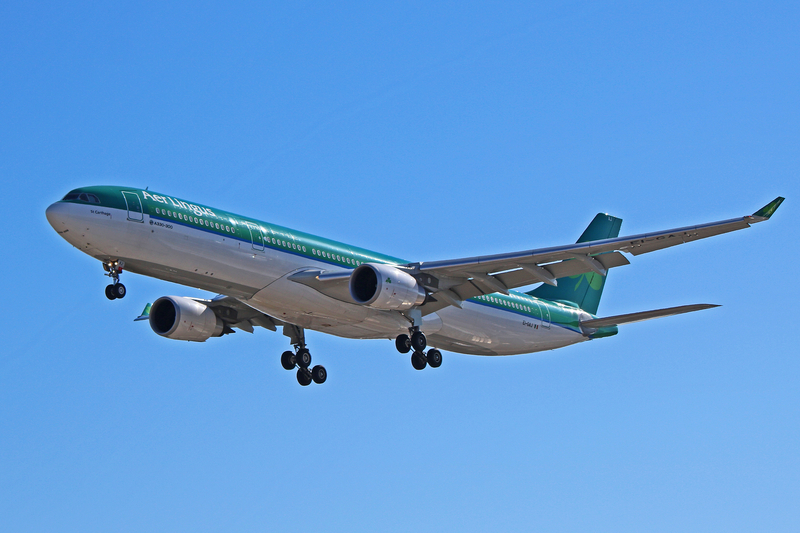
For any carrier—especially a small regional operator—an AOC or operating privilege disruption is existential. The moment an airline can’t fly, revenue effectively goes to zero overnight, but the cost stack remains: aircraft leases, insurance, maintenance planning, training currency, airport charges, and the steady bleed of customer confidence. On short-haul lifeline routes like Pointe-à-Pitre (PTP) – Fort-de-France (FDF) or PTP – Grand Case (SFG), even a brief grounding can be enough to break forward bookings and trigger a cascading cash crisis.
A Caribbean network built around short fields and turboprop fundamentals
Air Antilles is not a “nice-to-have” airline in the French Antilles—it is a connectivity tool. The carrier focuses on short, high-frequency sectors linking:
-
Guadeloupe via Pointe-à-Pitre (PTP)
-
Martinique via Fort-de-France (FDF)
-
Saint-Martin via Grand Case (SFG)
-
Saint-Barthélemy via Gustaf III/St. Jean (SBH)
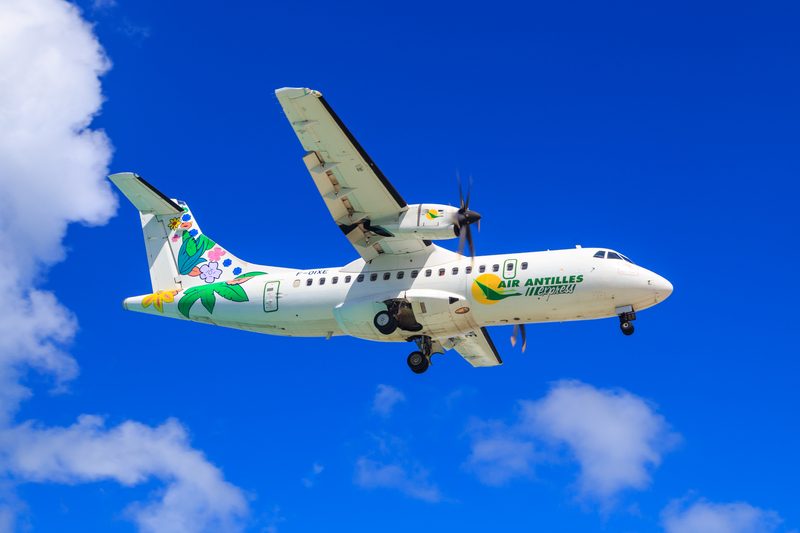
That geography strongly shapes fleet choices. Air Antilles’ current fleet is reported as four aircraft: two ATR 72-600s, one ATR 42-600, and one DHC-6-400 Twin Otter.
This mix is purpose-built for the islands:
ATR 72-600
The ATR 72-600 sits at the high-capacity end of regional turboprops (up to 78 seats in standard configurations) and is optimized for short-to-medium sectors where speed-to-cost and payload efficiency matter more than jet cruise. On dense trunk routes such as PTP–FDF, this airframe is typically the workhorse—able to carry meaningful volume without turning the route into a yield-destroying seat dump.
ATR 42-600
The ATR 42-600 is the right tool for thinner markets and schedule integrity. It’s commonly configured around the 48–50 seat class, giving the operator a way to preserve frequency without flying too much capacity. In the Caribbean, where demand can swing dramatically by day-of-week and season, that “right-size” flexibility is crucial.
DHC-6-400 Twin Otter
The Twin Otter is the specialist—famous for rugged reliability, short takeoff and landing performance, and the ability to serve constrained airports. That matters at Saint-Barthélemy (SBH), where runway and approach environment put hard limits on what can operate efficiently. It’s also a strong fit for quick turns and multi-sector days across SBH, SFG, and PTP, where stage lengths are short and ground time discipline drives the schedule.
In other words: Air Antilles’ fleet is not “small” by accident—it’s tailored to real-world runway, demand, and dispatch realities across PTP, FDF, SFG, and SBH.
Public money, public expectations, and the pressure to “rebuild differently”
The airline’s ownership structure adds another layer of complexity. Since acquiring Air Antilles at the end of 2023, the Collectivity of Saint-Martin has invested roughly €20 million into the carrier. Reported 2025 results included more than 121,000 passengers carried and approximately €18 million in revenue—meaning the airline was generating meaningful traffic, but not necessarily the financial resilience needed to absorb a shock as severe as a regulatory grounding.
That imbalance matters because the court’s decision will not just be about saving a brand. It will be about whether the airline can operate compliantly, sustainably, and predictably—without repeating the operational instability that led to this point.
If the court opens a reorganization procedure, the next phase becomes intensely practical:
-
How quickly can the airline satisfy regulators and restore full operating privileges?
-
Can it secure fresh capital and stabilize liquidity for a restart?
-
Will aircraft be kept current on maintenance and crews kept current on training during downtime?
-
How will the network be rebuilt first—PTP–FDF trunk frequency, or SBH and SFG lifeline schedules?
Without credible answers, liquidation becomes the default outcome, and the region loses a key operator in the PTP–FDF–SFG–SBH triangle where alternatives can be limited and fares can rise quickly when competition disappears.
Bottom Line
Air Antilles has reached the point where the court in Pointe-à-Pitre (PTP) must choose between a supervised reorganization and liquidation. The airline’s crisis is tightly linked to the December 2025 regulatory grounding, which cut off revenue and accelerated a cash collapse. Operationally, Air Antilles is built around exactly the aircraft the French Antilles need—ATR 72-600s and ATR 42-600s for the backbone network via PTP and FDF, and a Twin Otter for demanding, short-field flying into SBH and regional hops through SFG. What happens next will hinge on one thing: whether the airline can restore regulatory confidence and recapitalize fast enough to turn that well-matched fleet back into a reliable schedule.
Keep reading FlyMag
Get the Daily Brief in the morning or the Route Watch weekly recap on Fridays. Or both.