United Airlines (UA) is the largest U.S. international carrier by many measures and one of the biggest domestic operators. Yet, buried deep inside its network are routes where planes routinely depart with more empty seats than filled ones—some averaging around 28% full over a full year.

At first glance, that sounds like a network failure. In reality, it’s mostly a story about the Essential Air Service (EAS) program and how U.S. network carriers use small-city flying to feed their hubs at Chicago O’Hare (ORD), Denver (DEN), Washington Dulles (IAD), and Houston Intercontinental (IAH)—even when local demand is tiny.
The figures below reflect U.S. DOT data for the 12 months from December 2024 through November 2025, filtered for Lower 48 routes with at least 2,500 passengers.
Read our stories in your inbox
Two aviation newsletters. Zero fluff.
United’s 10 lowest load-factor routes in the Lower 48
| Rank | Route | Avg. load factor | Round-trip passengers (12 months) | Notes |
|---|---|---|---|---|
| 1 | Chicago O’Hare (ORD) – Fort Dodge (FOD) | 27.9% | 17,195 | EAS-funded |
| 2 | Chicago O’Hare (ORD) – Mason City (MCW) | 29.3% | 17,689 | EAS-funded |
| 3 | Denver (DEN) – Dodge City (DDC) | 29.4% | 18,014 | EAS-funded |
| 4 | Denver (DEN) – Liberal (LBL) | 30.7% | 18,716 | EAS-funded |
| 5 | Washington Dulles (IAD) – Morgantown (MGW) | 31.8% | 10,861 | EAS-funded |
| 6 | Denver (DEN) – Devils Lake (DVL) | 36.0% | 16,518 | EAS-funded |
| 7 | Chicago O’Hare (ORD) – Decatur (DEC) | 36.0% | 22,274 | EAS-funded |
| 8 | Denver (DEN) – Watertown (ATY) | 42.9% | 5,361 | EAS-funded |
| 9 | Denver (DEN) – Scottsbluff (BFF) | 47.1% | 34,858 | EAS-funded |
| 10 | Houston Intercontinental (IAH) – Victoria (VCT) | 47.8% | 27,700 | EAS-funded |
Look at the pattern: ORD and DEN dominate, with IAD and IAH appearing once each. That’s your first clue these aren’t “commercial routes” in the conventional sense. They’re connectivity obligations, designed to keep smaller communities linked to a major hub—often with federal subsidy support that changes the economics entirely.

Why these flights are so empty
EAS flying is built around access, not load factor. The program exists so smaller communities aren’t cut off from the national air system. It typically guarantees a minimum service pattern—often 12 weekly round trips—even when the catchment area is small and seasonal.
That produces three predictable outcomes:
The local market is microscopic
Take DEN–DDC (Dodge City, Kansas). Even when the route carries 18,000 round-trip passengers over a year, much of that traffic is not “two people flying from Denver to Dodge City for fun.” It’s travelers using DEN as the gateway to the rest of the United network.
When you isolate the true local demand on these routes, the number can be shockingly small on many departures—especially midweek.

Aircraft size is fixed by availability, not perfect economics
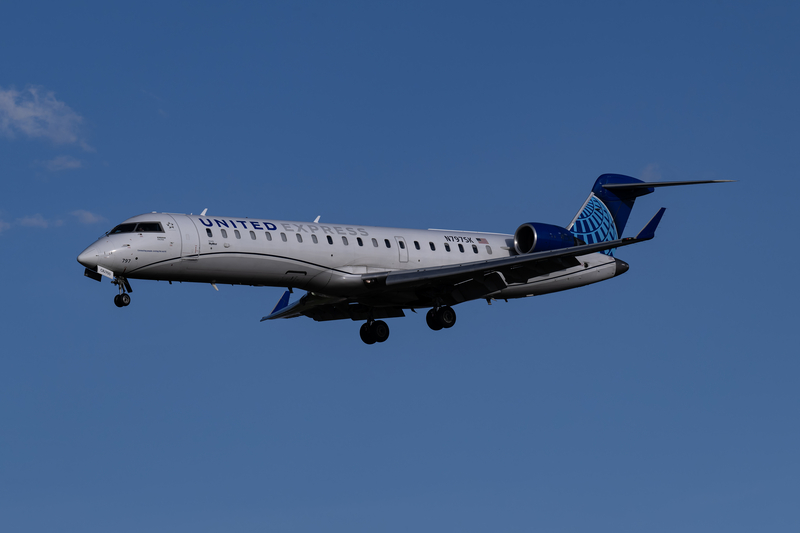
United Express flights on these routes are typically operated by SkyWest under the UA code using 50-seat Bombardier CRJ200s—a type that exists in large numbers, is easy to schedule, and fits EAS-required frequency patterns.
But a CRJ200 is also a blunt instrument for tiny markets:
-
50 seats is often too much for true local demand
-
the aircraft is designed for high-cycle regional flying, not comfort
-
and there’s limited opportunity to right-size further without switching to much smaller aircraft that may not be available in the operator’s fleet mix
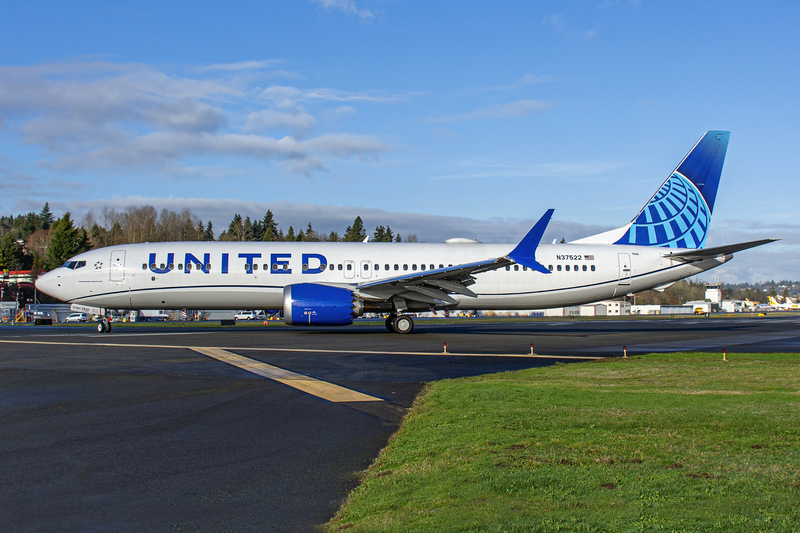
You’ll occasionally see a different tool appear. For example, IAH–VCT has been expected to see the CRJ550 (a 50-seat CRJ200 airframe certified and configured as 50 seats but with a three-cabin interior including a premium cabin) enter the rotation on some days—less about fixing load factor, more about improving the product mix and revenue per passenger in a small but business-relevant Texas market.
Load factor isn’t the metric that decides survival here
In pure commercial route planning, a 28% load factor would be an emergency meeting. In EAS flying, it can be “acceptable” if:
-
subsidy support is strong enough
-
the service meets contractual performance requirements
-
and the route provides strategic network feed into the hub
That’s why these flights can stay in place year after year, even when they look irrational to anyone scanning a seat map.
A closer look at the two extremes: DEN–DDC and IAH–VCT
Denver (DEN) – Dodge City (DDC): the emptiest of the emptiest
United’s worst performer in this set is DEN–DDC, averaging about 29% full. The route is short—around 254 nautical miles—and has typically been scheduled at about 12 weekly round trips.
The economics are not “ticket revenue vs. fuel burn.” They’re subsidy-and-connectivity driven. Under the current EAS contract term (covering multiple years), the total support for the route is substantial—enough that the flight exists primarily to keep Dodge City connected to a hub with global reach.
In a sense, this isn’t a Denver–Dodge City route. It’s a Dodge City-to-everywhere route via DEN.
Houston (IAH) – Victoria (VCT): short, subsidized, but strategically useful
IAH–VCT is an intrastate hop—around 107 nautical miles—and still averaged under 50% full. Yet it carries nearly 28,000 round-trip passengers over the year, far more than the markets sitting in the high-20% range.
Victoria is a different profile: closer to a business-and-connectivity “utility” route, with the hub at IAH providing access to United’s global network. Even with a low load factor, it can be operationally and commercially defensible when the subsidy plus connecting value pencils out.
What this says about United’s hub strategy
The list also underlines something network planners have known for years: United uses its big hubs as connectivity engines, and EAS flying acts like a set of thin “capillaries” feeding that system.
-
ORD is the Midwest megahub: EAS routes like ORD–FOD and ORD–MCW exist to preserve access from smaller communities into the hub’s massive domestic and international banks.
-
DEN is the Rocky Mountain super-connector: it’s the natural consolidation point for a wide swath of the Plains and Upper Midwest.
-
IAD (in this case, IAD–MGW) fills an East Coast connectivity role, particularly for government and international connecting flows.
-
IAH supports both domestic feed and a major long-haul gateway role.
If anything, the “emptiest routes” list is less about United underperforming and more about the reality of subsidized network architecture in U.S. aviation.
Why these routes matter even if they look inefficient
For aviation professionals, the importance is structural:
-
They preserve connectivity for communities that would otherwise lose scheduled air service.
-
They stabilize small airports and local economies by keeping aviation infrastructure active.
-
They provide United with incremental hub feed—valuable in aggregate, even if any single flight looks half-empty.
And during irregular operations, these routes can even become unexpectedly useful. When weather or ATC constraints hit, having distributed spokes into a hub can create additional rerouting options—though the limited frequency still caps recovery flexibility.
Bottom Line
United’s “10 emptiest routes” are not a warning sign about the airline’s network health—they’re a window into how Essential Air Service flying works in practice. Many of these markets (ORD–FOD, ORD–MCW, DEN–DDC, DEN–LBL, IAD–MGW, and others) are designed to keep small communities connected to major hubs, not to post impressive load factors.
Yes, seeing 27.9% on ORD–FOD looks shocking. But in an EAS world, the real metrics are contract performance, hub connectivity, and subsidy economics—not how many seats were filled on a Tuesday afternoon CRJ200.
Keep reading FlyMag
Get the Daily Brief in the morning or the Route Watch weekly recap on Fridays. Or both.
Share this story
Composed for each network — click to share, or copy the composed text for your own timing.