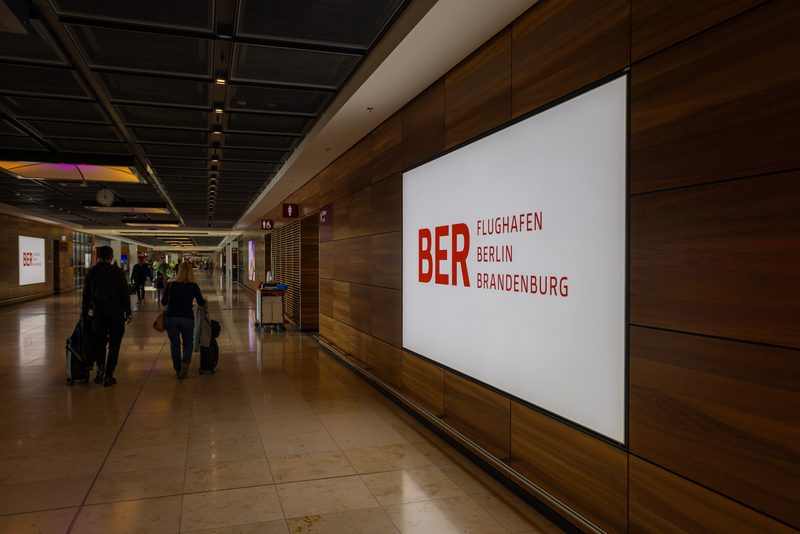
Berlin Brandenburg Airport (BER) is facing a full-day shutdown of scheduled passenger operations on March 18, with around 57,000 travelers expected to lose flights as a Verdi warning strike brings the German capital’s only commercial airport to a halt.
That headline number is serious enough on its own. But the deeper story is structural. Berlin no longer has the airport redundancy it once had when Schönefeld (SXF) and Tegel (TXL) split the city’s traffic. Today, all of that scheduled passenger demand is concentrated at BER. So when a strike shuts the airport, there is no real fallback inside the city system. The disruption is not diluted. It is total.
This Is A Near-Daylong Shutdown, Not A Partial Walkout
The strike is scheduled to run from 4:00 a.m. to 10:59 p.m. on Wednesday, March 18. Berlin Brandenburg Airport has said no scheduled passenger flights will be possible during that period and has advised travelers to contact their airlines or tour operators for rebooking and alternative arrangements.
Read our stories in your inbox
Two aviation newsletters. Zero fluff.
That language is important. This is not a case of scattered cancellations or a reduced operating day. BER is effectively closed to regular passenger flying for 19 hours.
For an airport the size of Berlin Brandenburg, that has major knock-on consequences. Aircraft will be out of position, inbound rotations will be disrupted well beyond Berlin itself, and crews, passengers, and slot plans across Europe will need to be reworked. Even flights not touching BER directly can feel the ripple effect when an airport of this scale drops out of the network for most of a day.
The Core Dispute Is About Real Wages, Not Just Headline Raises
The strike is being driven by dissatisfaction with the airport employer side’s current pay offer in the ongoing collective bargaining talks.
Verdi has argued that the proposed increases amount to only around 1% more pay per year through 2028, a figure the union says falls short of rising living costs and therefore amounts to a real-terms pay cut. That is the key issue here. This is not simply a symbolic labor action over bargaining tone. It is a fight over whether airport workers are being asked to absorb a drop in purchasing power over time while maintaining critical operational functions.
That matters because airport labor disputes are often framed too narrowly as traveler inconvenience. In reality, they are usually about staffing sustainability, retention, and the value placed on work that keeps a complex transport system functioning safely.
Why So Many Flights Are Affected
BER says 445 arrivals and departures are expected to be hit, affecting about 57,000 passengers.
Those numbers show the scale of the shutdown clearly. Berlin is not Germany’s largest hub in the way Frankfurt (FRA) or Munich (MUC) are, but it remains one of the country’s most important point-to-point markets and a major capital-city gateway. A full-day stoppage at BER therefore strands not only local Berlin travelers, but also passengers connecting through partner hubs across Europe.
That is why even a one-day labor action can feel much larger in practice than the raw numbers suggest. Flights might be cancelled only for Wednesday, but the resulting dislocation can bleed into the next day or longer as airlines reposition aircraft and reaccommodate disrupted passengers.
It Is Not Every Worker Walking Out — But It Does Not Need To Be
One nuance worth noting is that this is not a blanket strike involving every airport worker category.

Verdi represents around 2,000 employees at BER in functions including the fire service, terminal management, and other operationally important areas. Other groups, such as ground handling and security personnel, are represented by different unions. But at an airport, not every group has to walk out to make passenger operations impossible. If the categories that stop work are critical enough to safe functioning, the airport cannot keep scheduled service running.
That is exactly what appears to be happening here. The result for passengers is the same even if the labor map behind it is more complicated.
Lufthansa’s Rail Option Softens The Blow — But Only For Some
One of the more interesting operational responses comes from Lufthansa.
Because the group already has a long-standing partnership with Deutsche Bahn, some affected Berlin passengers will be able to switch from flights to long-distance rail services instead. For domestic routes, that is a logical and increasingly familiar workaround in the German market. It is also being extended to some nearby international destinations, including cities such as Amsterdam, Brussels, Luxembourg, Paris, Basel, Geneva, Zurich, Salzburg, Vienna, Innsbruck, Linz, Graz, Budapest, Prague, and Warsaw.
That is a useful mitigation tool, but it has limits.
Rail substitution works best where geography, infrastructure, and journey time make it competitive. It does not replace the whole BER network. Low-cost carrier passengers, long-haul travelers, and those headed to destinations beyond the rail-friendly zone will still face a much messier recovery path. But for Lufthansa and its customers, it offers something more valuable than a generic rebooking promise: a physically different transport mode that can keep people moving when the airport cannot.
The Berlin Problem Is Now Also A Design Problem
The strike also highlights something more fundamental about Berlin’s airport architecture.
When the city consolidated commercial air traffic at BER, it gained a cleaner, more modern single-airport system. But it also gave up flexibility. There is no Tegel to absorb a reduced schedule. There is no Schönefeld operating independently as a parallel city airport. If BER stops, Berlin’s scheduled passenger aviation stops with it.
That does not mean the one-airport model was wrong. It means it carries a tradeoff that becomes painfully visible on days like this.
For airline and airport professionals, that is one of the most interesting takeaways. Resilience is not just about snow plans, spare gates, or backup systems. It is also about whether a city has any operational redundancy when a labor action or infrastructure problem hits its main gateway.
Bottom Line
The March 18 Verdi strike at Berlin Brandenburg Airport (BER) will do more than cancel a day’s worth of flights. It will expose how completely Berlin now depends on a single airport.
With 445 arrivals and departures affected and about 57,000 passengers disrupted, the shutdown is substantial even by major-airport standards. The labor dispute itself centers on pay offers the union says amount to only around 1% annual increases through 2028, which it views as a real-terms wage cut. And because BER has no intra-city airport backup, there is almost no way to spread or soften the disruption locally.
Lufthansa’s rail replacement options will help some travelers, especially on domestic and nearby international routes. But the broader lesson is bigger than one airline response. Berlin’s entire commercial aviation system now runs through one airport, and when that airport stops, the city’s air connectivity stops with it.
Keep reading FlyMag
Get the Daily Brief in the morning or the Route Watch weekly recap on Fridays. Or both.