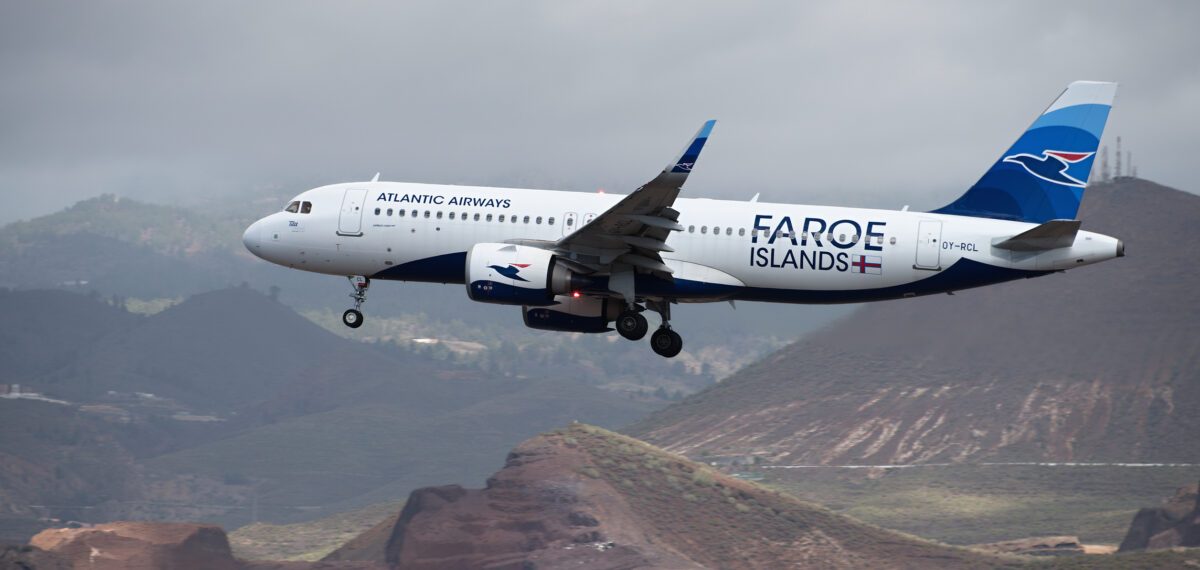
Atlantic Airways has placed a firm order for two additional Airbus A320neo aircraft, extending a fleet renewal program intended to leave the Faroe Islands’ national carrier with a single-generation narrowbody fleet.

Airbus confirmed the agreement on October 27, saying the purchase would support greater operational commonality and simpler maintenance. Atlantic Airways Chairman Niels Mortensen said the airline’s ambition was to operate exclusively with A320neos in the near future.
The transaction adds to a previous direct order for two A320neos signed at the 2019 Paris Air Show. Atlantic Airways’ 2025 annual report schedules those aircraft for delivery in summer 2028 and fall 2029. The latest agreement therefore takes its outstanding direct Airbus commitments to four A320neos.
Read our stories in your inbox
Two aviation newsletters. Zero fluff.
A Four-Aircraft Fleet Split Between Two Generations
Atlantic Airways currently operates two A320ceos and two A320neos. Its published fleet information identifies the current-generation aircraft as OY-RCK, built in 2019, and OY-RCL, built in 2020. Both are powered by CFM International LEAP-1A26 engines and seat 174 passengers in a single-class layout.
The two A320-214s, OY-RCJ and OY-RCM, were built in 2016 and use CFM56-5B engines. OY-RCJ seats 174 passengers, while OY-RCM carries 180. Replacing the ceos with neos would therefore be primarily an efficiency and standardization move rather than a major increase in seats per departure.

Atlantic lists a maximum range of 6,500 kilometers for its present A320neos, compared with 4,800 to 5,700 kilometers for the A320ceos. That range comfortably covers the airline’s European scheduled and charter work while preserving the flexibility to operate longer sectors when commercial opportunities arise.
The ownership structure is also relevant to the renewal plan. At the end of 2025, Atlantic owned one of its four fixed-wing aircraft and held the other three under long-term leases, including both A320neos. The four outstanding factory orders give the airline options to replace its ceos and manage the eventual disposition of the leased neos without changing aircraft families.
The order should not automatically be read as a plan to expand the active fleet from four to eight aircraft. Delivery sequencing, lease expirations and retirement dates will determine how many jets Atlantic operates at any one time. Its previously stated objective, contained in the 2024 annual report, was to reach an all-A320neo fleet by 2030.
Renewal Continues After Costly LEAP Engine Work
The commitment comes after an expensive period of engine maintenance for the carrier’s existing neos. Atlantic reported that three of the four LEAP-1A engines fitted to its two aircraft required earlier-than-planned overhauls. Two engines went through workshops during 2025, while work on the third was scheduled for 2027.
The airline put the overhaul cost for the first two engines at approximately DKK 140 million, with about DKK 72 million in direct operational impact during 2025. It also incurred indirect expenses from leasing replacement capacity to protect its flying program. Atlantic recorded a DKK 56.2 million loss after tax for the year, compared with a DKK 27.3 million profit in 2024.
Despite that disruption, the board has stayed with the A320neo as its long-term platform. For a four-aircraft operator, retaining common flight decks and broadly common airframes has value across crew qualification, spares, maintenance planning and schedule recovery. Moving entirely to the neo generation would also remove the need to support both CFM56 and newer-generation engine installations within the permanent fleet.
Airbus says the A320neo Family delivers at least 20% lower fuel consumption and carbon dioxide emissions than previous-generation single-aisle aircraft. Atlantic’s own reporting uses a more conservative comparison, attributing at least a 15% reduction in fuel use and emissions to its current neos against similarly sized older Airbus aircraft.
Commonality Matters at Vágar
Fleet consistency carries particular importance for an airline whose scheduled operation is concentrated at Vágar (FAE). Atlantic’s aircraft use RNP AR 0.1 procedures, technology the carrier introduced in combination with the instrument landing system in 2014. The procedures allow approaches in poorer visibility and have improved regularity at an airport where terrain and rapidly changing weather can constrain operations.

Standardizing on one A320 generation will not remove those operational challenges, but it can reduce the number of fleet-specific variables involved in crewing, maintenance and aircraft substitution. With only four fixed-wing aircraft, an extended technical absence represents a substantial share of available capacity.
The renewal also comes as the scheduled business reaches new highs. Atlantic carried 378,913 scheduled passengers in 2025, up 3% from the previous year and a company record. Charter operations added 165,506 passengers and accounted for 4,223 block hours, or 37% of combined fixed-wing and helicopter production.
That mix places demands on the fleet beyond a conventional hub-and-spoke schedule. Aircraft must cover core Faroese connectivity while remaining available for substantial charter work. Four directly purchased A320neos, arriving over several years, give Atlantic a pathway to renew that capacity without introducing another type or altering the operating model built around the A320 Family.
Bottom Line
The latest order completes the procurement framework Atlantic Airways needs to replace its current fleet with owned, new-generation aircraft. The first two factory-built A320neos are already planned for 2028 and 2029; the timing of the additional pair will determine how quickly the two A320ceos leave and how the airline handles its leased neos. That sequencing will decide whether the order produces temporary growth, a direct one-for-one replacement cycle or a combination of both.
The more significant signal is that Atlantic remains committed to the A320neo after a maintenance event that materially affected its 2025 earnings. For a small national carrier, the economics of commonality can outweigh the appeal of diversifying technical risk across aircraft types. An all-neo fleet would concentrate Atlantic’s operation around one cabin size, one pilot type rating and one modern narrowbody platform while preserving the range required for its European network and charter program.
Passengers are unlikely to see a large change in capacity per flight, but the airline should gain a younger and more consistent fleet with lower fuel consumption. The next major steps will be the arrival of the 2028 aircraft, the retirement or return schedule for the existing jets and the way Atlantic structures maintenance support after its recent LEAP engine experience.