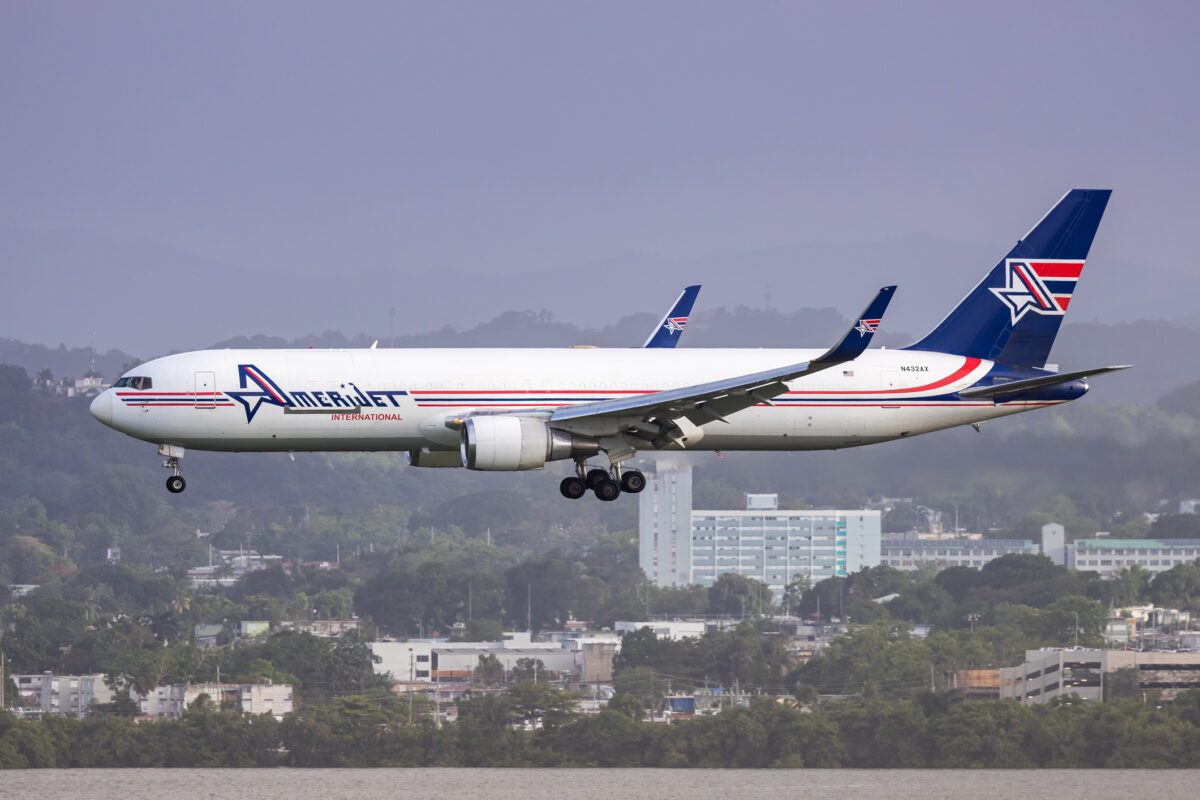
An Amerijet Boeing 767-300 freighter remains grounded at Guatemala City (GUA) with structural damage to the crown of its fuselage after diverting there while operating a Miami-San Juan cargo flight.
The aircraft, N373CM, reached Guatemala late on September 6 local time, corresponding to early September 7 UTC. It had departed Miami (MIA) as flight M6 8743 for San Juan (SJU) before turning southwest and landing at GUA.
Amerijet’s maintenance control record lists the 767 as aircraft on ground at GUA and describes buckle damage to the upper fuselage at station 650, extending from stringer 14 left to stringer 14 right. Maintenance personnel have mapped the affected area and photographed it for an engineering assessment.
Read our stories in your inbox
Two aviation newsletters. Zero fluff.
The record confirms the structural damage and the aircraft’s removal from service, but it does not characterize the landing or identify the event that produced the buckle. FlyMag is therefore not treating reports of a hard landing as independently confirmed.
Temporary Repair Planned Before Ferry Flight
Amerijet’s latest maintenance entry says the carrier plans to work with SOAR on a temporary repair that would allow N373CM to make a non-revenue ferry flight to a maintenance, repair and overhaul facility. The aircraft’s estimated completion date remains listed as to be determined, with a further field update expected on September 14.
That plan indicates the 767 is not expected to return directly to cargo service at GUA. A temporary repair would instead have to provide an approved structural condition for a controlled positioning flight, potentially with operating limitations specified by engineering and accepted by the relevant authorities.
The station and stringer references in Amerijet’s entry define the affected section using the 767’s structural coordinate system. Station 650 identifies its longitudinal position, while the left-to-right stringer limits describe the width of the affected area across the upper fuselage. Damage spanning the crown requires more than a local cosmetic inspection because the fuselage skin, frames and stringers form an integrated load-bearing structure.
Before a ferry permit can be used, engineers must define the repair, determine inspection requirements and establish any restrictions needed for the flight. The eventual permanent work may be performed only after the aircraft reaches an MRO with the tooling, access and engineering support required for the job.
Amerijet Boeing 767-300F sustains fuselage damage at Guatemala City
Amerijet International Boeing 767-300F N373CM was involved in an event involving flight M68743 (Miami–San Juan) on September 6, 2026.
The flight diverted to Guatemala City (GUA), where the aircraft made a hard… pic.twitter.com/6xdocViIje
— FL360aero (@fl360aero) September 12, 2026
Flight 8743 Diverted Away From San Juan
Amerijet’s published flight schedules use the 8743 number for a Miami-San Juan service. The September 6 operation departed MIA late and flew for more than two hours before reaching Guatemala, placing the aircraft hundreds of miles west of its intended Caribbean destination.
The diversion also followed an unusually disrupted day for N373CM. Tracking records show the aircraft operating or positioning through several Central American and Florida airports before returning to Miami and departing again as M6 8743. It has recorded no subsequent revenue flight from GUA.
Guatemala City was not on the planned Miami-San Juan routing. Its selection as the diversion airport nevertheless gave the crew a long paved runway and access to a major international airport accustomed to handling widebody aircraft. The aircraft was moved clear of the active movement area and remains parked while the repair plan is developed.
N373CM Is a Converted Passenger 767
The FAA registry identifies N373CM as Boeing serial number 24929, a 767-338 manufactured in 1990 and powered by General Electric CF6-80C2B6 engines. Cargo Aircraft Management owns the aircraft, while Amerijet operates it.
The jet began life as a passenger 767-300ER before conversion into a 767-300 BDSF. In freighter service, the former passenger cabin becomes a reinforced main cargo deck with a large freight door, cargo-handling system, rigid barrier and fire-protection modifications.
Amerijet’s own 767-300 loading documentation shows several main-deck arrangements. One layout accommodates 17 transverse 88-by-125-inch positions, while others accept centerline pallets, containers, engine stands and 16-foot loads. The forward lower hold can also carry palletized freight or standard lower-deck containers.
The airline advertises a maximum payload of about 125,000 pounds and approximately 15,000 cubic feet of cargo volume for its 767-300 fleet. Those figures place the type in the medium-widebody segment, where it can combine containerized lower-deck freight with outsized or palletized cargo on the main deck.
Boeing describes the 767-300 freighter family as offering a structural payload of roughly 57 metric tons and a range of about 3,300 nautical miles at that payload. That combination is well suited to Amerijet’s network linking Miami with the Caribbean, Mexico, Central America and northern South America, where sectors are comparatively short but individual markets can require more lift than a narrowbody freighter provides.
Grounding Adds Pressure to Amerijet’s Available Fleet
N373CM’s loss removes one widebody from an operation built around the 767-300. Amerijet’s maintenance control board also lists another aircraft undergoing a C-check and a separate 767 as AOG in Miami for corrosion repair. Even where the airline can rearrange rotations, multiple unavailable aircraft reduce the margin for recovering delayed cargo and covering maintenance substitutions.
The immediate engineering question is whether the deformation is confined to replaceable skin and supporting members or extends into a larger section of the crown structure. The temporary repair and ferry strategy will provide an early indication of how engineers intend to manage the damage, but the scale of the permanent repair will become clearer only after detailed inspection at the selected MRO.
Bottom Line
Amerijet gains little from rushing N373CM back into the schedule. Crown-area buckling demands a repair based on measured structural damage, not simply the visible crease, and moving the aircraft under an approved ferry plan is the practical way to place it with a facility equipped for extensive 767 work. The September 14 update should show whether the temporary repair can be completed in Guatemala or whether additional engineering work is required first.
The grounding also illustrates the operational exposure created by a highly standardized but relatively small freighter fleet. Commonality simplifies crews, spares and maintenance, yet the temporary loss of one 767 represents a meaningful block of payload and volume. Amerijet can protect priority services by swapping aircraft and consolidating freight, but prolonged downtime may require schedule changes, charter lift or reduced recovery capacity elsewhere in the network.
What matters next is the ferry authorization, the choice of repair facility and the estimated duration of the permanent work. If inspections find damage limited to a defined fuselage section, N373CM may remain economically repairable despite its age. A wider pattern involving frames, stringers or adjoining skin panels would make the project more complex and keep a useful medium-widebody freighter out of service for substantially longer.