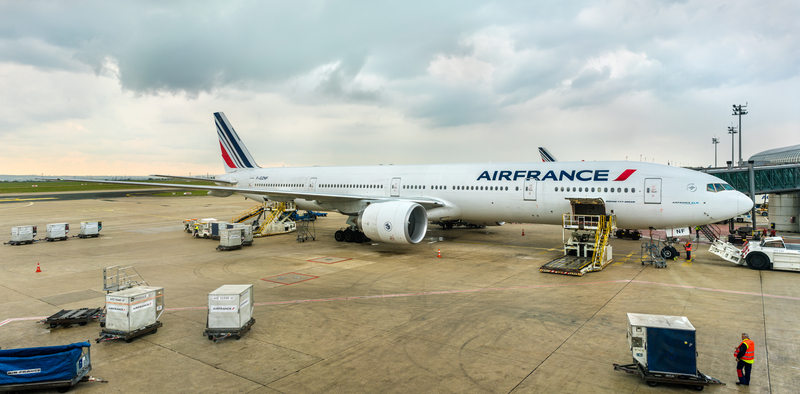
Air France flight AF895 pushed back from Martinique Aimé Césaire International Airport Fort-de-France (FDF) on February 21, 2026, bound for Paris Charles de Gaulle (CDG)—a transatlantic overnight sector normally measured in hours, not minutes.

Instead, the Boeing 777-300ER (B77W) operating the flight, registration F-GSQO, returned to FDF about 25 minutes after departure following an engine surge event shortly after takeoff. Air France said the crew’s decision to discontinue the flight and return was made in line with manufacturer procedures and company safety protocols. The aircraft landed normally at approximately 21:30 local time in Martinique.
Passengers were assisted at FDF, and Air France planned a replacement aircraft to continue the service to CDG.
Read our stories in your inbox
Two aviation newsletters. Zero fluff.
The aircraft: 777-300ER power, redundancy, and why it matters on a heavy departure
The 777-300ER is the “big twin” backbone of many long-haul fleets—high payload, long range, and designed to remain controllable and safe even when abnormal events occur early in the profile.
Air France’s -300ERs are powered by GE90-115B engines, among the highest-thrust commercial turbofans ever certificated (roughly 115,000 lbf class). For crews, that matters because the GE90’s operating envelope and protections are built around handling disturbances in airflow without automatically becoming a catastrophic failure scenario.
On an FDF–CDG mission, the aircraft typically departs heavy—fuelled for the Atlantic crossing with reserves. If a return becomes necessary shortly after takeoff, the jet may be above maximum landing weight. The 777 family is equipped with fuel jettison capability, giving crews the option to reduce weight quickly and return without an extended hold solely to burn fuel—exactly the kind of systems-level resilience long-haul operators depend on.
What an “engine surge” really is (and why it can look dramatic)
Witnesses and local reports described visible flames from one engine. That visual is consistent with a surge or compressor stall scenario—and it’s one reason these events can feel more alarming than they are.
A modern high-bypass turbofan depends on stable airflow through its compressor stages. If airflow becomes disrupted (for example, due to transient conditions, ingestion, or internal disturbances), the compressor can momentarily lose the smooth pressure rise it needs. In practical terms, a surge can involve:
-
A loud bang or series of reports
-
A brief yaw tendency toward the affected engine
-
Fluctuating engine parameters (thrust, EGT, vibration indications)
-
Visible flame at the exhaust as combustion becomes irregular and unburned fuel ignites downstream
The key point: a surge is a known phenomenon. It is often visually impressive, but it is not automatically the same as an uncontained failure, separation, or major fire. Crews train for these scenarios repeatedly in the simulator, and the checklist philosophy is straightforward: stabilize, assess, and take the conservative option—especially on an oceanic sector where continuing is rarely worth the risk when a safe return is immediately available.
The decision to return to FDF: conservative, operationally logical, and procedure-driven
Turning back quickly is often the most disciplined move when an event occurs close to departure and the aircraft remains within easy reach of the departure airport—particularly at night, on a long-haul mission, and before committing to the mid-Atlantic portion of the flight.
From a flight-ops perspective, the likely priorities for AF895 would have been:
-
Maintain safe climb and aircraft control while the crew assessed the engine parameters
-
Configure for a return and coordinate with ATC for vectors/holding
-
Manage weight (hold to burn or use fuel jettison as appropriate)
-
Return to FDF for a normal landing and a controlled passenger handling environment
It’s also worth noting the human-factors dimension: an abnormal event early in flight is exactly when clear cockpit resource management pays dividends. The “keep flying the airplane, then work the problem” discipline is what prevents a dramatic-looking engine event from becoming a serious safety outcome.
What happens next: inspection depth after a surge event
Even when the landing is normal and the aircraft returns under control, a surge typically triggers a serious technical response before the aircraft can be released again.
For a 777-300ER, that can include:
-
Engine borescope inspections of compressor/turbine sections
-
Review of recorded engine data (trend monitoring, EGT margin, vibration)
-
Checks for secondary damage (wiring, cowling, exhaust, sensors)
-
Maintenance actions dictated by engine manufacturer limits and operator policy
Because F-GSQO returned to FDF rather than diverting to a larger maintenance base, logistics become part of the story too: positioning specialized technicians, tooling, and any required spares to Martinique, or arranging a ferry flight once the aircraft is cleared.
Bottom Line
Air France AF895—a Boeing 777-300ER (F-GSQO) from Fort-de-France (FDF) to Paris CDG (CDG)—returned to Martinique about 25 minutes after takeoff on February 21, 2026 after the crew reported an engine surge, with some witnesses describing visible flames from the affected engine. The aircraft landed normally at FDF around 21:30 local time, passengers were assisted, and Air France arranged a replacement aircraft for the onward trip to CDG.