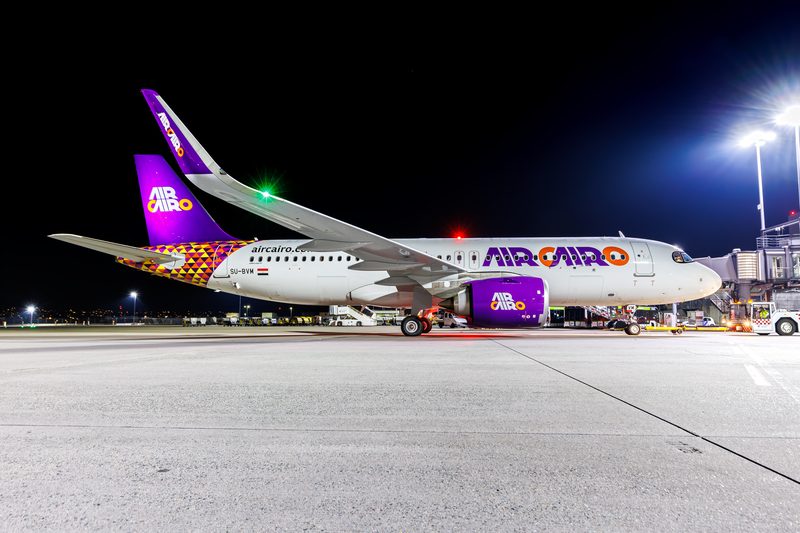
Air Cairo is pushing further into Northern Europe with a new Norway launch for Winter 2026, adding nonstop service from Oslo Gardermoen (OSL) to both Cairo (CAI) and Hurghada (HRG). The move gives Oslo a year-end boost in Egypt connectivity: one route aimed at cultural and business demand via the capital, and one aimed squarely at Red Sea leisure traffic.
Air Cairo will operate the routes using Airbus A320-family aircraft—both A320ceo and A320neo variants—in a 180-seat, single-class configuration, with midday departure/arrival timing designed to fit Oslo’s operational peaks and Egypt’s inbound tourism rhythms.
The routes and frequencies: two very different Egypt propositions
Air Cairo’s OSL expansion includes two services with different demand curves:
Read our stories in your inbox
Two aviation newsletters. Zero fluff.
Oslo (OSL) – Cairo (CAI)
-
2 flights weekly
-
Mondays and Thursdays
-
Midday operating pattern (depart/arrive around the middle of the day)
This route is the “gateway” play. Cairo (CAI) is Egypt’s largest airport and its principal hub, and a nonstop from Oslo provides not only point-to-point access for business, cultural travel, and visiting friends and relatives, but also a connection platform into Air Cairo’s broader network.
Oslo (OSL) – Hurghada (HRG)
-
1 flight weekly
-
Sundays
-
Midday operating pattern (depart/arrive around the middle of the day)
This is the classic winter sun route: weekly, weekend-biased, leisure-led. Hurghada (HRG) is one of the Red Sea’s biggest resort gateways and performs especially well in Northern European winter periods when travelers seek guaranteed sunshine, diving, and beach-focused packages.
Aircraft: why an A320 at 180 seats is the right tool
Air Cairo’s use of 180-seat A320-family narrowbodies tells you exactly how it intends to compete:
-
Low trip cost and high seat density are ideal for leisure-heavy markets like HRG, where price sensitivity is high and demand spikes are tightly seasonal.
-
The A320neo adds fuel-burn efficiency and improved range margins versus older ceo aircraft, helpful for longer Northern Europe sectors, winter headwinds, and schedule reliability.
-
A single-class layout simplifies operations and boarding, and it aligns with the tour operator and package-holiday channel that typically drives Red Sea flying.
For Oslo (OSL), the A320 is also a practical match: the airport is built for high-frequency narrowbody operations, and it can handle quick turns even in winter conditions.
Network implications: OSL gains access to Egypt—and beyond
Air Cairo is positioning these services as more than just “Oslo to Egypt.” The airline expects the new OSL flights to open practical onward connectivity via CAI and HRG to:
-
Domestic Egypt points (Upper Egypt, the Nile corridor, and secondary coastal airports depending on schedule)
-
Select African markets
-
Middle East points including destinations in Saudi Arabia and Iraq
This matters because Oslo (OSL) has historically had limited nonstop access into Egypt beyond leisure peaks. Adding a Cairo (CAI) link provides a more versatile option: cultural travel to Cairo and Giza, business travel into Egypt’s commercial center, and onward connections that don’t require rerouting through Gulf hubs.
Why Oslo wanted Cairo (CAI): a “missing” capital-to-capital link
Airport stakeholders in Norway have long viewed Cairo as a strategic destination: it’s one of the region’s most important capitals for tourism and trade, and it’s a cultural magnet with year-round appeal. A direct OSL–CAI link tends to stimulate demand rather than simply serve it, because it removes connection friction for:
-
short cultural breaks,
-
museum and heritage travel (including the Giza corridor),
-
and business travel where reliability and directness matter.
In airline terms, this is also an access play into a large destination market that has historically been under-served nonstop from Norway compared with other major European countries.
Bottom Line
Air Cairo’s winter 2026 launch from Oslo (OSL) adds two clear products: twice-weekly Cairo (CAI) for gateway and connection utility, and weekly Hurghada (HRG) for Red Sea leisure demand. Operated with 180-seat Airbus A320-family aircraft, the routes reflect Air Cairo’s broader European expansion approach—using high-density narrowbody economics to connect Northern Europe with Egypt’s strongest cultural and resort destinations, while also offering onward connectivity through Egypt to the wider region.
Keep reading FlyMag
Get the Daily Brief in the morning or the Route Watch weekly recap on Fridays. Or both.
Share this story
Composed for each network — click to share, or copy the composed text for your own timing.