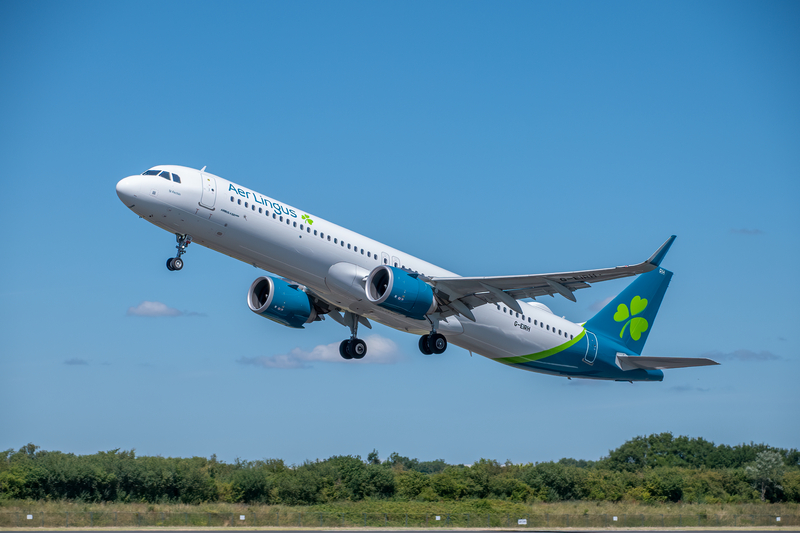
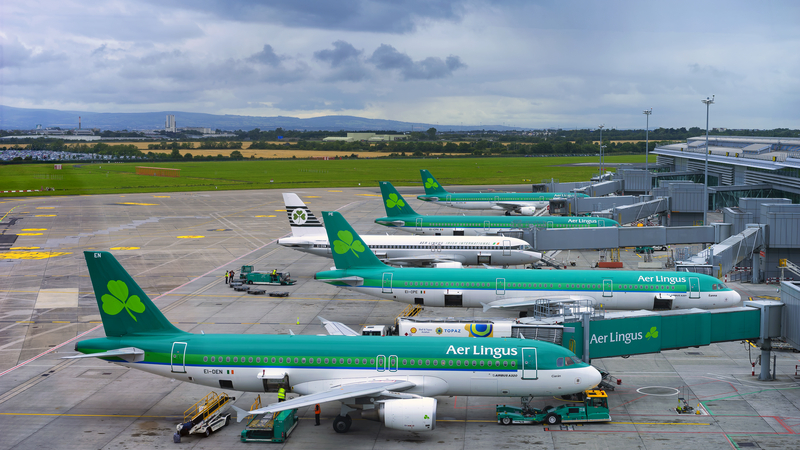
Aer Lingus (EI) is adding a new Caribbean headline to its Spring 2026 map: a nonstop Dublin Airport (DUB)–Grantley Adams International Airport (BGI) service launching March 31, 2026. The route will run three times weekly (Tuesdays, Fridays, Sundays) through May 31, 2026, operated by the Airbus A321XLR—the long-range single-aisle aircraft that’s turning “widebody-only” city pairs into realistic, right-sized flying.

The schedule is designed like a classic hub carrier long-haul pattern, even though it’s on a narrowbody:
-
DUB 13:50 → BGI 18:00 (local time)
Read our stories in your inbox
Two aviation newsletters. Zero fluff.
-
BGI 19:30 → DUB 08:40+1 (local time)
With Dublin on Irish Summer Time by late March and Barbados on Atlantic Standard Time year-round, those timings translate to an approx. 9:10 westbound and 8:10 eastbound block—exactly what you’d expect with prevailing winds favoring the return across the North Atlantic.
Introductory pricing has been filed from €229 one-way, including taxes and fees.
Why Barbados (BGI) — and why a spring window matters
Spring is a savvy period for a Barbados (BGI) launch from Ireland: it captures late winter / early spring “sun demand” without committing scarce long-haul capacity into the deepest summer peak, when Aer Lingus’ widebody and transatlantic schedules are already under pressure.
There’s also a very practical commercial driver. Aer Lingus has stated the DUB–BGI service is being introduced primarily to re-accommodate customers affected by the end of its Manchester (MAN) long-haul operation. In other words, DUB becomes the long-haul gateway, and the airline uses its own metal to protect customer itineraries while also testing true Ireland–Barbados demand in the process.
For Barbados Tourism Marketing Inc., the route is more than a seat count—it’s about unlocking a new origin market with clean, nonstop access for festivals, cultural travel, and higher-spend leisure.
The aircraft that makes this possible: Airbus A321XLR, Aer Lingus-style
The Airbus A321XLR is the enabling technology here. Airbus markets the type at up to 4,700 nautical miles of range—the distance that finally pushes a single-aisle deep enough into the Caribbean and beyond without requiring a widebody.
The DUB–BGI great-circle distance is about 3,485 nautical miles, which sits comfortably inside the XLR envelope. That margin matters to dispatchers and planners because it leaves room for real-world considerations: Atlantic winds, alternates, routing constraints, and payload planning.
Aer Lingus’ cabin configuration is built to deliver a “proper long-haul product” on one aisle:
-
184 seats total
-
16 full-flat Business Class
-
168 Economy
It’s also an Airspace-cabin jet with noticeably improved bin volume versus older narrowbodies—useful on a leisure-heavy route where carry-on behavior can make or break turn times.
From an airline economics lens, this is exactly the XLR’s sweet spot: routes that are too thin or too seasonal for a widebody but long enough to benefit from a true premium cabin and a long-haul service proposition.
Schedule logic: connecting utility at DUB, daylight arrival at BGI, red-eye back to Ireland
The flight times aren’t random—they’re built for connectivity and aircraft productivity.
-
A 13:50 departure from DUB gives Aer Lingus room to feed the flight from morning European arrivals into DUB, including UK and short-haul banks.
-
An 18:00 arrival into BGI lands before late evening, which is typically easier for hotel transfers and first-night operations.
-
The 19:30 departure from BGI turns the aircraft quickly and brings it back into DUB at 08:40, lining up for onward morning connections across Europe and Ireland.
It’s also a clean way to keep the airframe productive: a long westbound sector, a short ground time, then the eastbound overnight that returns the jet to base for the next day’s flying.
A connectivity milestone that aligns with broader ties
This route also lands at a moment when Ireland–Barbados links are visibly strengthening. Barbados opened its first resident embassy in Dublin in 2024, a diplomatic step that signals deeper long-term engagement and helps frame why direct air service is now appearing on the schedule.
For Aer Lingus, it’s another example of how DUB is evolving: not just a North American gateway, but a long-haul hub capable of supporting niche leisure markets when the aircraft technology and schedule geometry finally make the numbers work.
Bottom Line
Aer Lingus is launching a seasonal Dublin (DUB)–Bridgetown/Barbados (BGI) nonstop on March 31, 2026, flying three times weekly through May 31 on the Airbus A321XLR. With a roughly 3,485 nm stage length, a true long-haul cabin (16 lie-flat Business / 168 Economy), and a schedule built for connectivity at DUB, the route is a strong proof point for what the XLR was designed to do: open long, thin markets that previously needed a widebody—or a connection.
Keep reading FlyMag
Get the Daily Brief in the morning or the Route Watch weekly recap on Fridays. Or both.