Biman Bangladesh Airlines (BG) is temporarily suspending its Manchester Airport (MAN) service from March 1, 2026, removing one of the carrier’s most distinctive UK links: the Dhaka (DAC) – Sylhet (ZYL) – Manchester (MAN) one-stop operation.
For UK-based Bangladesh traffic flows—especially communities with strong ties to the Sylhet region—this is more than a minor timetable tweak. MAN has long served as a practical alternative to London for northern England, and Biman’s ability to carry passengers via Osmani International Airport (ZYL) has been a meaningful differentiator in a market otherwise dominated by one-stop Gulf and European options.
What’s actually being suspended
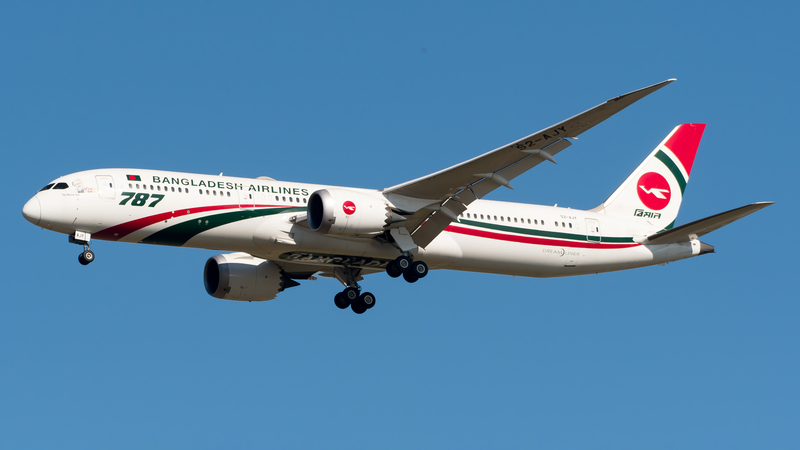
Biman has been operating the DAC–ZYL–MAN routing twice weekly, typically using a Boeing 787-8 Dreamliner (B788). The 787-8 is well suited to the mission profile: long-range capability, efficient economics versus older-generation widebodies, and a cabin product that can compete credibly in a price-sensitive VFR market.
Read our stories in your inbox
Two aviation newsletters. Zero fluff.
On Biman’s 787-8s, the airline’s published configuration is commonly listed as 271 seats split between 24 Business and 247 Economy—a dense, network-driven layout that prioritizes volume while still offering a lie-flat premium cabin on a route where upgrades and paid premium demand can spike during peak periods.
Why BG says MAN is the one that had to give
Biman’s public rationale centers on a set of operational realities that airline planners will recognize immediately:
The first is fleet scarcity in the widebody category. BG’s long-haul and high-demand regional flying leans on a relatively tight widebody pool—meaning when just one aircraft falls out of rotation, the schedule becomes fragile.
The second is maintenance-driven downtime. Widebody heavy checks, engine work, and structural inspections can remove aircraft from service for weeks, and that risk is amplified when a carrier doesn’t have deep spare coverage.
The third is seasonal flying pressure, particularly around Hajj operations, when carriers need to surge capacity into narrow time windows. In practical terms, aircraft that might otherwise be utilized on long-cycle routes like MAN are more valuable when they can be rotated through higher-frequency sectors tied to peak pilgrimage demand, often involving Saudi gateways such as Jeddah (JED) and Medina (MED).
Then there’s the point that matters most to schedulers: time-on-task. A long, multi-sector pattern like DAC–ZYL–MAN can tie up a widebody for extended periods when you factor in duty limits, rest requirements, ground time, and recovery buffers. Compared with shorter long-haul or high-yield regional flying, the aircraft utilization and network flexibility simply aren’t as attractive—especially if yields have softened or disruption costs have risen.

The London Heathrow fallback—and what it really solves
To soften the blow, Biman is directing disrupted MAN passengers toward London Heathrow (LHR), including re-accommodation and refunds. Operationally, LHR is easier to protect because it’s the carrier’s primary UK anchor and tends to benefit from stronger year-round demand, better feed opportunities, and more established handling routines.
Biman has also pointed to five weekly London Heathrow (LHR) frequencies as a mitigation measure, typically structured as a mix of Sylhet-linked services and at least one rotation originating from Dhaka (DAC). For passengers, the tradeoff is clear: Heathrow offers more onward options and schedule resilience, but it’s not a like-for-like replacement for northern England access via MAN—especially for travelers who chose MAN to avoid a lengthy southbound journey after arriving in the UK.
The 787-8 angle: why this aircraft matters to the MAN decision
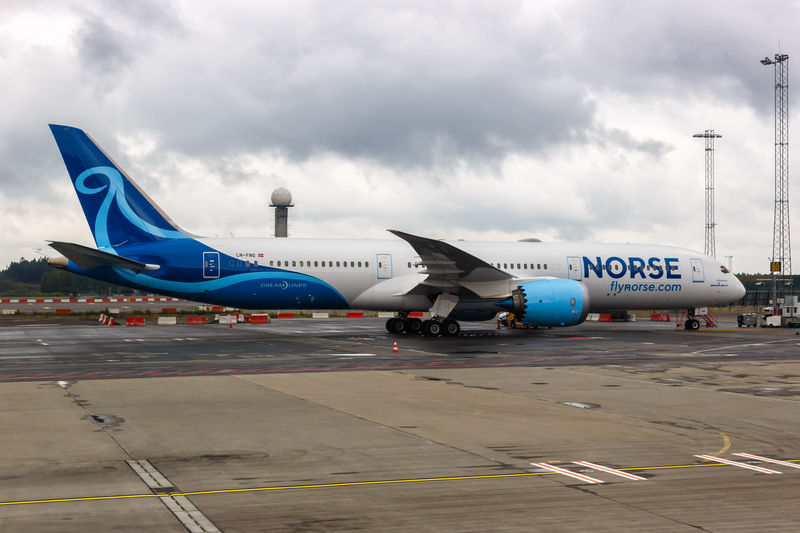
For network professionals, the aircraft assignment tells its own story. The Boeing 787-8 is the smallest Dreamliner variant and is optimized for long-haul “right-sized” flying—exactly the kind of aircraft you’d expect to see on a twice-weekly diaspora route where demand can be strong but uneven.
In Boeing’s own published specifications, the 787-8 is typically marketed around 248 passengers with long-range capability, while actual airline configurations vary widely. Biman’s higher-density layout improves unit costs, but it also underscores the challenge: if you’re already flying dense and the route still isn’t meeting the airline’s internal hurdles—whether yield, disruption exposure, or opportunity cost—then MAN becomes a logical candidate for a temporary pause.
Fleet renewal could change the calculus—but not overnight
Biman has signaled that it may revisit MAN once aircraft procurement and crew recruitment progress. The most consequential development is the carrier’s stated plan to acquire 14 Boeing aircraft, including 787-10s and 737 MAX 8s, plus additional 787-9s.
If those deliveries materialize, the strategic implications are straightforward:
A larger widebody fleet creates true spare coverage, reducing the need to cut thin routes whenever a heavy check or engine issue hits.
The 787-10 adds substantial capacity versus the 787-8/787-9 family, but with a shorter range profile—making it especially attractive on trunk markets where demand is high and stage lengths are well within its performance envelope. In a Biman context, that could free 787-8/787-9 aircraft to operate longer missions with fewer payload compromises.
The 737 MAX 8 component would modernize short/medium-haul operations and potentially reduce pressure on widebodies that sometimes get pulled into missions better suited to efficient narrowbodies.
That said, even with a signed deal, OEM delivery timelines can stretch, and pilot/engineer training pipelines move at their own pace. So from an operational standpoint, MAN being described as “temporary” should be read as strategic intent—not a near-term guarantee.
Bottom Line
Biman’s suspension of Manchester (MAN) from March 2026 is a classic case of network triage: a long-cycle, twice-weekly widebody route that consumes scarce 787-8 utilization is difficult to defend when heavy maintenance, crew constraints, and seasonal Hajj flying all peak at the same time.
For passengers, London Heathrow (LHR) provides a workable alternative via Dhaka (DAC) and Sylhet (ZYL), but it doesn’t replace MAN’s geographic convenience for northern England. For industry watchers, the bigger story is what happens next: if Biman’s Boeing-heavy fleet renewal actually lands on schedule and staffing catches up, MAN could become viable again—this time with a stronger operational buffer and a more flexible widebody roster.