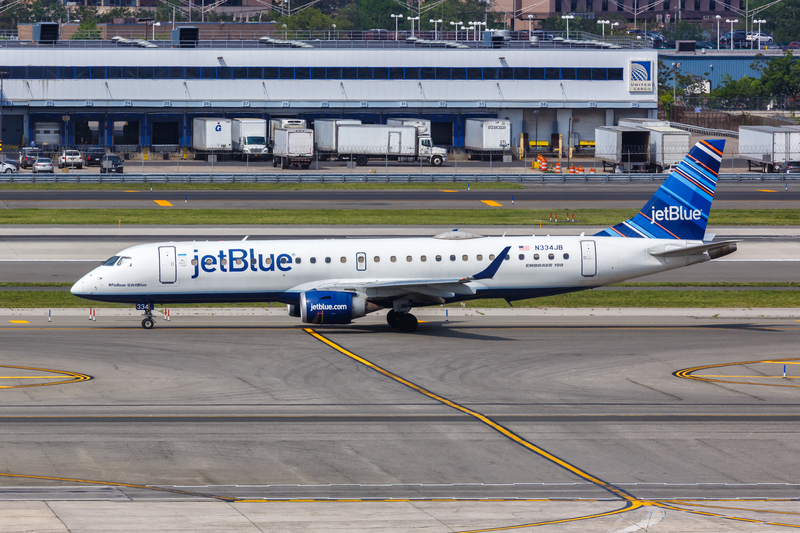
JetBlue Airways will leave Manchester-Boston Regional Airport (MHT) this summer, with the airline’s final flight now scheduled for July 8, 2026. On paper, it is one carrier pulling out of one airport. In practice, it is another sign of how exposed smaller U.S. airports have become when airlines face tighter aircraft availability, rising fuel costs, and pressure to concentrate flying where returns are strongest.

For Manchester, the loss is meaningful. JetBlue was one of the airport’s few low-cost competitors on high-profile Florida leisure routes, and its departure reduces both choice and competitive pressure in a market that has already spent years fighting to hold onto service against the pull of nearby Boston Logan International Airport (BOS).
For aviation readers, the bigger story is not just JetBlue’s exit. It is what that exit says about the current U.S. network environment.
Read our stories in your inbox
Two aviation newsletters. Zero fluff.
JetBlue Is Pulling Out Less Than Two Years After Arriving
The speed of the reversal is what makes the move notable.
JetBlue launched service at Manchester less than two years ago, and the airport worked hard to support it with incentives, marketing, and local promotion. Yet even with those efforts, the service did not survive. That matters because it shows that in the current environment, airlines are less willing to give thinner secondary-market routes long periods to mature.
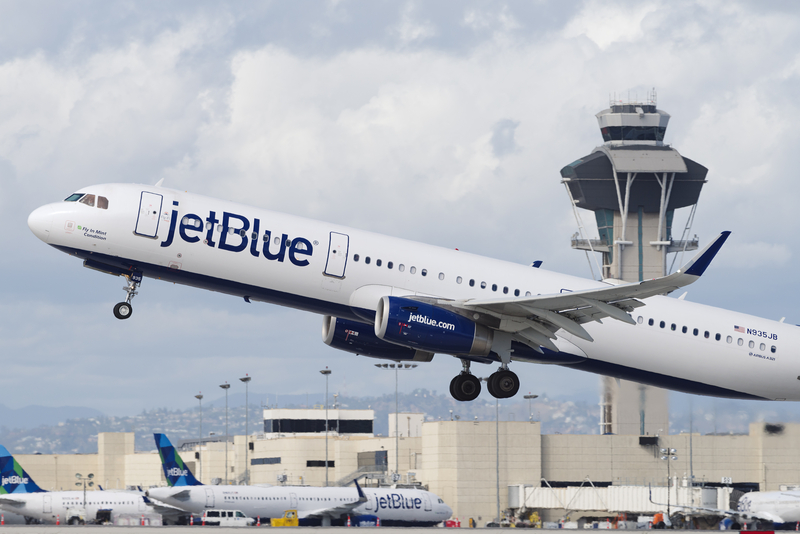
If a route does not perform strongly enough, quickly enough, the aircraft may be more valuable elsewhere.
That appears to be exactly what happened here.
The Phrase “Capacity Crisis” Matters
One of the most revealing parts of the story is the language reportedly used by JetBlue and echoed by airport officials: “capacity crisis.”
That phrase is important because it captures a wider airline reality in 2026. Carriers are facing a combination of:
- limited aircraft availability
- delivery delays from manufacturers
- higher fuel costs
- pressure to improve profitability
- stronger demand in larger, more proven markets
When airlines do not have enough effective capacity to do everything they would like to do, they start making hard network choices. Smaller airports are often the first places to feel that pain.
South Florida Is Part Of The Reason
JetBlue’s retreat from Manchester is also happening at a time when the airline is moving aggressively in Fort Lauderdale-Hollywood International Airport (FLL) after Spirit Airlines’ collapse.
That matters because aircraft are finite. When a carrier sees a better opportunity in a major market where pricing power and demand look stronger, something else often has to give. In this case, Manchester appears to have fallen on the wrong side of that trade-off.
This is not unusual in airline planning. It is just especially painful when the market losing service is a regional airport that had already worked hard to win it.
Manchester’s Biggest Problem Is Geography
The airport’s broader challenge has not changed: Boston is too close and too strong.
Manchester serves a real market in southern New Hampshire, but it also sits within reach of BOS, one of JetBlue’s largest focus cities and one of the most important airports in New England. When times are tight, an airline will almost always prefer to concentrate aircraft in the bigger hub with more demand, more connectivity, and higher average revenue potential.
That does not mean Manchester has no value. It means Manchester has to work harder than Boston to justify every airplane.
And in the current operating climate, that is a difficult fight.
This Is Not Just A JetBlue Story
It would be a mistake to view this only as a reflection of JetBlue’s own network or financial pressure.
The underlying issue is broader. Secondary airports across the United States are increasingly vulnerable when airlines become more selective. During expansionary periods, carriers are willing to experiment with thinner markets, launch secondary-airport service, and try to stimulate demand. In more constrained periods, those same routes are often the first to be cut if they do not produce strong enough results.
Manchester is therefore not an isolated case. It is part of a wider pattern.
JetBlue Still Cares About New England — Just Not Equally Everywhere
JetBlue has made clear that it remains committed to New England overall, and that is true.
But New England is not one market to an airline. It is a hierarchy. Boston is central. Manchester is secondary. Worcester is secondary. Providence and Hartford each have their own different place in the network logic. When pressure rises, those distinctions become sharper.
That is what this exit really demonstrates. JetBlue is not abandoning the region. It is narrowing its focus inside it.
What This Means For Travelers
For passengers in southern New Hampshire, the practical implication is straightforward: more of them will now drive to Boston Logan (BOS) for JetBlue service, especially to Florida and other leisure destinations.
That may not sound dramatic, but it matters. One reason regional airports fight so hard for service is that nonstop flights from nearby airports change traveler behavior, reduce leakage to larger hubs, and help keep local air service viable. Once a carrier leaves, the larger airport often wins back that traffic quickly.
That is likely what happens here.
The Airport’s Response Will Matter
Manchester now has two immediate challenges.
The first is replacing JetBlue’s capacity, whether with another airline or with expanded service from one already there. The second is making sure the airport does not lose momentum and slip further into the long-term decline that has shaped much of its post-2000s history.
That is easier said than done. Route replacement is difficult in an environment where many airlines are already short of aircraft and focused on stronger-performing markets. But if Manchester wants to avoid becoming even more dependent on Boston leakage, it will need to move quickly and realistically.
Bottom Line
JetBlue’s decision to leave Manchester-Boston Regional Airport (MHT) on July 8, 2026 is a setback for the airport, but it is also a clear example of how airlines are now thinking. In a period of constrained fleet availability, higher fuel prices, and heightened profit pressure, secondary airports are often the first to lose out when aircraft are needed elsewhere.
For JetBlue, the move is about concentrating scarce capacity in stronger markets like South Florida and Boston. For Manchester, it is another reminder that sustaining service at a regional airport is no longer just about local demand. It is about whether that demand can compete with the airline’s next-best use of the airplane.
Keep reading FlyMag
Get the Daily Brief in the morning or the Route Watch weekly recap on Fridays. Or both.