JetBlue’s transatlantic build-out has become one of the more consequential post-pandemic stories in North Atlantic aviation, not because the airline is matching the scale of the joint venture giants, but because it has carved out a credible premium niche using narrowbody Airbus aircraft on routes that many legacy operators long treated as widebody terrain.

In 2026, JetBlue’s Europe operation is larger than some summaries suggest. Based on JetBlue’s published schedule, the airline is serving 14 transatlantic routes to Europe this year, not 13, with all service flowing from its two East Coast gateways at Boston Logan International Airport (BOS) and New York John F. Kennedy International Airport (JFK). The network reaches nine European airports and includes a mix of year-round trunk routes and summer-seasonal flying.
That matters because JetBlue is no longer just testing the market with a handful of prestige routes. It has built a real, if still tightly focused, transatlantic network centered on Boston (BOS) and New York-JFK (JFK), with London, Paris, Amsterdam, Dublin, Edinburgh, Madrid, Barcelona, and Milan all now part of the carrier’s 2026 Europe portfolio.
Read our stories in your inbox
Two aviation newsletters. Zero fluff.
JetBlue’s 2026 Europe Route Count Is 14, Not 13
The first thing worth correcting is the route total.
JetBlue’s current published 2026 Europe schedule shows nine routes from Boston Logan International Airport (BOS) and five from New York John F. Kennedy International Airport (JFK), for a total of 14 Europe routes. The Boston side includes Amsterdam Schiphol Airport (AMS), Josep Tarradellas Barcelona-El Prat Airport (BCN), Dublin Airport (DUB), Edinburgh Airport (EDI), London Gatwick Airport (LGW), London Heathrow Airport (LHR), Adolfo Suárez Madrid-Barajas Airport (MAD), Milan Malpensa Airport (MXP), and Paris Charles de Gaulle Airport (CDG).

From JFK, JetBlue is serving Amsterdam Schiphol Airport (AMS), Dublin Airport (DUB), Edinburgh Airport (EDI), London Heathrow Airport (LHR), and Paris Charles de Gaulle Airport (CDG).
That JFK-AMS route is the one often missed when the network is summarized quickly, but it is part of JetBlue’s published 2026 transatlantic plan. Once it is counted, the total rises to 14.
Boston Has Become JetBlue’s Main European Growth Engine
Boston Logan International Airport (BOS) is now the clear center of JetBlue’s European expansion.
JetBlue has built BOS into a nine-route Europe gateway, which is notable both commercially and strategically. For years, Boston’s long-haul market was dominated by larger global network airlines and alliance structures. JetBlue has instead used Boston as a transatlantic growth platform where it can feed premium leisure, visiting-friends-and-relatives traffic, and selective business demand from a domestic network it already controls well.
The 2026 BOS-Europe network consists of:
- Boston (BOS) to Amsterdam (AMS)
- Boston (BOS) to Barcelona (BCN)
- Boston (BOS) to Dublin (DUB)
- Boston (BOS) to Edinburgh (EDI)
- Boston (BOS) to London Gatwick (LGW)
- Boston (BOS) to London Heathrow (LHR)
- Boston (BOS) to Madrid (MAD)
- Boston (BOS) to Milan Malpensa (MXP)
- Boston (BOS) to Paris Charles de Gaulle (CDG)
That is a substantial Europe operation for an airline still associated in many travelers’ minds primarily with U.S. domestic and Caribbean flying. It also reflects a deliberate strategy: use Boston as an East Coast transatlantic bridge where JetBlue can leverage local brand strength and a sizable domestic catchment without needing to mirror the sheer scale of the legacy alliances.
Barcelona And Milan Are JetBlue’s Two New Europe Additions In 2026
The headline additions for 2026 are JetBlue’s new Boston routes to Barcelona El Prat Airport (BCN) and Milan Malpensa Airport (MXP).

Boston (BOS) to Barcelona (BCN) launched in mid-April and runs as a daily summer-seasonal route through late October. That gives JetBlue a second Spanish market after Madrid and broadens its Mediterranean reach from Boston. Barcelona is a strong fit for JetBlue’s network logic because it combines premium leisure demand, cultural appeal, inbound U.S. traffic, and enough corporate and academic traffic to support an upscale narrowbody product.
Boston (BOS) to Milan Malpensa (MXP), launching in May, is arguably the more strategically interesting addition. Milan gives JetBlue its first Italian destination and opens a market with strong premium demand, fashion and design traffic, and significant broader Northern Italy catchment potential. Malpensa is also a more practical airport for this kind of operation than central-city Linate would be, offering long-haul infrastructure and a large hinterland.
These routes are important not simply because they expand the map, but because they show JetBlue still sees room to grow selectively across the Atlantic despite heavier competition and the limits of a narrowbody fleet.
Heathrow Remains The Flagship Market
If one route best symbolizes JetBlue’s transatlantic strategy, it is New York John F. Kennedy International Airport (JFK) to London Heathrow Airport (LHR).
JetBlue operates JFK-LHR twice daily year-round, making it the airline’s highest-frequency Europe market and the clearest statement of intent in the premium transatlantic arena. Heathrow is not just another European station. It is one of the most competitive, slot-constrained, high-yield long-haul markets in the world. Any airline serving it meaningfully is making a deliberate play for relevance, not just for publicity.
Boston (BOS) to London Heathrow (LHR) also remains part of the year-round core, giving JetBlue a second premium London market beyond its seasonal London Gatwick Airport (LGW) service. The two-airport London strategy is smart. Heathrow delivers prestige, connectivity, and premium traffic, while Gatwick broadens leisure access and schedule flexibility.
For JetBlue, London remains the center of gravity of its Europe proposition, even as the network diversifies.
Paris And Amsterdam Show JetBlue Is Building Depth, Not Just Headlines
JetBlue’s year-round service from both Boston Logan International Airport (BOS) and New York-JFK (JFK) to Paris Charles de Gaulle Airport (CDG) is another signal that the carrier is moving beyond novelty status.
Paris is one of the strongest transatlantic markets available to any U.S. airline, blending premium business traffic, leisure demand, and strong connecting relevance on both sides of the Atlantic. Daily service from both BOS and JFK gives JetBlue real visibility in the market and allows it to compete not only on price, but also on cabin product and onboard experience.
Amsterdam Schiphol Airport (AMS) is equally revealing. Boston (BOS) to Amsterdam (AMS) is part of JetBlue’s year-round offering, while New York-JFK (JFK) to Amsterdam (AMS) returns as a seasonal route in 2026. Amsterdam is a more slot-sensitive and operationally constrained market than many casual readers realize, which makes its inclusion notable. It suggests JetBlue is prepared to pursue strategically valuable routes even where airport access and operating discipline matter as much as raw demand.
These are not token network additions. They are serious European business and leisure markets that help anchor JetBlue’s transatlantic credibility.
Dublin, Edinburgh, And Madrid Strengthen The Summer Portfolio
JetBlue’s Europe operation is not built only on blue-chip trunk routes. It also includes a carefully chosen set of summer-seasonal markets that fit the airline’s narrowbody model well.
Dublin Airport (DUB) and Edinburgh Airport (EDI) return from both Boston (BOS) and New York-JFK (JFK), giving JetBlue valuable presence in Ireland and Scotland without needing the scale of a major alliance carrier. These are strong summer leisure markets, but they also benefit from visiting-friends-and-relatives traffic and, in Dublin’s case, the added value of U.S. preclearance on the westbound journey.
Madrid-Barajas Airport (MAD), meanwhile, returns from Boston (BOS), reinforcing JetBlue’s push into Spain after the route’s 2025 launch. Madrid is slightly different from some of JetBlue’s other leisure-heavy European points because it also has a meaningful business and institutional travel component. That broadens the route’s appeal and helps support the Mint premium product.
This is where JetBlue’s Europe strategy looks especially deliberate. Rather than overextending, it has added cities that sit at the intersection of premium leisure demand and workable narrowbody economics.
The Airbus A321LR Remains The Core Aircraft Behind The Strategy
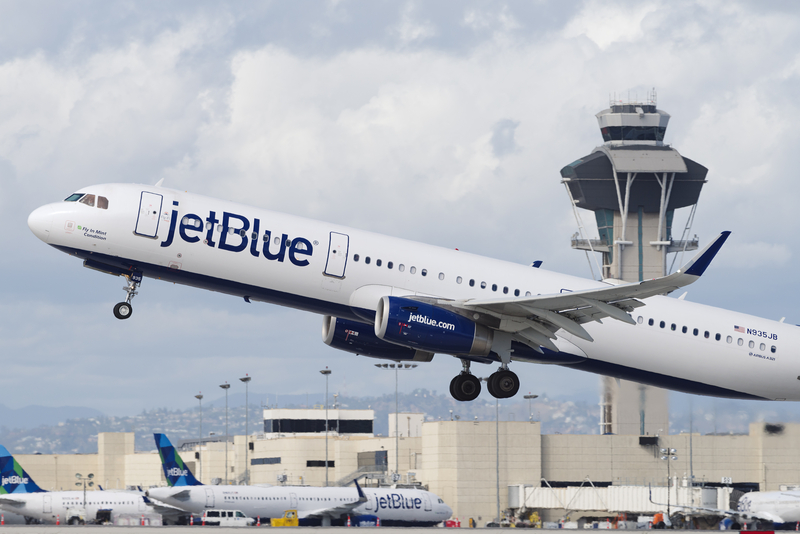
JetBlue’s European network is possible because of the Airbus A321LR.
The A321LR gives the airline true transatlantic range in a single-aisle platform, allowing JetBlue to open routes that would be difficult to justify with a widebody. In JetBlue service, the A321LR is fitted with 24 Mint suites and 114 core seats, for a total of 138 seats. That is a low-density, premium-heavy configuration by narrowbody standards, and it is central to the airline’s competitive pitch.
For JetBlue, the A321LR is not just an aircraft type. It is the enabler of the whole model. It brings lower trip costs than a widebody, allows thinner long-haul markets to work, and lets the airline deliver a boutique premium cabin with direct aisle access at every Mint seat. That matters on sectors that can approach nine hours westbound, where cabin quality becomes a major part of the airline’s value proposition.
The A321LR also gives JetBlue something strategically useful in slot-constrained markets: long-haul capability without the need to fill a much larger aircraft every day.
The Standard A321neo Also Plays A Role On Shorter Atlantic Missions
Not every JetBlue Europe flight requires the full long-range variant.
The carrier also uses Airbus A321neo aircraft with Mint on parts of its transatlantic operation, particularly where stage length and payload requirements allow. In JetBlue’s Mint-equipped A321neo layout, the aircraft carries 160 seats, including 16 Mint suites and 144 core seats. That makes it denser than the A321LR, but still premium by comparison with many transatlantic competitors.
This distinction matters because it shows JetBlue is matching aircraft to mission rather than treating every Europe route as identical. The airline can use the A321LR where range and premium density matter most, while assigning the standard A321neo where the mission is somewhat less demanding and higher seat count improves economics.
For an airline trying to maximize a relatively small fleet of premium-configured narrowbodies, that fleet flexibility is a genuine advantage.
JetBlue’s Europe Network Is More Impressive Than Its Size Suggests
On paper, 14 Europe routes may not sound enormous compared with the sprawling Atlantic networks of Delta Air Lines, American Airlines, United Airlines, British Airways, Air France, or Lufthansa Group carriers.
But scale alone is not the right benchmark here.
JetBlue is operating a narrowbody-based premium transatlantic network from two East Coast hubs, using a fleet that is much smaller and less diversified than those of its larger rivals. Yet it has managed to establish a recognizable brand position across some of the most contested city pairs in the market. That is not trivial.
Its advantage is not breadth in the traditional sense. It is precision. JetBlue has chosen high-profile cities, strong local-demand markets, and routes where an attractive Mint product and well-regarded economy experience can help offset the lack of global alliance depth and long-haul feed on the European side.
That makes the network more strategically interesting than a simple route count might imply.
Bottom Line
JetBlue’s 2026 Europe network is larger and more mature than a quick glance suggests. The airline is serving 14 routes, not 13, from Boston Logan International Airport (BOS) and New York John F. Kennedy International Airport (JFK), with new Boston service to Barcelona El Prat Airport (BCN) and Milan Malpensa Airport (MXP) joining an established mix of London, Paris, Amsterdam, Dublin, Edinburgh, and Madrid flying.
The backbone of the operation remains the Airbus A321LR, with its 24-suite Mint cabin and 114-seat core cabin, while the higher-density Airbus A321neo with 16 Mint suites and 144 core seats gives JetBlue additional flexibility on suitable missions. For an airline still rebuilding financially, the Europe network is one of the clearest examples of where JetBlue has built something genuinely differentiated: a narrowbody transatlantic operation that is no longer experimental, but an established part of the North Atlantic market.
Keep reading FlyMag
Get the Daily Brief in the morning or the Route Watch weekly recap on Fridays. Or both.