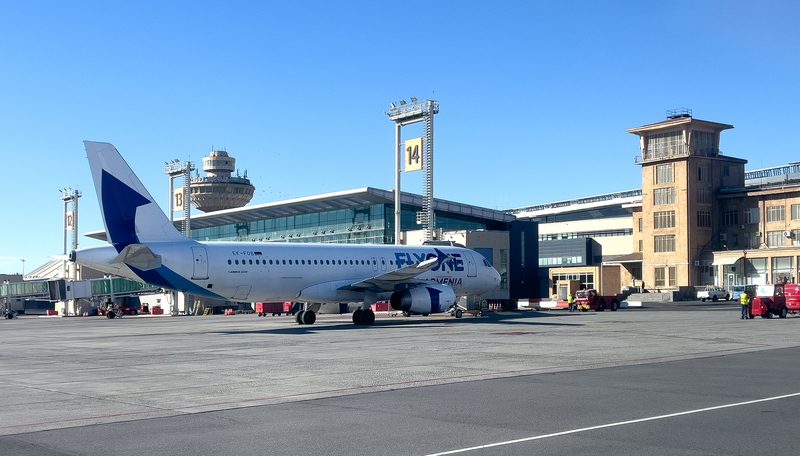
FlyOne Armenia has opened service between Vienna International Airport (VIE) and Yerevan Zvartnots International Airport (EVN), giving the airline a new foothold in Austria and adding more weight to one of the more interesting emerging air corridors between Central Europe and the Caucasus.

At first glance, this is a modest route launch. In reality, it is more strategically useful than the headline alone suggests. Vienna is a strong Central European origin market with broad diplomatic, business, and cultural ties across Eastern Europe and the former Soviet sphere, while Yerevan continues to grow its role as both a point-to-point market and a regional gateway. Putting the two together gives FlyOne Armenia an opportunity to tap diaspora traffic, city-break demand, and business flows at the same time.
That mix matters. Routes between Central Europe and the Caucasus tend to work best when they are not reliant on one segment alone, and Vienna–Yerevan has the ingredients of a broader, more durable market.
Read our stories in your inbox
Two aviation newsletters. Zero fluff.
The Airbus A320 Is a Logical Fit
FlyOne Armenia is operating the route with the Airbus A320, which is exactly the kind of aircraft suited to this stage of market development.
The A320 gives the airline enough capacity to make the route commercially meaningful, but without the risk of oversizing a still-maturing city pair. For carriers building thinner international services, that balance is important. A narrowbody like the A320 allows schedule growth in measured steps, while keeping trip costs under control and preserving the flexibility to increase frequency once the market proves itself.
That is the strategy here. Rather than entering Vienna with an overly ambitious commitment, FlyOne Armenia is building the route progressively, with frequencies set to rise during the summer season. For airline professionals, that is usually a positive sign. It suggests the carrier is trying to grow the market rationally rather than simply chase launch visibility.
Vienna–Yerevan Is Becoming a More Competitive Market
One of the most important details is that this route does not create Vienna–Yerevan traffic from scratch. It adds to an already existing market.
Austrian Airlines is already established between VIE and EVN, and FlyOne Armenia’s arrival means the route is shifting from a single-carrier market to a more competitive one. By the summer peak, total weekly frequencies between Vienna and Yerevan are set to reach 10, which is meaningful for a city pair of this size.
That is where the story becomes more interesting. Competition tends to do more than just add seats. It often improves schedule choice, widens fare options, and makes the route more visible in distribution channels. For passengers, that means more flexibility. For Vienna Airport, it means deeper Caucasus connectivity. And for Yerevan, it means another sign that the city’s European reach is continuing to widen.

Vienna Is Strengthening Its Eastern and Caucasus Profile
From the Austrian side, the route fits neatly into Vienna Airport’s broader role.
VIE has long been strongest when serving as a bridge between Western and Central Europe on one side and Eastern Europe, the Balkans, and the former Soviet space on the other. Yerevan sits naturally within that wider geography. It is not a mass-volume destination in the way London or Paris might be, but it is precisely the kind of market that reinforces Vienna’s value as a regional connector rather than only a local origin airport.
That is why the launch has more strategic value than a simple new route announcement. It supports Vienna’s network depth in a region where point-to-point demand is growing, but where traffic still benefits from a well-positioned Central European airport with strong business, diplomatic, and tourism flows.

Yerevan Continues to Build Its European Reach
From the Armenian side, the route is another sign that Yerevan Zvartnots International Airport (EVN) is gaining broader European relevance.
Armenia’s capital has become more visible to European airlines and travelers in recent years, helped by a combination of diaspora demand, tourism growth, and greater interest in the Caucasus as a distinct travel region rather than simply an extension of neighboring markets. For FlyOne Armenia, Vienna is a useful addition because it strengthens the airline’s Central European profile and gives it another market that can generate both local and connecting demand.
There is also a branding benefit. A route into Vienna carries a certain weight for a growing airline. It places the carrier into a prominent European capital market and signals ambition beyond strictly regional flying.
More Than a Tourism Story
It would be easy to frame Vienna–Yerevan as a cultural and tourism route, and that angle is certainly part of the picture. Yerevan’s historic core, Republic Square, and the Cascade Complex give the city strong visitor appeal, while Armenia more broadly has become increasingly attractive for travelers interested in landscapes, monasteries, and food culture.
But for an airline audience, the more important point is that this route is not only about leisure. Vienna brings business travel, institutional traffic, and stronger onward opportunities, while Yerevan brings both local demand and broader regional significance. That combination gives the route a better foundation than a purely seasonal leisure service would have.
Bottom Line
FlyOne Armenia’s entry into the Vienna market is a measured but strategically useful move. The new Vienna International Airport (VIE) to Yerevan Zvartnots International Airport (EVN) route adds competition, expands Central Europe–Caucasus connectivity, and gives the airline a stronger presence in a market that matters for both business and diaspora travel.
The Airbus A320 is the right aircraft for this phase of development, and the planned build-up in frequency shows the airline is treating the route as a growth market rather than a one-off experiment.
For Vienna, the route adds more depth to its eastern network. For Yerevan, it is another step in becoming more firmly embedded in Europe’s wider air transport map.