Avianca Shifts Venezuela Lifeline To Valencia As Caracas Airport Disruption Continues
Avianca has opened a temporary air bridge between Colombia and Venezuela through Valencia, moving quickly to preserve connectivity after earthquake damage disrupted operations at Caracas’ main international airport.

The Colombian carrier is now operating between Bogotá El Dorado International Airport (BOG) and Arturo Michelena International Airport (VLN) in Valencia, Venezuela. The move is designed to support passengers affected by the interruption of Bogotá (BOG)–Caracas (CCS) service while also creating capacity for emergency teams, medical personnel, and humanitarian cargo moving into Venezuela.
The operation is initially scheduled through July 10, 2026, but Avianca says that window may be extended depending on the evolution of the contingency at Simón Bolívar International Airport in Maiquetía (CCS), the primary airport serving Caracas.
This is not a routine network adjustment. It is an emergency-driven rerouting of international capacity into an alternate Venezuelan airport at a moment when reliable air access is critical.
Valencia Becomes Avianca’s Temporary Venezuela Gateway
Avianca’s temporary Bogotá (BOG)–Valencia (VLN) operation gives the airline a way to keep Colombia–Venezuela passenger flows moving while Caracas/Maiquetía (CCS) remains affected by the earthquake emergency.

Valencia’s Arturo Michelena International Airport (VLN) serves Venezuela’s central region and is located in Carabobo state, west of Caracas. It is not a like-for-like substitute for Maiquetía (CCS), which is Venezuela’s principal international gateway, but it provides a workable alternate airport for passengers who need to enter or leave the country while Caracas operations are constrained.
That distinction matters. Caracas/Maiquetía (CCS) is the natural airport for Venezuela’s capital, diplomatic traffic, business travel, and many international connections. Valencia (VLN), by contrast, requires onward surface travel for passengers whose final destination is Caracas or La Guaira. But in an emergency environment, preserving any structured air corridor can be more important than maintaining the perfect airport pairing.
Avianca is positioning the Valencia (VLN) flights as both a passenger recovery measure and a humanitarian support operation. Travelers holding Bogotá (BOG)–Caracas (CCS) bookings are being contacted through the email address attached to their reservation with instructions on how to use Valencia (VLN) as an alternate departure or arrival point.
Two Daily Flights Designed Around The Caracas Schedule
Avianca is offering two daily Bogotá (BOG)–Valencia (VLN) frequencies, with timings built to resemble the structure of its Bogotá (BOG)–Caracas (CCS) operation as closely as possible.

The first daily Bogotá (BOG)–Valencia (VLN) flight departs Colombia at 07:35 and arrives in Valencia (VLN) at 10:35 local time. The return leaves Valencia (VLN) at 12:27 and lands back in Bogotá (BOG) at 13:10.
The second daily rotation departs Bogotá (BOG) at 23:20 and arrives in Valencia (VLN) at 02:20 the following morning. The return sector departs Valencia (VLN) at 04:17 and arrives in Bogotá (BOG) at 05:00.
Those timings are not especially passenger-friendly in every direction, particularly the overnight operation, but they are operationally useful. They help Avianca re-accommodate passengers from the suspended Caracas (CCS) schedule, maintain aircraft utilization, and create two daily windows for emergency movement between Colombia and Venezuela.
In a crisis, schedule similarity matters. It reduces the complexity of moving passengers from one airport pair to another, especially when thousands of people may be watching for rebooking instructions, alternate travel options, or humanitarian access.
The Aircraft: Avianca’s Airbus A320
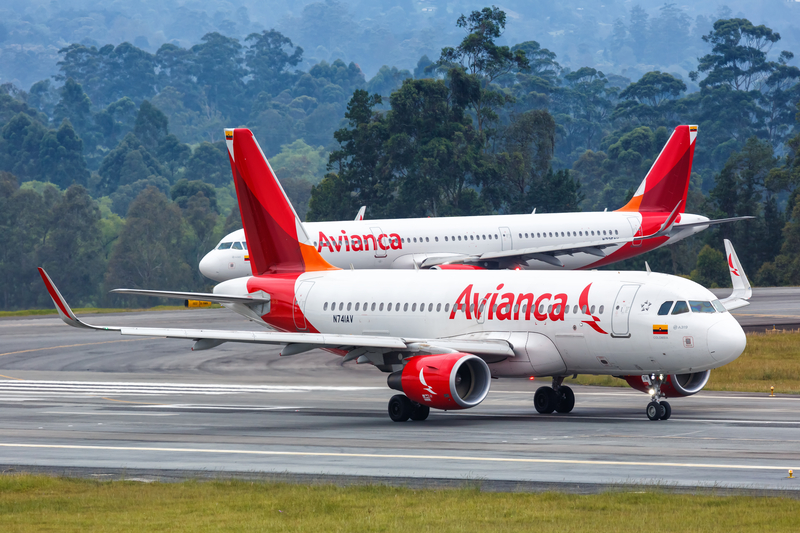
The route is being operated with aircraft from Avianca’s Airbus A320 fleet, with capacity for up to 180 passengers.
The Airbus A320 is one of the most widely used narrowbody aircraft in the world and is designed for short- and medium-haul flying. For a Bogotá (BOG)–Valencia (VLN) sector, the aircraft is a natural fit. The route is well within the A320’s range, does not require widebody capacity, and gives Avianca enough seats to move both passengers and response personnel without overcomplicating the operation.
Avianca’s modern operating model is heavily built around the A320 family. That helps in a disruption like this. A standardized narrowbody fleet allows the airline to redeploy aircraft more easily, schedule crews more efficiently, and support irregular operations with fewer fleet-specific constraints.
The A320 is also appropriate from an airport-performance standpoint. Valencia (VLN) is a capable international airport, but it is not Caracas/Maiquetía (CCS). Using a mainline narrowbody rather than a larger widebody keeps the operation more flexible while still providing meaningful capacity.
For passengers, the aircraft choice also means Avianca can move people at scale. Two daily A320 rotations can create several hundred seats per day in each direction, which is significant during a temporary airport closure or major operational disruption.
Humanitarian Capacity Is Part Of The Mission
Avianca says the Valencia (VLN) operation will also support the transport of rescue teams, medical personnel, emergency responders, and humanitarian cargo.
The airline is coordinating with humanitarian partners including the Colombian Red Cross and the Colombian Civil Air Patrol. Avianca’s statement also referenced additional social-impact partners as part of the broader response effort.
That is an important part of the story. Airlines often become critical infrastructure during disasters, especially when road access is damaged, airport capacity is reduced, or ground logistics are unstable. In this case, the air operation is not only about rebooking stranded passengers. It is also about moving people and supplies into a country facing a major emergency.
Avianca has a particular role because Bogotá (BOG) is one of northern South America’s most important aviation hubs. From El Dorado (BOG), the airline can connect passengers, aid teams, and cargo from across Colombia and the wider Avianca network into Valencia (VLN), then onward by road or local coordination inside Venezuela.
That makes the Bogotá (BOG)–Valencia (VLN) route a temporary but strategically important humanitarian corridor.
Why Caracas/Maiquetía Matters So Much
The need for the Valencia operation stems from the disruption at Simón Bolívar International Airport in Maiquetía (CCS), Venezuela’s main international airport and the primary gateway for Caracas.
Maiquetía (CCS) is not just another airport in the Venezuelan system. It handles the bulk of international service to the capital region, including flights that connect Venezuela with Colombia, Panama, Spain, Portugal, Turkey, the Caribbean, and other regional markets. When CCS is unavailable or capacity-constrained, the impact spreads quickly across airlines, passengers, cargo operators, diplomatic missions, and humanitarian organizations.
Earthquake damage at an airport is especially complicated because reopening is not simply a matter of clearing debris from a terminal. Authorities need to assess passenger-processing areas, roof and ceiling structures, electrical systems, baggage systems, security screening points, boarding gates, emergency exits, fire-safety systems, access roads, and airside infrastructure.
Even if runways and taxiways are usable, the airport may not be able to safely process passengers at normal levels until terminal and support systems are cleared. That is why airlines such as Avianca need alternate plans before a full assessment at CCS is complete.
Valencia Is Useful, But Not A Perfect Substitute
Valencia (VLN) gives Avianca and Venezuelan authorities an important pressure-relief option, but it does not eliminate the operational burden created by the Caracas (CCS) disruption.
For travelers whose final destination is Caracas, Valencia (VLN) means additional ground transportation. Depending on road conditions, traffic, fuel availability, and emergency restrictions, that surface journey can be complex. Passengers may also need help with baggage, family coordination, local transport, hotel arrangements, or onward domestic connections.
That is why clear passenger communication is essential. Avianca is telling affected customers to monitor official communication channels and the email address attached to their booking. That is the right approach, because airport changes during emergencies can shift quickly as authorities update safety assessments and airlines adjust schedules.
The airline is also maintaining protection measures for passengers with tickets dated between June 24 and July 15, including options to reprogram travel, change routes to Valencia (VLN), Cúcuta (CUC), or Riohacha (RCH), or request refunds for unused segments under the conditions outlined by the airline.
Those protections matter because not every Caracas-bound passenger can easily use Valencia (VLN). Some may be traveling for urgent family reasons. Others may not be able to reach their final destination safely from Valencia. Flexibility is essential when the alternate airport solves the aviation problem but not necessarily the entire journey.
A Measured Response From A Key Regional Carrier
Avianca’s response shows how regional airlines can use network depth and fleet flexibility during a crisis.
The airline could have simply canceled Bogotá (BOG)–Caracas (CCS) flights and waited for Maiquetía (CCS) to reopen. Instead, it has created a temporary scheduled operation through Valencia (VLN), added the ability to support charter flying, and aligned the route with humanitarian movement.
That is a more complex response, but a more useful one.
It also reflects the importance of Colombia–Venezuela air links. Travel between the two countries is driven by family ties, migration, business, medical needs, humanitarian movement, and regional connectivity. When normal air service is interrupted, the disruption is felt well beyond ordinary tourism.
For Avianca, maintaining a Venezuela operation also protects customer trust. Passengers holding Caracas (CCS) bookings need options, not just cancellation notices. A temporary Valencia (VLN) operation gives the airline a way to keep people moving while still respecting the operational reality at Maiquetía (CCS).
Operational Risks Remain
The temporary operation will depend on several moving parts.
Valencia (VLN) must be able to handle the additional passenger flow, ground handling, immigration processing, baggage activity, security screening, and aircraft turns. Avianca must also manage aircraft availability, crew duty time, airport slots, coordination with Colombian and Venezuelan authorities, and the needs of humanitarian partners.
The route may also change as conditions at Caracas/Maiquetía (CCS) evolve. If CCS reopens quickly and safely, Avianca can shift back toward its normal Bogotá (BOG)–Caracas (CCS) operation. If the contingency lasts longer, Valencia (VLN) may remain important for a longer period, and additional schedule adjustments could follow.
That uncertainty is why Avianca is calling the operation temporary and initially limiting it through July 10. The airline is giving itself room to extend, reduce, or reshape the service as airport infrastructure and emergency needs become clearer.
For passengers, the best advice is straightforward: check Avianca’s official channels, monitor the email linked to the booking, and avoid assuming that a Caracas (CCS) ticket will operate exactly as originally planned.
Bottom Line
Avianca’s Bogotá (BOG)–Valencia (VLN) operation is a practical aviation response to a serious emergency in Venezuela.
With Caracas/Maiquetía (CCS) disrupted by earthquake damage, Avianca is using Valencia’s Arturo Michelena International Airport (VLN) as a temporary gateway to keep Colombia–Venezuela travel moving. The airline is operating two daily A320 flights, initially through July 10, while also supporting the movement of rescue teams, medical personnel, and humanitarian cargo.
This is not a normal route launch. It is a temporary lifeline built around passenger recovery, humanitarian access, and operational flexibility.
For travelers, Valencia (VLN) may not be as convenient as Caracas (CCS), but it keeps an essential air corridor open. For Avianca, the move shows the value of a standardized A320 fleet, a strong Bogotá (BOG) hub, and the ability to adapt quickly when infrastructure disruption turns aviation into part of the emergency-response system.