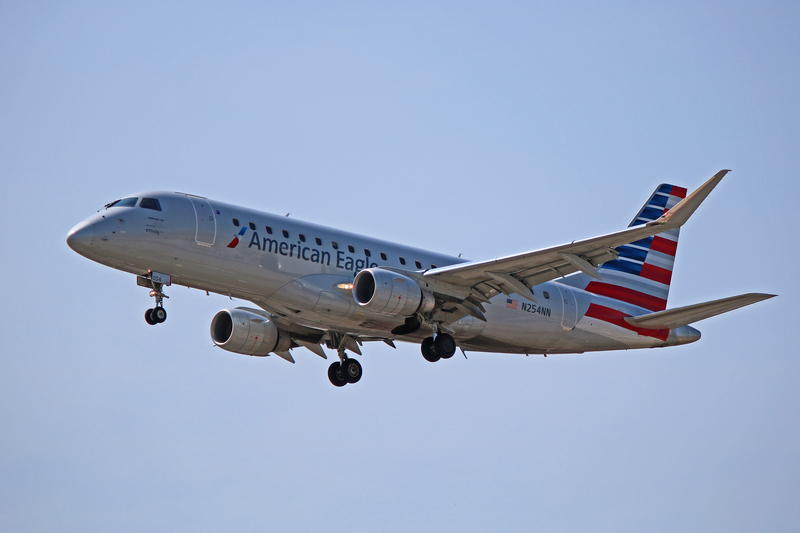
American Airlines is set to restore nonstop service between Miami International Airport (MIA) and Caracas Simón Bolívar International Airport (CCS), marking the return of scheduled U.S.-Venezuela flying by a U.S. carrier after a gap of more than six years. The route is expected to launch on April 30, with daily service operated not by a mainline narrowbody, but by an Embraer E175.

That aircraft choice is the most revealing part of the story.
American once served Caracas with significantly larger aircraft, including the Boeing 757, Boeing 767, Airbus A300, and Boeing 737-800, during an era when Venezuela supported far more robust U.S. demand and a much bigger international airline footprint. This time, the airline is returning with a far smaller gauge, through Envoy Air, using a 76-seat Embraer E175. For aviation professionals, that is a clear signal that American sees opportunity in the MIA-CCS market, but is approaching the relaunch with caution, tight capacity discipline, and a strong emphasis on flexibility.
Read our stories in your inbox
Two aviation newsletters. Zero fluff.
The Route Is Back, But On A Much Smaller Scale
American’s return to Caracas Simón Bolívar International Airport (CCS) is significant because it restores a nonstop link that once formed a routine part of the airline’s Latin America network from Miami International Airport (MIA). But the scale of the relaunch is very different from the pre-2019 operation.
The current plan is for one daily roundtrip rather than multiple frequencies, and the aircraft is an Embraer E175 rather than a larger Boeing or Airbus narrowbody. That is a major reset in how the route is being viewed commercially.

In the past, Caracas was a large enough market for multiple daily departures and larger aircraft because it combined business traffic, visiting-friends-and-relatives demand, and significant commercial connectivity between Venezuela and South Florida. In 2026, the market is being re-entered more cautiously. American is preserving nonstop access, but in a way that limits exposure if demand, operating conditions, or the wider regulatory environment prove less stable than hoped.
That is prudent airline planning, not timidity.
Why The Embraer E175 Is Such An Interesting Choice
The Embraer E175 is not the first aircraft most people associate with South America service from the United States. That is exactly why this route stands out.
In American Eagle service, the E175 seats 76 passengers in a three-cabin layout: 12 First Class seats, 20 Main Cabin Extra seats, and 44 Main Cabin seats. It is a regional jet, but a premium-configured one, with a much more comfortable cabin profile than many travelers expect from the category. For an airline like American, it offers a useful combination of lower trip cost, respectable premium seating, and enough range to operate a relatively short northern South America mission from Miami International Airport (MIA) to Caracas Airport (CCS).
That makes it a logical fit for a route like this.
A larger narrowbody would spread fixed operating costs across more seats, but only if those seats can be filled consistently and at acceptable fares. The E175 allows American to test the rebuilt market with lower risk. It also gives the carrier the ability to restore nonstop service and premium product visibility without overcommitting capacity in a politically and operationally sensitive market.
For a relaunch of this nature, that is smart fleet deployment.

This Will Be One Of The Few Scheduled E175 Links From The U.S. To South America
From a network-planning perspective, the route is unusual because it places a 76-seat Embraer E175 on an international sector to northern South America, rather than on the domestic or near-Caribbean flying where the type is more commonly seen.
American has used the E175 on South America-adjacent and northern Latin American missions before, and it previously flew the aircraft into Colombian markets such as Gustavo Rojas Pinilla-San Andrés Airport (ADZ) and Barranquilla Ernesto Cortissoz International Airport (BAQ). But Miami International Airport (MIA) to Caracas Simón Bolívar International Airport (CCS) is a higher-profile relaunch because it restores a capital-city link and reopens a country market absent from U.S. airline networks for years.
The route is also short enough to suit the E175 well. Scheduled block times are just over three hours each way, which is well within the operating comfort zone of the aircraft. That allows American to preserve same-aircraft utilization efficiency while still offering a product that feels more substantial than a simple feeder mission.
In other words, the E175 may be small, but this is not a token route.
Miami Remains The Natural Gateway For The Relaunch
If American was going to return to Venezuela, Miami International Airport (MIA) was always the obvious place to do it.
MIA is the carrier’s most important Latin American hub and one of the strongest O&D and connecting gateways in the hemisphere. It combines deep local South Florida demand with extensive onward feed throughout the United States, the Caribbean, and Latin America. For a route like Caracas, that matters because the traffic base is not just point-to-point. It is also about reconnecting Venezuela to a broader network.
That is one reason the route can work even with only 76 seats per flight. American does not need to start with huge volume to have strategic relevance. A single daily roundtrip from Miami can still restore meaningful connectivity for business, family, and humanitarian travel while giving the airline a platform to evaluate whether the market can support more.
For Caracas, there was never going to be a more logical U.S. relaunch point than MIA.
American Is Re-Entering A Market That Remains Operationally Sensitive
The restart of MIA-CCS is commercially notable, but it should not be mistaken for a full normalization of the U.S.-Venezuela market.
American has made clear that the service remains subject to government approvals and security assessments, and the airline’s own wording around the relaunch has consistently emphasized regulatory coordination. That is an important signal. Caracas is not being re-added like a routine seasonal destination. It is being reintroduced within a framework of heightened scrutiny and oversight.
That context matters because even once flying resumes, the route will remain exposed to political developments, security assessments, regulatory reviews, and demand uncertainty in ways that many other Latin American markets are not.
That is another reason the Embraer E175 is such a sensible starting aircraft. It gives American an entry point into the market without the weight of a large-capacity commitment.
The Aircraft Choice Also Says Something About Demand Quality
A 76-seat Embraer E175 is not just about limiting downside. It also says something about how American likely views the traffic mix.
Because the aircraft includes 12 First Class seats and 20 Main Cabin Extra seats, it allows American to carry a relatively premium-heavy cabin for such a small aircraft. That can be especially useful on a route where higher-yield traffic may matter more than raw volume in the early stages of a relaunch.
For airline network planners, that matters. A market re-entry is not always about flooding demand. Sometimes it is about identifying the highest-value traffic, restoring connectivity, and building confidence before deciding whether a larger aircraft makes sense.
The E175 is well suited to that kind of measured return. It supports a credible premium offering while still preserving the lower trip cost advantages of a regional jet.
Caracas Is Back, But American Is Clearly Testing Before It Expands
One of the clearest takeaways from the relaunch is that American is not pretending 2026 is the same as 2018.
The route may be back, but the structure of the service shows the airline is testing the market rather than declaring full-scale confidence in it. One daily flight, one small but premium regional jet, and a route currently shown through late October all suggest a measured approach rather than an aggressive rebuild.
That is the correct reading of the move. The nonstop is important because it restores a missing link between the United States and Venezuela. But it is equally important because it gives American a low-risk way to study actual booking patterns, operational performance, premium uptake, and broader market resilience.
If those indicators are strong, a larger aircraft or broader schedule could follow in time. If not, American has preserved room to stay disciplined.
The Wider Competitive Picture Is Starting To Shift
American is not the only airline reconnecting Caracas, but it is the first U.S. carrier to move. That distinction matters.
For years, passengers traveling between the United States and Venezuela have typically needed to connect through points such as Bogotá El Dorado International Airport (BOG) or Panama City Tocumen International Airport (PTY). Those routings added time, complexity, and often significant uncertainty to an already difficult market.
A daily MIA-CCS nonstop changes that immediately. Even on a modest aircraft, nonstop service by a major U.S. airline resets the competitive landscape. It creates a direct option that did not previously exist and puts American in a strong first-mover position if the market continues to reopen.
That does not mean the route will automatically scale quickly. But it does mean American is in a favorable position to shape the market’s early return.
Bottom Line
American Airlines’ return to Caracas Simón Bolívar International Airport (CCS) from Miami International Airport (MIA) is an important route relaunch, but the real insight lies in the aircraft choice. By using a 76-seat Embraer E175, American is restoring the nonstop link in the most cautious and commercially disciplined way possible.
The E175 gives the airline lower trip costs, a credible premium cabin, and the flexibility to test demand without repeating the larger-capacity assumptions of the past. For aviation readers, that makes this more than just a route resumption. It is a case study in how a major airline re-enters a sensitive international market carefully, deliberately, and with the right aircraft for the uncertainty involved.
Keep reading FlyMag
Get the Daily Brief in the morning or the Route Watch weekly recap on Fridays. Or both.