Qatar Airways is preparing to open one of the most unusual long-haul routes in its network next month, linking Doha with two new South American capitals on a single triangular operation.

From July 22, 2026, Qatar Airways plans to begin twice-weekly service from Hamad International Airport (DOH) to El Dorado International Airport (BOG) in Bogotá and Simón Bolívar International Airport (CCS) in Caracas. The service will operate under flight number QR783 and is scheduled on Wednesdays and Sundays.
The route is significant for several reasons. It adds Colombia and Venezuela to Qatar Airways’ passenger network, gives Bogotá (BOG) and Caracas (CCS) their first direct Middle East link, and makes Qatar Airways the first Gulf carrier to serve Venezuela.
Read our stories in your inbox
Two aviation newsletters. Zero fluff.
It is also a demanding piece of flight planning. Depending on direction and schedule, passengers traveling between Doha (DOH) and South America will spend close to 21 hours in the system, including the intermediate stop. This is not a 21-hour nonstop flight, but it is still one of the longest and most complex passenger routings Qatar Airways will operate.
A Two-City South America Route From Doha
Qatar Airways’ regular published schedule routes the service from Doha (DOH) to Bogotá (BOG), then onward to Caracas (CCS), before returning nonstop from Caracas (CCS) to Doha (DOH).
Qatar Airways Trims San Francisco Flights for Summer 2026 as the DOH–SFO Market Cools
The scheduled pattern is:
Doha (DOH) to Bogotá (BOG), departing 07:30 and arriving 16:05
Bogotá (BOG) to Caracas (CCS), departing 17:35 and arriving 20:40
Caracas (CCS) to Doha (DOH), departing 22:40 and arriving 19:55 the next day
That gives the flight a 90-minute ground stop in Bogotá (BOG) and a two-hour stop in Caracas (CCS). The longest passenger journey is the Doha (DOH)–Caracas (CCS) direction via Bogotá (BOG), where total elapsed travel time pushes toward the 21-hour mark.
There is one scheduling wrinkle. The inaugural July 22 rotation is filed differently, operating Doha (DOH)–Caracas (CCS)–Bogotá (BOG), with the aircraft then returning from Bogotá (BOG) to Doha (DOH) via Caracas (CCS). From July 26, the regular Doha (DOH)–Bogotá (BOG)–Caracas (CCS)–Doha (DOH) pattern is scheduled to take over.
For route planners, that distinction matters. Triangular services are often shaped by a mix of commercial demand, aircraft performance, airport elevation, bilateral rights, crew timing, fuel planning, and ground-handling constraints.
Why Bogotá’s Elevation Matters
Bogotá El Dorado International Airport (BOG) is one of the highest major international airports in the world, sitting at roughly 8,360 feet above sea level.
That creates a very different operating environment from sea-level airports such as Doha (DOH) or Caracas/Maiquetía (CCS). High-elevation airports affect aircraft performance because thinner air reduces engine thrust, wing lift, and takeoff performance. On very long routes, where an aircraft must carry large fuel loads, that can become a significant planning factor.
The Boeing 777-200LR is one of the most capable long-range aircraft ever built, but physics still applies. A nonstop westbound arrival into Bogotá (BOG) is straightforward from an airport-performance standpoint because the aircraft lands lighter after burning fuel for more than 16 hours. The more sensitive question is departure performance on a very long sector from Bogotá’s high-altitude runway environment.
That helps explain why the regular return to Doha is routed through Caracas (CCS). The aircraft only needs to operate the short Bogotá (BOG)–Caracas (CCS) sector after leaving Colombia. It can then depart from lower-elevation Caracas (CCS) for the long eastbound sector back to Doha (DOH), giving Qatar Airways a more favorable performance profile for the longest departure.
This is the sort of detail that makes the route interesting. It is not just a line on a map. It is a carefully constructed operation built around aircraft capability, airport geography, and commercial opportunity.
The Aircraft: Boeing 777-200LR
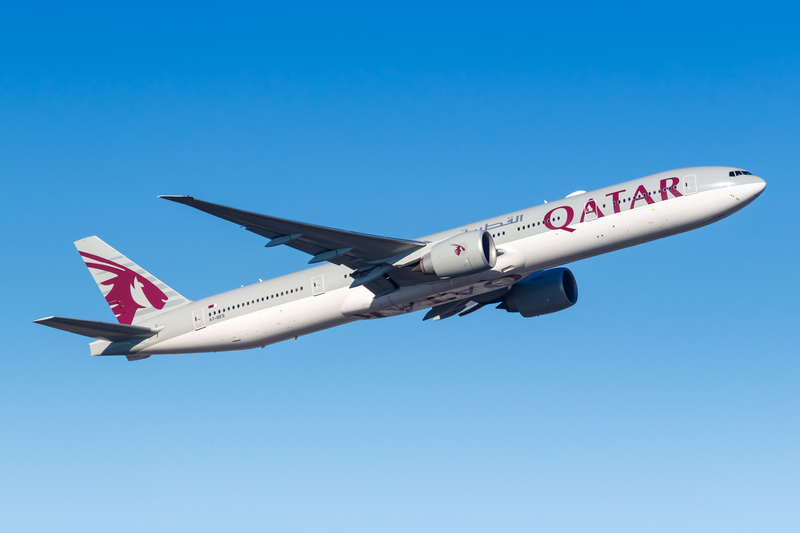
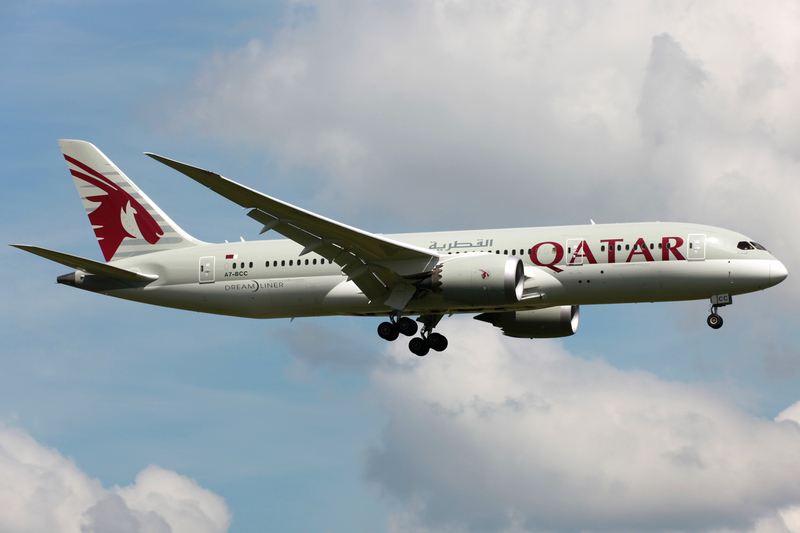
Qatar Airways is expected to use the Boeing 777-200LR on the Bogotá (BOG) and Caracas (CCS) route.
The 777-200LR is the right aircraft for the mission. The “LR” stands for Long Range, and the type was developed for exactly the kind of ultra-long-haul operation where endurance, payload capability, and twin-engine efficiency matter. Powered by General Electric GE90 engines, the 777-200LR was once the longest-range passenger aircraft in the world and remains one of the most capable widebodies in commercial service.
For Qatar Airways, the type has long been useful on demanding routes where range and payload are more important than maximum seat count. The aircraft is smaller than the 777-300ER but carries the fuel and performance margin needed for long missions such as Doha (DOH)–Bogotá (BOG) and Caracas (CCS)–Doha (DOH).
Qatar Airways’ 777-200LR fleet includes aircraft with 272 or 276 seats, depending on configuration. The Qsuite-equipped layout has 42 Business Class seats and 230 Economy Class seats. The non-Qsuite layout also has 42 Business Class seats but 234 Economy seats.
For passengers, the Qsuite version is the one to watch. Qatar’s Qsuite Business Class is arranged in a 1-2-1 configuration with direct aisle access, privacy doors, alternating forward- and rear-facing seats, and center seats that can work well for couples or groups traveling together. In Economy, the 777 generally uses a 3-4-3 layout through most of the cabin, narrowing toward the rear on some configurations.
As always with long-haul flying, aircraft substitutions can happen. Qatar itself notes that Qsuite availability can vary for operational reasons. Still, if the 777-200LR operates as planned, this will be a substantial onboard product for a route that will test passenger endurance.
A Major Step For Qatar Airways In South America
Qatar Airways’ South American passenger network has long been centered on São Paulo Guarulhos International Airport (GRU) in Brazil. Adding Bogotá (BOG) and Caracas (CCS) gives the airline a broader foothold in the northern part of the continent.
That is commercially important. Bogotá is one of Latin America’s largest air markets and a major hub for Colombia, with strong regional feed across the Andean region, Central America, the Caribbean, and North America. Caracas is more complicated, but potentially significant. Venezuela’s international aviation market has been rebuilding after years of isolation, service suspensions, economic instability, and operational uncertainty.
For Qatar Airways, the route is not likely to be driven purely by local Doha–Bogotá or Doha–Caracas traffic. The real value is connectivity over Doha (DOH). The airline has specifically highlighted onward markets including Australia, China, Japan, Lebanon, South Korea, and the United Arab Emirates.
Those markets make sense. Colombia and Venezuela both have long-haul demand to the Middle East, Asia, and Australia, but direct service has historically been limited or nonexistent. Qatar Airways can use Doha (DOH) as a global transfer point, connecting South American passengers to a network that would otherwise require backtracking through Europe, the United States, Panama, or other hubs.
Bogotá Brings Scale, Caracas Brings Strategic Significance
The two South American cities play very different roles in the route.
Bogotá (BOG) brings scale. Colombia is one of South America’s most important aviation markets, and El Dorado (BOG) is the country’s principal international airport. The airport already supports extensive long-haul flying to Europe and North America, plus deep regional connectivity across Latin America. A Qatar Airways link gives Bogotá a new eastbound option and creates a direct bridge to the Gulf.
Caracas (CCS) brings strategic significance. Simón Bolívar International Airport in Maiquetía serves Venezuela’s capital region and remains the country’s main international gateway. Qatar becoming the first Gulf carrier to serve Venezuela is a major milestone, particularly at a time when Venezuela’s global aviation links have only recently begun to rebuild.
The challenge is that Caracas (CCS) is also a more fragile market. Recent earthquake damage at Maiquetía (CCS) has forced airport closures and safety inspections, and any long-haul launch into the airport will depend on the facility being operationally ready. Terminal infrastructure, passenger processing, airside systems, emergency response, customs, immigration, security, and ground handling all need to support a widebody operation before a service like Qatar’s can begin reliably.
That context should not be ignored. The route is scheduled, but the airport environment in Caracas will need close watching in the weeks before launch.
A Route Built For Connections, Not Just Local Traffic
The strongest logic behind the route is Qatar Airways’ hub-and-spoke model.
Doha Hamad International Airport (DOH) is one of the world’s most efficient long-haul connecting hubs. It is designed around moving passengers between continents, and Qatar Airways has built its network around connecting flows between Europe, Africa, Asia, the Middle East, Australasia, and the Americas.
Bogotá (BOG) and Caracas (CCS) fit that model well. Neither city can rely on massive local demand to Doha alone, but both can generate traffic across dozens of onward markets. A passenger from Bogotá to Tokyo, Seoul, Sydney, Dubai, Beirut, Bangkok, or Delhi can now use Doha as a single connecting point.
That is the real competitive proposition. The new route is not only about Qatar Airways entering Colombia and Venezuela. It is about giving northern South America a new path to Asia, the Middle East, and Australia without routing through the United States or Europe.
For passengers who face visa, transit, or connection complexity in other regions, that can be a meaningful advantage.
Why The Route Is Unusual
Triangular long-haul routes are less common than they used to be, but they still make sense when demand is split between two markets that may not each support a standalone nonstop.
In this case, Doha (DOH)–Bogotá (BOG) and Doha (DOH)–Caracas (CCS) each has strategic value, but the combined routing allows Qatar Airways to serve both with one aircraft rotation. That reduces risk compared with launching separate nonstop services to each city.
There are tradeoffs. Passengers traveling to the second stop face a longer journey. Ground time adds complexity. A delay on one sector can affect the entire triangle. Crew planning becomes more demanding. Fuel planning, catering, cleaning, passenger handling, and local regulatory processes must all work across three countries.
But for a new long-haul market, the triangular model can be the right tool. It allows Qatar Airways to test demand, establish brand presence, build traffic flows, and evaluate whether one or both destinations could eventually support a different schedule structure.
The Venezuela Question
Caracas (CCS) is the most politically and operationally sensitive part of the route.
Venezuela’s aviation market has been through years of turbulence, including reduced foreign airline service, economic pressure, airspace concerns, and inconsistent international connectivity. Recent efforts to rebuild service have made CCS one of the most closely watched airports in Latin America.
Qatar Airways’ arrival would be a major symbol of that reopening. A Gulf carrier operating a 777-200LR into Caracas would put Venezuela back on a more global aviation map and create a direct link to markets far beyond the Americas.
However, the earthquake damage at Maiquetía (CCS) adds uncertainty. Even if runways and taxiways are usable, a long-haul international operation requires more than pavement. Qatar will need confidence in terminal processing, baggage systems, widebody stands, fueling, security, customs and immigration, fire cover, ground handling, crew support, and passenger safety.
If CCS is fully cleared and ready by late July, the route could become a highly visible reopening milestone. If recovery takes longer, Qatar may need to delay, modify, or temporarily adjust the operation.
Competitive Impact
Qatar Airways will not be competing only for passengers traveling to Qatar.
The airline will be competing against established one-stop flows over Europe, North America, Panama, and regional Latin American hubs. Travelers from Bogotá (BOG) and Caracas (CCS) heading to Asia, Australia, the Middle East, and parts of Africa often face indirect routings today. Qatar’s Doha (DOH) hub gives them a new alternative.
For Bogotá (BOG), the route could pressure European and U.S. connecting options for eastbound traffic. For Caracas (CCS), the impact may be even more meaningful because long-haul options are more limited and the market has fewer global network-carrier choices.
Cargo should also not be overlooked. The 777-200LR has meaningful belly capacity, and routes linking South America with the Middle East and Asia can carry high-value goods, perishables, pharmaceuticals, and e-commerce traffic, depending on local handling and customs capability. On very long sectors, payload will be carefully managed, but cargo can still play an important role in route economics.
Passenger Experience On A Very Long Journey
For passengers flying the full Doha (DOH)–Caracas (CCS) journey via Bogotá (BOG), this will be a long day in the aircraft environment.
The upside is that the 777-200LR is a true long-haul aircraft, not a stretched narrowbody being pushed to its limits. Business Class passengers on Qsuite-equipped aircraft will have direct aisle access, lie-flat seating, privacy, and Qatar’s full long-haul service. Economy passengers will have a more demanding experience, particularly on the longest segments, but the aircraft is designed for flights of this length.
The intermediate stop also changes the rhythm of the journey. Some passengers will disembark in Bogotá (BOG), others will board for Caracas (CCS), and through passengers will experience the stop as part of a very long multi-sector service. How Qatar handles through-passenger procedures, cabin cleaning, catering uplift, and security requirements will shape the customer experience.
For aviation professionals, this is one of the more interesting launches of 2026 because it combines ultra-long-haul flying, high-altitude airport planning, triangular routing, geopolitical context, and a specialized aircraft type.
Bottom Line
Qatar Airways’ new Doha (DOH)–Bogotá (BOG)–Caracas (CCS) service is one of the most ambitious route launches of the summer.
The twice-weekly operation begins July 22, 2026, with the regular schedule routing Doha to Bogotá, Bogotá to Caracas, and Caracas back to Doha. The service will use the Boeing 777-200LR, an aircraft well suited to the route’s long stage lengths and performance demands.
For Qatar Airways, the route expands its South American presence beyond Brazil and creates the first direct Middle East link to Bogotá and Caracas. For Colombia and Venezuela, it opens a new eastbound gateway through Doha to Asia, the Middle East, Australia, and beyond.
The biggest variable is Caracas (CCS). Recent earthquake damage at Maiquetía means airport readiness will be crucial before Qatar’s widebody operation can begin reliably.
If the route launches as planned, it will be more than another long-haul addition. It will be a technically complex, strategically important South America triangle that shows exactly how far Qatar Airways is willing to stretch its Doha hub model.
Keep reading FlyMag
Get the Daily Brief in the morning or the Route Watch weekly recap on Fridays. Or both.