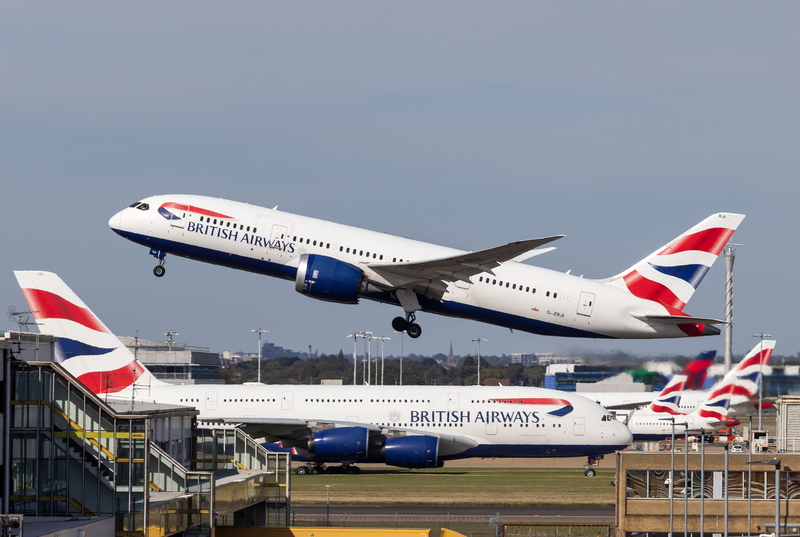
British Airways has expanded and extended its schedule disruption across the Gulf and wider Middle East as ongoing conflict and airspace instability continue to affect one of the world’s most sensitive aviation regions.

But one important correction is needed at the outset: British Airways’ current official travel notice does not say Dubai flights are canceled until June. As of the airline’s latest published advisory, flights to and from Dubai International Airport (DXB), Doha Hamad International Airport (DOH), Bahrain International Airport (BAH), Amman Queen Alia International Airport (AMM), and Tel Aviv Ben Gurion Airport (TLV) are suspended until later this month, while Abu Dhabi Zayed International Airport (AUH) remains suspended until later this year.
That distinction matters, especially in a market where airline schedules are changing rapidly and passenger decisions are being shaped by every new operational update.
Read our stories in your inbox
Two aviation newsletters. Zero fluff.
British Airways Is Cutting Back Across The Region, Not Just Dubai
The current disruption is much broader than one route.
British Airways has temporarily reduced its flying across several Middle East markets, reflecting the reality that airlines are now planning around both immediate security concerns and the unpredictability of regional airspace access. Dubai (DXB) is one of the most high-profile suspended routes, but it sits within a larger pattern that also includes Bahrain (BAH), Amman (AMM), Doha (DOH), Tel Aviv (TLV), and Abu Dhabi (AUH).
That wider context is important because it shows British Airways is not responding to a single airport event in isolation. It is responding to an operating environment that has become materially less stable across the Gulf and surrounding region.
Dubai’s Situation Helps Explain The Caution
British Airways’ caution on Dubai is not difficult to understand.
Dubai International Airport (DXB) recently suffered a major disruption after a drone strike caused a fire near airport fuel infrastructure, forcing a temporary suspension of operations and a wave of diversions and cancellations. Even though flights later resumed, the incident underlined how exposed major Gulf aviation hubs have become to low-cost, high-impact attacks.

For airlines, the issue is not only whether one airport can reopen after a disruption. It is whether the route can be operated with enough predictability to protect passengers, crew, aircraft, and onward schedules. In the current environment, that answer is clearly still unstable enough for BA to keep a cautious stance.
Abu Dhabi Stands Apart
The most striking part of the British Airways schedule picture may actually be Abu Dhabi (AUH).
While Dubai (DXB), Doha (DOH), Bahrain (BAH), Amman (AMM), and Tel Aviv (TLV) are currently listed as suspended until later this month, Abu Dhabi remains off the board until later this year. That suggests BA sees AUH not simply as another temporarily impaired route, but as a market where restoration may take significantly longer.
That is notable because it creates a much sharper difference in treatment between major Gulf destinations than travelers might expect from the outside.
Riyadh And Jeddah Remain On The Map
One of the more revealing aspects of British Airways’ regional response is what has not been canceled.
Flights to King Khalid International Airport (RUH) in Riyadh and King Abdulaziz International Airport (JED) in Jeddah are continuing as planned. That says a great deal about how airlines are now segmenting the region operationally. The Gulf and Middle East are not being treated as one uniform risk zone. Instead, carriers are making more selective route-by-route judgments based on airspace, airport exposure, and local operating conditions.
For readers in the industry, that is a much more useful way to understand the current wave of cancellations than broad regional language alone.
The Broader Pattern Is Industry-Wide
British Airways is far from alone in taking this approach.
Carriers across Europe and Asia have been extending suspensions, rerouting flights, or reducing schedules as the conflict continues to disrupt normal operating assumptions in the Gulf. The regional map has become highly fluid, with airports in the United Arab Emirates and elsewhere facing temporary closures, reduced service windows, and heightened operating uncertainty.
That means BA’s decision should be viewed less as an outlier and more as part of a wider industry recalibration.
Passengers Still Have Some Flexibility
British Airways says affected customers can change bookings or seek alternatives through the current disruption period.
That is an important practical point. In a situation like this, schedule changes are not only about whether a flight is canceled. They are also about whether passengers have enough flexibility to avoid being stranded by a route that may remain technically available one day and unavailable the next. In that sense, rebooking options are now almost as important as the raw schedule itself.
Bottom Line
British Airways has widened its Middle East and Gulf disruption, but the claim that Dubai flights are canceled until June overstates the airline’s current official position.
As of its latest published travel advisory, British Airways has suspended flights to Dubai (DXB), Doha (DOH), Bahrain (BAH), Amman (AMM), and Tel Aviv (TLV) until later this month, while Abu Dhabi (AUH) remains suspended until later this year. Flights to Riyadh (RUH) and Jeddah (JED) are continuing.
For aviation readers, the key takeaway is that BA is not making a blanket retreat from the region. It is responding selectively to a rapidly changing operational environment, with Dubai’s recent disruption helping explain why the airline remains cautious even as some Gulf services continue.
Keep reading FlyMag
Get the Daily Brief in the morning or the Route Watch weekly recap on Fridays. Or both.