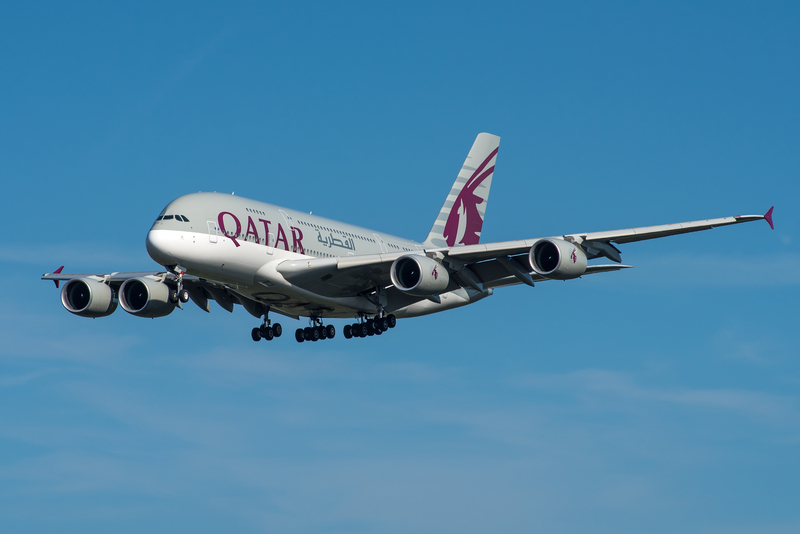
Qatar Airways (QR) is preparing for a rare, capacity-constraining maintenance window at its home hub, Hamad International Airport (DOH), confirming temporary network reductions during planned runway works in 2Q26.

From April 13 to June 13, 2026, DOH will operate with one runway instead of two, forcing airlines to keep schedules within a lower declared movement rate. For a banked hub like Doha—where tightly timed arrival and departure waves drive global connectivity—single-runway operations don’t just shave peak capacity. They reshape the entire “pulse” of the network.
What’s being repaired and why it matters
Hamad (DOH) was built with two parallel runways designed for simultaneous operations:
Read our stories in your inbox
Two aviation newsletters. Zero fluff.
-
RWY 16L/34R (4,850 m) — the airport’s longer runway and a cornerstone for heavy long-haul departures
-
RWY 16R/34L (4,250 m) — the companion runway supporting parallel arrivals/departures and peak-bank resilience
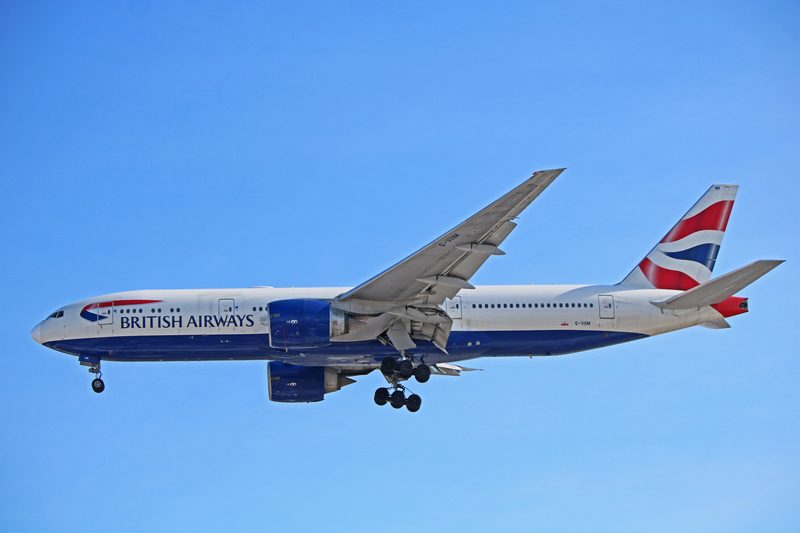
The current program focuses on the Eastern Runway (16L/34R), including concrete reconstruction at both ends, asphalt rehabilitation, and airfield ground lighting and drainage/electrical upgrades. The airport’s phasing notes that the final stage includes a full closure beginning April 13, with the airport remaining operational via the alternate runway—exactly the kind of project that is routine for airfield engineering, but disruptive for hub-and-spoke scheduling.
The size of the cut: where Qatar is pulling back
Qatar Airways says the changes are part of routine network planning aligned to the runway program, with the work scheduled to wrap up by early June—yet the single-runway operating window extends into mid-June, suggesting a buffer for reinstatement, testing, and slot normalization.
Data tracking for the schedule period indicates Qatar is planning an overall capacity reduction of about 8.2% between early April and early May, a timeframe that overlaps with the most operationally restrictive portion of the works.
The most notable reductions by market are concentrated on high-frequency trunk routes where a few daily frequencies can be trimmed quickly without eliminating the city:
-
Doha (DOH) – London Heathrow (LHR): down 4,818 weekly seats (about 22%) as weekly frequencies fall from 66 to 48
-
Doha (DOH) – Colombo Bandaranaike (CMB): down 2,267 weekly seats (about 27%) as service drops from 4x daily to 3x daily
-
Doha (DOH) – Paris Charles de Gaulle (CDG): down 2,025 weekly seats (about 20%) as service drops from 4x daily to 3x daily
These are exactly the kinds of routes you’d expect to absorb short-term runway constraints: multiple daily frequencies, strong baseline demand, and enough network elasticity to protect connections by retiming the remaining flights.
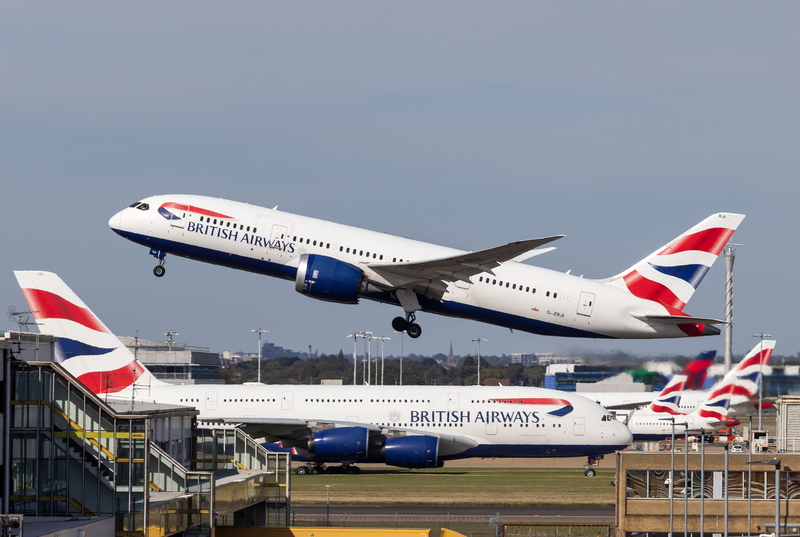
What airline ops teams will watch: banks, buffers, and upgauge strategy
A single-runway hub doesn’t just “lose flights.” It loses peak flexibility. In a normal two-runway environment, a late inbound bank can often be smoothed out with parallel sequencing and recovery. With one runway, that recovery bandwidth shrinks—so airlines usually respond in three ways:
1) De-peaking the hub
Instead of sharp arrival/departure waves, schedules get “stretched,” reducing the number of aircraft needing the runway within the same narrow time window. That protects on-time performance and reduces missed-connection spikes—at the cost of longer connection times in some markets.
2) Cutting frequency more than cutting cities
Dropping a DOH–CDG (CDG) fourth daily flight is often more operationally efficient than dropping an entire destination, because it preserves station presence, sales continuity, and connectivity—while still easing runway pressure.
3) Upgauging where possible
When frequencies are reduced, airlines often try to recover some seat capacity by swapping aircraft types on select departures—moving from an A330/787-sized departure to an A350 or 777 family aircraft, or consolidating demand into fewer, larger gauge flights. On routes like DOH–LHR (LHR), where Qatar historically deploys its largest widebodies, the carrier has more room than most to protect premium inventory and cargo while trimming frequency.
What this means for passengers connecting at Doha (DOH)
For travelers, the biggest effects will likely be felt in three areas:
-
Tighter availability and fuller loads on the remaining departures, especially on high-demand banks
-
More re-timings (same city pair, different departure times) as Qatar smooths peaks around the single-runway constraint
-
Higher misconnect sensitivity during irregular operations, because fewer daily frequencies can mean fewer same-day recovery options on some city pairs
For corporate travel and alliance itineraries, the more important detail is that Qatar is adjusting ahead of the maintenance window—meaning the airline is trying to bake reliability into the schedule rather than “fix it live” during the works.
Bottom Line
Qatar Airways is proactively trimming its global schedule to match a major airfield constraint at Doha Hamad International (DOH), which will operate on a single runway from April 13 to June 13, 2026 during planned maintenance. Early schedule data points to an ~8% capacity reduction in the peak constraint period, with the sharpest cuts on high-frequency trunk routes like London Heathrow (LHR), Colombo (CMB), and Paris CDG (CDG).
For a hub carrier built on tightly timed connection banks, this is less about headline flight cancellations and more about engineering a stable network under reduced runway throughput—cutting select frequencies, retiming banks, and preserving the long-haul spine of the operation while DOH’s runway program reaches completion.
Keep reading FlyMag
Get the Daily Brief in the morning or the Route Watch weekly recap on Fridays. Or both.