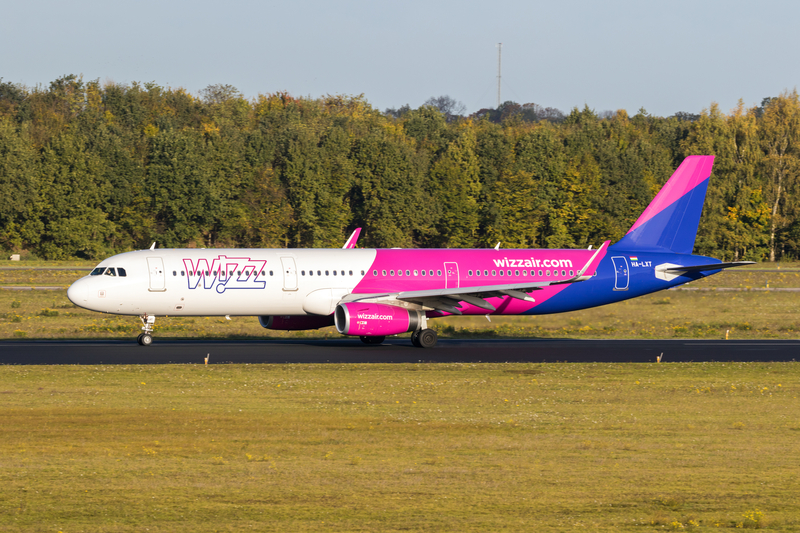
Wizz Air’s name has popped up in U.S. regulatory circles again—and on the surface, it’s the kind of filing that normally precedes headline-making new routes. In reality, the ultra-low-cost carrier is laying groundwork rather than launching a scheduled network.

The request was submitted by Wizz Air UK, the group’s U.K.-based operator, to the U.S. Department of Transportation (DOT) for authority to operate between the United Kingdom and the United States. The language in filings like these is often broad (“as soon as possible” is common), because the goal is to get the legal permission in place first—then decide which specific flying opportunities are worth executing.
Management has since been explicit: this is not a pivot into regular transatlantic service. The filing is designed to keep charter flying on the table for a narrow set of high-demand events—most notably the 2026 FIFA World Cup.
Read our stories in your inbox
Two aviation newsletters. Zero fluff.
Charter flying is a very different beast than scheduled transatlantic service
In airline planning terms, the charter vs. scheduled distinction is the entire story.
A scheduled route commitment means:
-
published frequencies that customers can rely on for months,
-
long-term station setup at U.S. airports,
-
and a commercial strategy resilient enough to survive the ugly weeks (weather, ATC, maintenance, demand dips).
Charters can be far more surgical. They’re typically:
-
time-limited,
-
tied to an event window,
-
and often contracted or packaged through tour operators, sports organizations, sponsors, or corporate groups.
That makes charters an attractive way to test long-haul operational capability without building an entire transatlantic business model. If the economics don’t work, you stop flying and walk away—without the reputational damage of “route cancellations” and stranded crews and assets.
The aircraft question: narrowbody long-haul is possible, but it’s not plug-and-play
Wizz Air is fundamentally an Airbus A320-family carrier. That matters because the economics and the passenger proposition are both shaped by narrowbody realities.
For a U.K.–U.S. charter, the practical aircraft discussion centers on two scenarios:
Airbus A321neo (A21N)
Wizz operates the A321neo in high-density layouts across Europe and into longer sectors to North Africa and the Middle East. It’s efficient, but pushing it across the North Atlantic is not the same as flying within Europe. Range, alternates, winds, payload, and diversion planning become much less forgiving.
Airbus A321XLR (A21XLR)
The XLR is the platform that makes “narrowbody transatlantic” genuinely viable at scale, particularly on U.K. gateways to the U.S. East Coast (think New York-area airports like Newark (EWR) and JFK (JFK), Boston (BOS), or even Philadelphia (PHL) depending on wind and payload assumptions). But even with XLR capability, the operation still requires robust ETOPS planning, crew training, and contingency support.
The bigger point: Wizz can file paperwork today, but the operational readiness is what determines whether it can actually run charters reliably—especially during a summer peak where aircraft utilization is already tight.
Why the World Cup creates a real niche for “one-off” U.K.–U.S. flights
The 2026 FIFA World Cup is spread across 16 host cities in three countries, and that geographic sprawl is a demand multiplier. The event footprint is expected to drive travel surges into major gateways like:
-
New York/New Jersey (EWR/JFK)
-
Los Angeles (LAX)
-
Miami (MIA)
-
Dallas (DFW)
-
Houston (IAH)
-
Atlanta (ATL)
-
Seattle (SEA)
-
San Francisco Bay Area (SFO)
-
Boston (BOS)
-
Philadelphia (PHL)
-
Kansas City (MCI)
Even if Wizz’s DOT authority focuses on U.S.–U.K. flying, the World Cup creates classic charter conditions: short booking windows, concentrated peaks around matchdays, and customer groups willing to prioritize price and nonstop convenience over a full-service widebody cabin.
Why this move fits Wizz’s post–Middle East reset
Wizz’s leadership has been clear that this is an opportunistic play, not a strategic transatlantic rollout. That lines up with where the company is in 2026: the group has been recalibrating after its Abu Dhabi (AUH) venture ended, and it’s operating under ongoing fleet and maintenance constraints.
There’s also a pragmatic angle: when you’re dealing with operational headwinds—especially high utilization and maintenance complexity—charters can be a smart way to generate incremental revenue without committing to year-round station costs and long-term market exposure.
The real gate isn’t demand—it’s approvals, ops specs, and station capability
Even “just charters” into the U.S. aren’t casual. A U.K. carrier still needs the full stack to line up:
-
DOT economic authority for the intended operation type (charter vs. scheduled)
-
FAA operational approvals applicable to the aircraft and mission profile
-
TSA security programs and station-level compliance
-
U.S. airport handling readiness (turn capability, contingency support, irregular ops planning)
That’s why filings like this often appear months before any real flying. The paperwork is the first step; the hard part is building an operation that doesn’t crack the first time a flight diverts, times out, or needs a part at an outstation.
Bottom Line
Wizz Air’s U.S. filing is best read as strategic optionality, not a declaration of scheduled transatlantic intent. By pursuing DOT authority via Wizz Air UK, the carrier is positioning itself to run limited, event-driven charter flights—with the 2026 FIFA World Cup as the obvious demand catalyst—while avoiding the massive commercial and operational commitments that have historically punished low-cost transatlantic experiments. If you see a Wizz tail at EWR, JFK, or BOS, don’t assume “new route.” Assume “windowed opportunity”—and a carrier trying to monetize peaks without buying the whole market.
Keep reading FlyMag
Get the Daily Brief in the morning or the Route Watch weekly recap on Fridays. Or both.