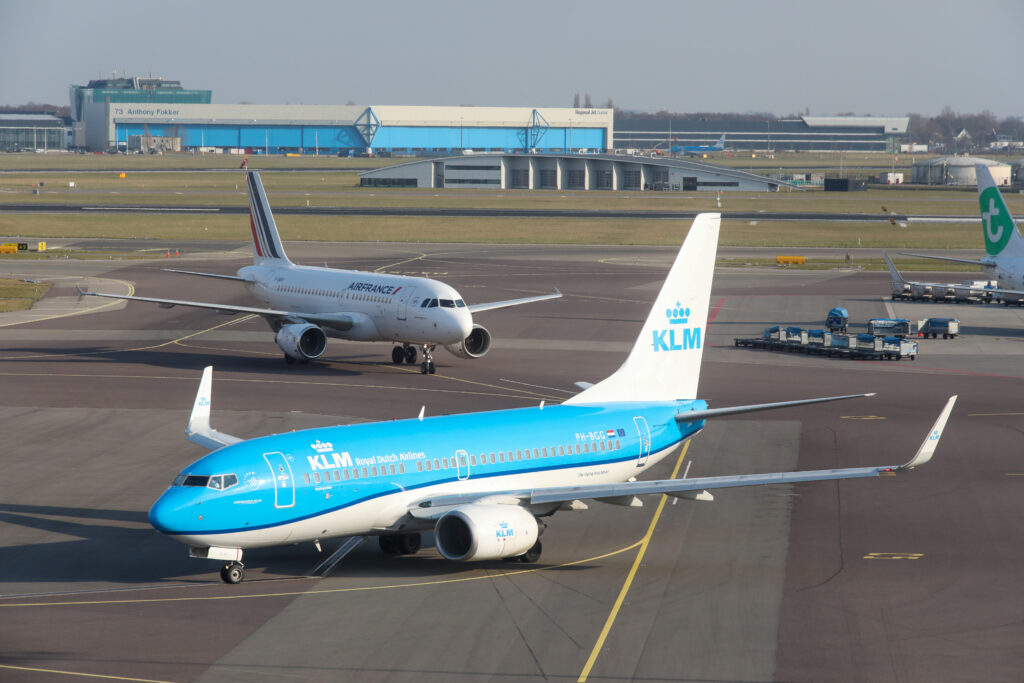
KLM is flipping a meaningful switch on its intra-European product: free onboard Wi-Fi across its European flying, starting January 22, 2026. For an airline that moves massive connecting flows through Amsterdam Schiphol (AMS) on tight banks and short stage lengths, “free internet” isn’t just a passenger perk—it’s a network utility. If you can keep customers connected gate-to-gate on the short segments that feed long-haul, you reduce friction across the whole journey.
KLM’s move is also notable because it’s positioned as unlimited internet access after passengers log in or sign up for Flying Blue (which can be done on the spot). And unlike some “free Wi-Fi” rollouts that really mean messaging-only, KLM is explicitly talking about browsing, email, music, and even streaming during the flight.
Read our stories in your inbox
Two aviation newsletters. Zero fluff.
What KLM Is Actually Launching (and How Access Works)
As of January 22, 2026, KLM says passengers traveling within Europe can use free Wi-Fi for the duration of the flight. Access is tied to Flying Blue: log in with your account or register onboard, then you’re online.
That choice matters operationally. Airlines increasingly bundle connectivity with loyalty because it’s a clean way to authenticate users, simplify the onboard purchase flow, and reduce payment-friction at 35,000 feet. It also aligns with the way many carriers are reframing connectivity—from an ancillary sale to a retention tool.
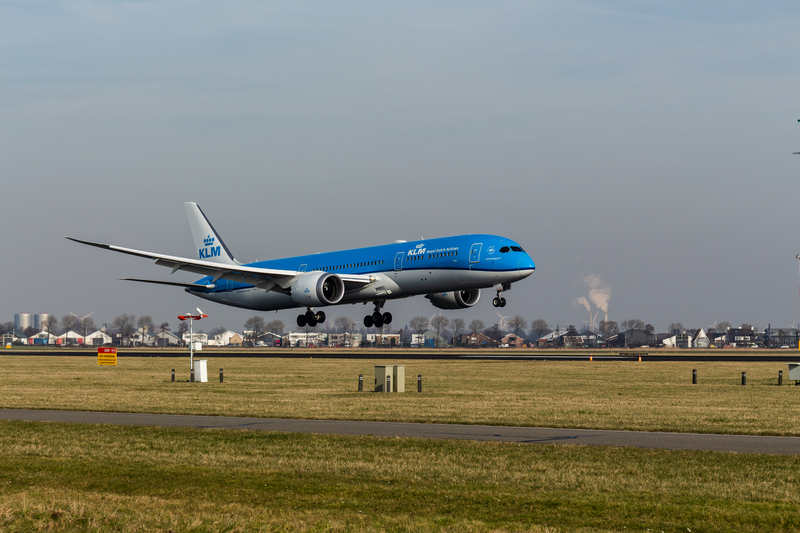
KLM is rolling the product out in phases, with about half of its European fleet enabled at launch, and broader coverage expanding over time.
Fleet Rollout: Which Aircraft Get Free Wi-Fi First
KLM’s European flying is a mix of mainline narrowbodies and regional jets, and the free Wi-Fi plan follows that footprint:
-
Airbus A321neo (KLM mainline): KLM says Wi-Fi will be available across the A321neo fleet as the rollout matures. The A321neo is already positioned as a cornerstone of KLM’s European renewal. In KLM’s configuration, the A321neo seats up to 227 passengers, with a 3–3 layout and “Europe Business Class” achieved via blocked middle seats—exactly the kind of high-density, high-frequency platform where connectivity usage can spike quickly on peak business departures out of Amsterdam (AMS).
-
Embraer 195-E2 (KLM Cityhopper): These jets are increasingly central to the “right gauge” strategy—especially on thinner routes and off-peak frequencies that still need schedule integrity into Amsterdam (AMS). KLM lists the E195-E2 at up to 132 passengers in its cabin layout, with 2–2 seating (no middle seat), and a published maximum range of 4,815 km—plenty for the far edges of KLM’s European map.
-
Boeing 737-800: KLM says a portion of the 737-800 fleet will be included. In KLM’s published aircraft details, the 737-800 seats up to 186 passengers and currently shows Wi-Fi as available “partly,” which lines up with the idea of selective equipage and phased activation.
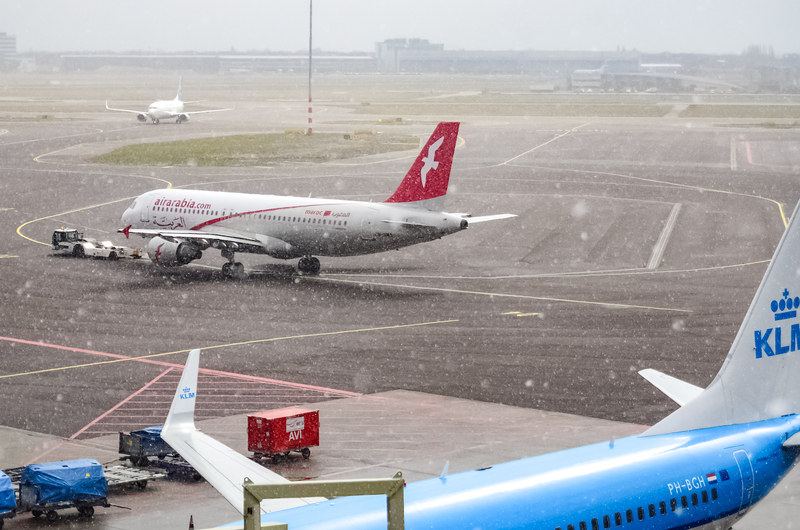
From a passenger experience standpoint, this aircraft mix is exactly where free Wi-Fi is most visible: short block times, high phone-dependence, and customers who increasingly assume connectivity is part of the fare—especially when traveling via a major hub like Amsterdam (AMS).
Why This Matters More for KLM Than Many Other Airlines
KLM’s European fleet typically does not have seatback entertainment screens, which makes the onboard internet proposition feel less like an add-on and more like “the entertainment layer.” When there’s no embedded IFE to fall back on, reliable connectivity becomes the product: messaging, music, streaming, work tools, and real-time trip management all live on the passenger’s device.
That’s especially relevant at Amsterdam (AMS), where a big portion of the customer base is connecting—often with tight turn times and multiple flight numbers on one itinerary. Free internet is one of those upgrades that quietly improves irregular-operations resilience: passengers can rebook faster, communicate with ground handlers or colleagues, and receive real-time updates without fighting captive portals and payment steps.
The Aircraft Angle: Why the A321neo and E195-E2 Are Good Platforms for Connectivity
KLM’s fleet renewal isn’t just about fuel burn and noise. It’s also about bringing more consistent cabin infrastructure across the European operation—power at the seat, modern cabin lighting, and a baseline that supports a more digital passenger journey.
Airbus A321neo: High-Capacity Short-Haul With “New Engine Option” Economics
KLM’s A321neo is explicitly part of its Boeing 737 replacement strategy on European routes, and the airline notes the “neo” designation as “new engine option,” tied to lower CO₂ output versus predecessors. In KLM’s own published spec, the aircraft offers USB-C power and onboard Wi-Fi capability—exactly what frequent flyers want on 60–150 minute sectors out of Amsterdam (AMS). KLM also indicates it expects around 13 A321neos by the end of 2025, underscoring how quickly this type is becoming the dominant narrowbody for intra-Europe flying.
At the manufacturer level, the A321neo is widely used across the industry as a high-density European workhorse, typically seating in the 180–220 range in two-class layouts (and higher in dense configurations). That capacity makes connectivity harder to deliver consistently (more simultaneous users), but it also makes the customer payoff bigger when it works.
Embraer 195-E2: No Middle Seat, Strong Range, and the “Right Gauge” Sweet Spot
On the KLM Cityhopper side, the Embraer 195-E2 is a different kind of tool: right-sized capacity with a cabin that naturally feels more premium because of the 2–2 layout. KLM’s own numbers put it at 132 seats, and the published cruise speed is 876 km/h, which is more than adequate for keeping bank structures intact into Amsterdam (AMS) while maintaining passenger comfort.
For connectivity, the E195-E2 is also a practical platform because it blends regional operations with “mainline-like” expectations: business travelers don’t treat it like a compromise aircraft anymore. Free Wi-Fi helps reinforce that perception.
Boeing 737-800: A Transitional Fleet, Getting the Upgrade Where It Counts
KLM’s 737-800 is still a core European aircraft type, but it’s increasingly transitional in a fleet that’s moving toward the A321neo and eventually A320neo. KLM lists the 737-800 with Wi-Fi only “partly” available today, and power availability that varies by aircraft and cabin. Selectively enabling free Wi-Fi on part of this fleet is a pragmatic move: focus investment on frames scheduled on the most commercially sensitive rotations to and from Amsterdam (AMS), while the A321neo fleet expands.
The Competitive Subtext: Free Wi-Fi Is Becoming the New Baseline
KLM isn’t making this move in a vacuum. Across Europe, airlines and airline groups are accelerating connectivity upgrades, and the definition of “good Wi-Fi” is shifting from “works for email” to “supports streaming and real work.” KLM’s announcement is best read as a signal that the era of paid, tiered short-haul Wi-Fi in Europe is starting to break—especially when loyalty login can make “free” economically viable.
Bottom Line
KLM’s decision to introduce free Wi-Fi on European flights starting January 22, 2026 is more than a passenger-friendly headline. For an airline built around connecting flows through Amsterdam Schiphol (AMS), it’s a network-quality investment: fewer pain points on feeder segments, a stronger digital experience on aircraft without seatback screens, and a loyalty-tied model that simplifies access while nudging Flying Blue enrollment.
With phased activation across roughly half the European fleet at launch—and longer-term coverage planned for the A321neo fleet, the Embraer 195-E2 fleet, and part of the 737-800 fleet—KLM is effectively turning connectivity into a core short-haul product feature, not an optional extra.
Keep reading FlyMag
Get the Daily Brief in the morning or the Route Watch weekly recap on Fridays. Or both.