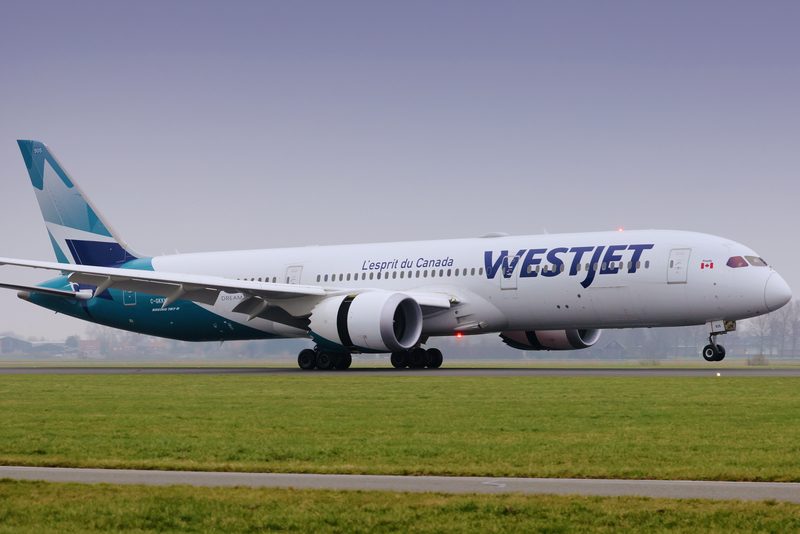
WestJet (WS) has adjusted its Boeing order mix in a way that says more about network strategy than raw aircraft counts. The airline confirmed it has converted six Boeing 737-10 orders into two Boeing 787-9 Dreamliners, increasing its firm 787-9 pipeline from seven to nine while retaining four 787-9 options.

On paper, swapping six narrowbodies for two widebodies looks like a simple reshuffle. In practice, it’s a signal that WestJet wants more long-haul “metal” available to deploy—particularly as it continues to build out international flying anchored by its largest hub at Calgary International Airport (YYC).
The orderbook math, and why it matters operationally
WestJet already operates seven 787-9s. With nine now on firm order and four options still available, the airline has a clear pathway back to a 20-aircraft Dreamliner footprint—the same scale implied by its original 787 agreement nearly a decade ago.
Read our stories in your inbox
Two aviation newsletters. Zero fluff.
That history is worth revisiting because it frames why WestJet is comfortable recommitting to the 787: in 2017, the airline signed for 10 firm 787-9s plus 10 options. Seven aircraft ultimately entered service, and the remaining commitments were later canceled. This week’s conversion effectively reopens the door to the original long-haul growth runway—only now under a very different market reality, where widebody capacity and long-haul aircraft utilization can make or break an airline’s seasonal profitability.
From a planning standpoint, the jump from “seven in service” toward a fleet that could realistically sit in the low-to-mid teens is where the widebody operation becomes more resilient. A seven-ship widebody fleet has very little slack: one aircraft down for heavy maintenance or an AOG event can force network-wide schedule compromises. Two additional 787-9s don’t just add seats—they add schedule protection, maintenance flexibility, and launch capacity for new routes without robbing Peter to pay Paul.
Why trade 737-10s for 787-9s?
A Boeing 737-10 and a Boeing 787-9 are not interchangeable assets, and that’s exactly the point.
The 737-10 is intended to be WestJet’s highest-capacity 737, optimized for dense North American flying—high-frequency domestic trunks, transborder peaks, and leisure routes where seat-mile economics matter more than range. The 787-9, by contrast, is a true long-haul tool: it allows WestJet to scale intercontinental flying from YYC (and other gateways like Toronto Pearson (YYZ) and Halifax Stanfield (YHZ)) with a cabin and cargo profile that simply can’t be replicated with a narrowbody.
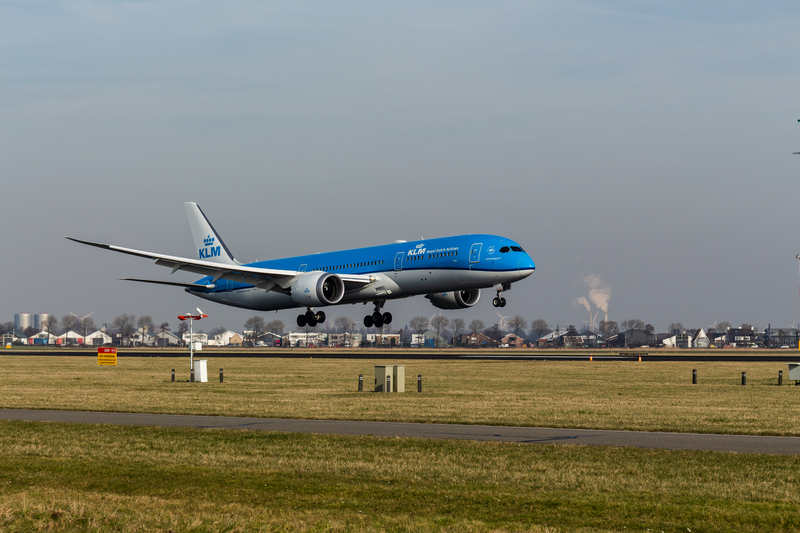
WestJet’s own published 787-9 configuration is 320 seats—16 Business, 28 Premium, and 276 Economy—powered by GE GEnx engines. That cabin mix is telling. It’s built to win on unit costs in Economy while still carrying enough premium inventory to monetize long-haul demand when it exists. In the real world, that means the 787 can be pointed at routes where WestJet needs both high seat count and high stage-length efficiency—the kind of missions where a narrowbody would either be range-limited, payload-restricted, or simply uncompetitive on passenger experience.
There’s also a timing and risk dimension: the 737-10 remains tied to certification milestones, and airlines are still building their fleet plans around uncertainty on the exact entry-into-service window. Converting a portion of narrowbody orders into widebodies gives WestJet a hedge—more flexibility to grow internationally even if the MAX 10 schedule slides.
The 737-10 cabin pivot: four lavatories becomes the first “locked-in” spec
Alongside the order conversion, WestJet also confirmed a notable cabin decision for its incoming 737-10s: the aircraft will feature four lavatories.
For airline people, that detail is more than a comfort footnote. Lavatory count affects:
-
boarding and deplaning flow (especially during tight turns)
-
galley and monument placement, which can drive trade-offs in seat count or service space
-
crew workload and aisle congestion on high-load factors
-
reliability at outstations, where lav servicing can become a turn-time constraint
Earlier internal concepts for the MAX 10 reportedly leaned toward a 12-seat premium section and a ~200-seat economy cabin, which would have been an aggressive lavatory ratio for a single-aisle operating longer sectors at high utilization. WestJet has since referenced a 199-seat direction, but it has not finalized the full layout. What it has done is lock in the one change that tends to matter most when flights go full: more lav capacity, fewer pinch points, and a better chance of keeping the cabin moving smoothly during the busiest phases of flight.
This also lands in the context of WestJet’s recent cabin-strategy recalibration across parts of its 737 fleet—where the airline has shown it is willing to adjust decisions when passenger experience and frontline feedback collide with densification goals.
What to watch next
Two things will tell the real story of this move:
First, delivery timing. If WestJet can align 787-9 deliveries with its next long-haul growth wave, those aircraft become immediate network enablers. If delivery slots push later, they become longer-term fleet insurance.
Second, how the MAX 10 ultimately emerges. Four lavatories is a meaningful clue that WestJet is threading a needle between economics and usability. The rest of the layout—premium seat count, extended comfort footprint, galleys, and seat pitch strategy—will determine whether the 737-10 becomes a pure high-density workhorse or a more balanced product designed to protect yields on longer domestic and transborder sectors from YYC.
Bottom Line
WestJet’s decision to convert six 737-10 orders into two 787-9 Dreamliners is a small change with big implications. It increases the airline’s widebody bench from a tightly constrained seven-aircraft operation toward something that can better absorb maintenance, disruptions, and seasonal redeployments—especially as WestJet continues building long-haul flying out of Calgary (YYC).
Just as notable, WestJet’s confirmation of four lavatories on the 737-10 is an early indicator that the airline is applying hard lessons from recent cabin debates: efficiency still matters, but so does keeping a 200-seat single-aisle functional for crews and tolerable for passengers.
Keep reading FlyMag
Get the Daily Brief in the morning or the Route Watch weekly recap on Fridays. Or both.