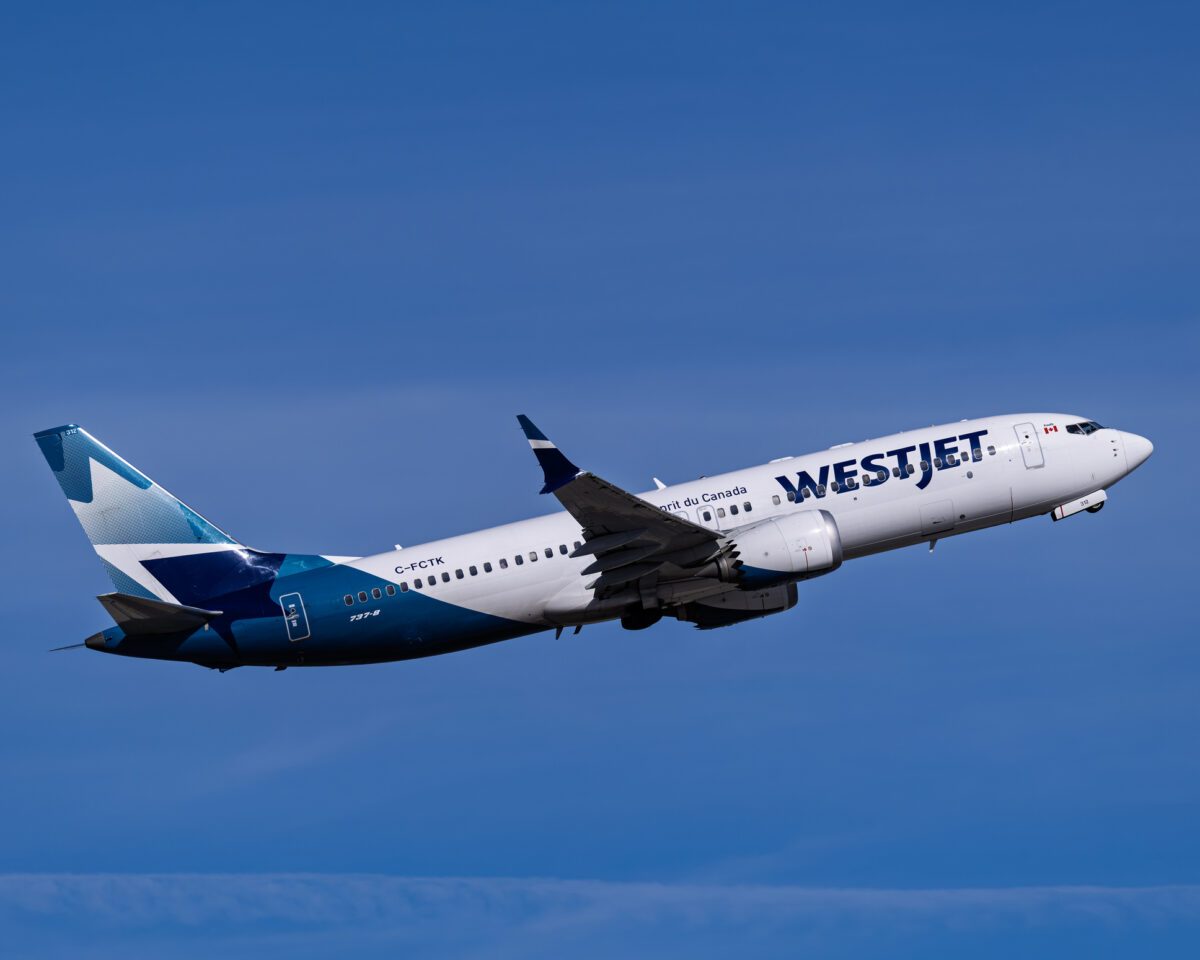
WestJet is facing the possibility of a major summer operational disruption after its mainline flight attendants delivered an almost unanimous mandate authorizing strike action.

The Canadian Union of Public Employees Local 8125, which represents approximately 4,400 WestJet flight attendants, said 97.3% of eligible members participated in the vote. Of those who cast ballots, 99.4% supported giving the union authority to call a strike.
The result provides the bargaining committee with considerable leverage, but it does not mean WestJet flights have been canceled or that a strike will definitely occur.
Read our stories in your inbox
Two aviation newsletters. Zero fluff.
The 21-day federal cooling-off period must first expire. CUPE says its members could legally begin a strike as early as Sunday, August 2, 2026, provided the union gives WestJet and Canada’s labor minister at least 72 hours’ notice and satisfies the remaining requirements under the Canada Labour Code. WestJet will gain the corresponding right to lock out the flight attendants on the same date. (CUPE)
No strike date or 72-hour strike notice has been announced. WestJet and CUPE can continue negotiating throughout the cooling-off period and after both sides enter a legal strike or lockout position.
What the Strike Vote Actually Means
A strike-authorization vote allows union leaders to call a work stoppage if they conclude that further negotiations cannot produce an acceptable agreement.
It does not require the union to strike. The mandate can instead be used to increase pressure on the company during negotiations.
CUPE opened voting on July 8 and released the results on July 15. Based on the union’s reported membership and turnout, approximately 4,280 flight attendants cast ballots, with roughly 4,250 supporting strike authorization.
The union says the result demonstrates unusually strong support for its bargaining priorities, particularly compensation for duties completed before and after the period traditionally treated as paid flight time. CUPE has also identified wages, scheduling, work-life balance, and broader workplace conditions as major issues.
The relevant timeline is:
| Date | Bargaining Development |
|---|---|
| September 16, 2025 | CUPE serves notice to bargain |
| December 31, 2025 | Previous collective agreement expires |
| April 27, 2026 | CUPE files a notice of dispute with the federal labor minister |
| July 11, 2026 | Federally assisted conciliation concludes |
| July 15, 2026 | CUPE announces a 99.4% strike mandate |
| August 2, 2026 | Earliest possible legal strike or employer lockout |
The expired collective agreement remains subject to a statutory freeze while bargaining continues. WestJet flight attendants therefore remain at work under the existing terms unless the parties reach a new agreement or a legal work stoppage begins.
Under federal law, a strike mandate normally remains valid for 60 days. The union could conduct another vote if the bargaining process continues beyond that period without an agreement.
August 2 Is the Earliest Date, Not a Confirmed Strike Date
Canada’s federally regulated bargaining process requires several steps before airline employees can legally walk off the job.
WestJet’s 2026 International Expansion Adds Europe, South America And More Sun Flying
After receiving a notice of dispute, the federal labor minister appoints a conciliation officer. The normal conciliation period lasts 60 days unless the parties agree to an extension. Once conciliation ends, a mandatory 21-day cooling-off period begins.
A legal strike or lockout can occur only after:
- The cooling-off period has expired.
- The union has obtained a valid strike mandate.
- A maintenance-of-activities agreement has been filed or the Canada Industrial Relations Board has issued a decision.
- The initiating party has provided at least 72 hours’ written notice.
The maintenance-of-activities process determines whether any work must continue to prevent an immediate and serious danger to public health or safety. It does not ordinarily require an airline to preserve its normal passenger schedule simply because cancellations would inconvenience travelers.
To begin a strike at the earliest possible time on August 2, CUPE would generally need to issue its 72-hour notice on or around July 30, depending on the exact proposed starting time.
WestJet could also issue a lockout notice. A lockout would prevent bargaining-unit employees from working and could have substantially the same effect on the flight schedule as a strike.
Why a Flight Attendant Strike Could Ground Most WestJet Flights
Flight attendants are required safety crew members rather than optional onboard service employees.
Canadian Aviation Regulations require airlines to operate passenger aircraft with a minimum number of qualified flight attendants. The required complement depends on the aircraft’s approved evacuation configuration and either the number of passengers carried or the number of installed passenger seats.
WestJet has historically operated its Boeing 737 fleet under an authorization requiring at least one flight attendant for each unit of 50 passenger seats, although the final crew requirement for an individual aircraft can also be affected by its certification and evacuation demonstration. (Canadian Aviation Regulations)
WestJet’s current mainline passenger fleet includes:
| Aircraft | Published Capacity | Approximate Regulatory Minimum Based on One Per 50 Seats |
| Boeing 737-700 | 132 passengers | Three flight attendants |
| Boeing 737-800 | 174 passengers in the standard configuration | Four flight attendants |
| Boeing 737 MAX 8 | 174 passengers in the standard configuration | Four flight attendants |
| Boeing 787-9 Dreamliner | 320 passengers | At least seven, subject to the aircraft’s certified complement |
WestJet’s published specifications list 132 seats on the Boeing 737-700, 174 on its standard Boeing 737-800 and 737 MAX 8 layouts, and 320 on the Boeing 787-9 Dreamliner. (WestJet’s aircraft fleet)
The airline cannot legally operate those aircraft with passengers if it does not have the required qualified cabin crew.
Pilots cannot replace the flight attendants because they have separate duties, qualifications, training requirements, and assigned emergency positions. Airport customer-service employees or newly hired temporary workers could not simply be placed aboard an aircraft without completing the airline’s approved initial training and qualification process.
Federal legislation that took effect in June 2025 also generally prohibits federally regulated employers from using replacement workers to perform bargaining-unit work during a legal strike or lockout, subject to limited public-health and safety exceptions. That makes it considerably more difficult for an airline to maintain a meaningful schedule during a cabin crew strike.
The Vote Covers WestJet Mainline Flight Attendants
The strike mandate applies to WestJet’s mainline flight attendants represented by CUPE 8125.
Those employees crew the airline’s Boeing 737 and Boeing 787 passenger operations, including domestic Canadian flights, transborder services to the United States, vacation routes to Mexico and the Caribbean, and long-haul flights from Calgary International Airport (YYC).
WestJet Encore has a separate operating certificate, fleet, and collective-bargaining process. Its regional services use De Havilland Canada Dash 8-400 turboprops rather than WestJet mainline’s Boeing aircraft.
Encore flight attendants are also represented within CUPE’s WestJet structure, but they are negotiating a separate collective agreement. The July 15 result concerns the WestJet mainline bargaining unit.
Encore flights would not necessarily be included in a mainline flight attendant strike. However, the regional airline feeds passengers into WestJet’s larger network at airports including Calgary International Airport (YYC), Vancouver International Airport (YVR), Edmonton International Airport (YEG), and Toronto Pearson International Airport (YYZ).
Even if individual Encore services continued, many passengers could lose their onward mainline connections. WestJet might consequently reduce regional flights to avoid carrying customers into hubs where their connecting services were canceled.
WestJet Would Need Time to Shut Down Its Network
A potential WestJet shutdown would likely begin affecting passengers before the official strike or lockout time.
Airlines do not generally operate a full schedule until the final minute and then leave aircraft, passengers, and crews wherever they happen to be when a strike begins.
WestJet would need to consider:
- Returning aircraft to Canadian maintenance and operating bases
- Avoiding stranding Boeing 787-9s and crews at overseas airports
- Bringing flight attendants back to their home bases
- Canceling outbound flights whose return sectors would operate after the deadline
- Protecting aircraft requiring scheduled maintenance
- Rebooking or repatriating passengers already away from home
- Positioning airplanes for an eventual restart
Long-haul flights could be among the earliest affected because a single Boeing 787-9 rotation may keep an aircraft and crew outside Canada for more than 24 hours.
A Dreamliner departing Calgary International Airport (YYC) shortly before a strike deadline could arrive in Europe or Asia after the work stoppage had begun. WestJet would then need a legally available cabin crew to operate the return flight.
The same issue applies to longer Boeing 737 services to Hawaii, Mexico, Central America, and the Caribbean, although their rotations generally return to Canada more quickly.
WestJet has not published a strike-contingency schedule or identified which flights it would cancel first. Any advance shutdown sequence therefore remains an operational expectation rather than a confirmed plan.
Calgary Would Face the Largest Network Impact
WestJet’s operation is particularly concentrated at Calgary International Airport (YYC), where the airline connects domestic, transborder, leisure, and intercontinental services.
A mainline shutdown would also have significant consequences at:
- Toronto Pearson International Airport (YYZ)
- Vancouver International Airport (YVR)
- Edmonton International Airport (YEG)
- Winnipeg Richardson International Airport (YWG)
- Montréal-Trudeau International Airport (YUL)
- Halifax Stanfield International Airport (YHZ)
Calgary International Airport (YYC) would face the most complicated recovery because it hosts WestJet’s principal connecting operation and Boeing 787 network.
A cancellation from a smaller Canadian city may affect one point-to-point market. A cancellation at Calgary can break dozens of itineraries involving passengers connecting between domestic, U.S., vacation, and long-haul flights.
The airline would also face limited rebooking capacity. Air Canada, Porter Airlines, Flair Airlines, U.S. carriers, and international partners could absorb some passengers, but August is part of Canada’s peak summer travel season. Available seats would likely disappear quickly if WestJet canceled a substantial portion of its schedule.
Pay for Ground Duties Is the Central Dispute
CUPE’s most visible bargaining demand concerns payment for duties performed while an aircraft is on the ground.
Flight attendants traditionally receive much of their compensation through a credit-hour or block-hour system. Under a conventional block-hour structure, the primary hourly calculation is linked to the time between the aircraft leaving the departure gate and arriving at the destination gate.
Cabin crew responsibilities begin well before the aircraft moves.
Flight attendants must report for duty, attend briefings, inspect emergency and safety equipment, check the cabin, review passenger and operational information, prepare for boarding, assist travelers, monitor baggage placement, and confirm that the cabin is secure before departure.
After arrival, they supervise deplaning, respond to passenger issues, inspect the cabin, complete reports, and may remain with travelers during ground delays or irregular operations.
CUPE characterizes much of that period as unpaid work and says Canadian flight attendants perform an average of approximately 35 hours of uncompensated ground duties each month. The union wants WestJet employees to be paid explicitly for all time spent performing required work.
WestJet disputes that description.
The airline says its credit-hour compensation system was developed through collective bargaining and is structured to compensate employees for the complete job, including both flight and ground duties. It points to minimum monthly guarantees, premiums, profit sharing, retirement contributions, and other forms of compensation that are not necessarily represented by the block-hour rate alone.
WestJet CEO Alexis von Hoensbroech has called the assertion that attendants perform 35 unpaid hours each month an incorrect characterization, arguing that the contractual hourly rate and credit system are designed to cover more than one clock hour of work.
The two sides are therefore disputing both the amount of compensation and the structure used to describe it.
CUPE wants ground duties separately recognized and paid. WestJet maintains that those duties are already incorporated into the negotiated compensation model.
WestJet’s Minimum-Wage Audit Did Not Resolve the Dispute
WestJet and WestJet Encore completed minimum-wage compliance self-audits at the request of Canada’s Labour Program.
WestJet reviewed a sample of 40 junior mainline cabin crew members, while Encore reviewed 15 employees. The airline reported a 99% compliance rate during the May 2025 through January 2026 audit period.
WestJet said the small number of discrepancies generally involved employees modifying their originally assigned schedules in ways that created a minimum-wage issue. The company agreed to issue corrective payments where required.
The audit did not settle the larger collective-bargaining debate.
Minimum-wage compliance asks whether an employee’s total qualifying compensation divided by applicable working time meets the legal wage floor. CUPE is seeking a contractual right to be paid separately and transparently for every required duty period, potentially at or near the employee’s regular hourly flight rate.
An airline can therefore comply with federal minimum-wage requirements while the union continues to argue that the compensation system undervalues or obscures ground work.
The Air Canada Strike Changed the Bargaining Environment
WestJet’s negotiations are taking place less than a year after Air Canada’s flight attendants brought the country’s largest airline to a halt over many of the same issues.
More than 10,000 Air Canada and Air Canada Rouge flight attendants stopped working on August 16, 2025. Air Canada’s mainline and Rouge operations remained grounded until the parties reached a mediated settlement on August 19.
The airline warned that restoring its full network could require seven to 10 days because aircraft and crews had been displaced and many later flights had to be canceled as the operation was rebuilt.
The Air Canada agreement introduced separate ground compensation.
Flight attendants received payment for 60 minutes of ground duties on narrowbody flights and 70 minutes on widebody flights. The initial payment was calculated at 50% of the employee’s regular hourly wage, with the percentage scheduled to increase during the four-year agreement.
The agreement did not give Air Canada cabin crew their full hourly rate for all time on the ground, and its wage provisions were later sent to arbitration after employees rejected that portion of the proposed contract.
It nevertheless established a significant Canadian precedent: the country’s largest airline began identifying ground-duty compensation as a separate contractual payment.
CUPE is now attempting to build on that result at WestJet rather than preserve a credit system that treats ground work as part of an overall compensation package.
WestJet’s 180-Seat Cabin Dispute Added to Labor Tensions
The contract talks also follow WestJet’s controversial attempt to increase the capacity of selected Boeing 737-800 and Boeing 737 MAX 8 aircraft from 174 to 180 passengers.
The new configuration added an extra row by reducing standard Economy seat pitch to approximately 28 inches. Many of the seats also had fixed backs rather than conventional passenger-controlled recline.
WestJet presented the change as a way to offer more Premium and extended-legroom choices while reducing the unit cost of standard Economy seats.
Passengers and crew members criticized the densified layout. Flight attendants said they faced complaints from customers and raised concerns about working conditions, accessibility, and movement through the cabin.
WestJet paused the program in December 2025 and announced in January 2026 that it would remove the extra row and return the affected aircraft to its previous standard Economy configuration.
The seat decision is not identified as a formal primary issue in the strike vote. However, it has become part of CUPE’s broader public argument that management decisions affecting the cabin are sometimes implemented without enough consideration for the employees who must manage their consequences onboard.
The reversal also creates additional work for WestJet’s maintenance and engineering teams because the modified Boeing 737s must be reconfigured again while the airline continues operating its schedule.
WestJet Has Recent Experience With a Network Shutdown
WestJet’s management has already experienced the difficulty of closing and restarting a large airline network.
Aircraft maintenance engineers represented by the Aircraft Mechanics Fraternal Association began a strike over the 2024 Canada Day weekend. WestJet ultimately canceled more than 800 flights and parked approximately 130 aircraft at 13 airports.
Even after the airline and union reached a tentative agreement, WestJet warned that cancellations and delays would continue while aircraft and crews were returned to their scheduled positions.
A strike involving 4,400 mainline flight attendants could have an even broader effect because every scheduled WestJet passenger flight requires cabin crew.
The mechanics strike demonstrated that obtaining an agreement does not immediately restore normal operations. Aircraft may be at the wrong airport, crews may exceed duty limits, maintenance checks may become due, and passengers from previously canceled flights compete for seats with customers holding reservations on the restored schedule.
That recovery problem becomes more complicated during peak summer travel.
The Replacement-Worker Ban Changes WestJet’s Options
WestJet’s 2024 mechanics dispute occurred before Canada’s federal ban on replacement workers entered force in June 2025.
Under the amended Canada Labour Code, federally regulated employers are generally prohibited from using managers, contractors, newly hired employees, or transferred workers to perform bargaining-unit work during a legal strike or lockout.
Limited exceptions apply when work is necessary to prevent threats to life, health, public safety, serious environmental damage, or major damage to the employer’s property. The law is not designed to preserve normal commercial service or prevent economic losses from a strike.
WestJet could not realistically train thousands of replacement flight attendants in any case. Initial cabin crew training includes aircraft-specific emergency procedures, firefighting, evacuation commands, medical response, dangerous-goods awareness, security responsibilities, and practical testing.
The new law further reduces the possibility that WestJet could operate a substitute mainline schedule using temporary cabin crew.
What Travelers Should Watch Next
The most important development will be the issuance of a formal 72-hour strike or lockout notice.
Until that happens, WestJet’s published flights remain scheduled to operate. A strong strike mandate alone does not permit employees to stop working immediately.
Travelers with flights around August 2 should monitor:
- Notices from WestJet or CUPE
- Their flight status in the WestJet app
- Email and telephone contact information attached to the reservation
- Changes to aircraft or connecting itineraries
- Rebooking and refund options offered by WestJet
- Any flexible-change policy introduced by the airline
Passengers should be particularly attentive if their trip includes a cruise departure, wedding, international connection, prepaid accommodation, or another event that cannot easily be moved.
Travel insurance coverage varies. Some policies exclude strikes that were publicly known when the policy or trip was purchased, while others cover cancellations caused by a labor disruption. Customers would need to examine the terms of their individual policy.
The most disruptive period could extend beyond the eventual strike dates. Advance cancellations may be required to position the fleet, and a full restart could take several days even if the work stoppage is brief.
A Settlement Is Still Possible
Strong strike votes are common during difficult airline negotiations and do not always result in an actual strike.
A 99.4% mandate gives CUPE substantial credibility when it tells WestJet that members are prepared to reject the existing compensation structure. It also increases the airline’s incentive to resolve the dispute before cancellations begin.
Both sides have reasons to avoid a shutdown.
WestJet would face substantial revenue losses, passenger reaccommodation expenses, damage to customer confidence, and the operational cost of parking and restarting its fleet.
Flight attendants would lose wages during a strike and would assume the financial and legal risks associated with a prolonged dispute.
Canada’s federal mediators may continue assisting the parties even after the formal conciliation period. The law also permits voluntary arbitration if both WestJet and CUPE agree to have unresolved issues decided by a neutral third party.
Neither side is required to accept arbitration, and the union has emphasized that it wants an agreement negotiated at the bargaining table.
Bottom Line
WestJet’s approximately 4,400 mainline flight attendants have delivered an overwhelming strike mandate, with 99.4% voting in favor after a 97.3% turnout.
That is a powerful bargaining result, but it is not a strike notice.
The earliest legal strike or employer lockout could begin is August 2, 2026. Either side must first provide at least 72 hours’ notice, meaning the critical period for passengers will begin near the end of July.
The central dispute concerns how flight attendants are compensated for boarding, deplaning, safety checks, delays, and other duties performed while aircraft are on the ground. CUPE describes those periods as approximately 35 hours of unpaid work per month. WestJet argues that the existing credit-hour system compensates the entire job and complies with federal labor standards.
A strike would threaten nearly all WestJet mainline passenger operations. The airline’s Boeing 737-700s, 737-800s, 737 MAX 8s, and Boeing 787-9 Dreamliners cannot legally carry passengers without the required number of qualified flight attendants.
WestJet Encore’s Dash 8-400 operation is covered by a separate bargaining process, but even continued regional flights would have limited value if passengers could not connect to WestJet’s grounded mainline network.
The 2025 Air Canada cabin crew strike and WestJet’s 2024 mechanics dispute both demonstrated that airline disruptions begin before the formal shutdown and continue after employees return to work.
For now, WestJet is operating normally and negotiations can continue. The situation will become materially more serious only when CUPE or WestJet issues formal 72-hour notice—or when the parties announce that they have reached a tentative agreement.
Keep reading FlyMag
Get the Daily Brief in the morning or the Route Watch weekly recap on Fridays. Or both.