Vanuatu’s government is weighing a longer-term move to larger turboprops for Air Vanuatu (NF), including the potential acquisition of an ATR 42 by 2030 to strengthen the airline’s domestic network centered on Port Vila/Bauerfield International (VLI).

The message from Deputy Prime Minister and Finance Minister Johnny Koanapo is clear: the rebuild is being staged. The “right now” solution is to add lift that can reliably keep islands connected, while the “next phase” is to introduce a larger gauge aircraft that can sustainably carry more passengers on trunk sectors—without relying as heavily on ad-hoc capacity.
The funding: VUV 1.1 billion for two additional Twin Otters
In the interim, the government has earmarked VUV 1.1 billion (about USD 9.1 million) to purchase two incremental Twin Otters to support Air Vanuatu’s rebuilding phase.
Read our stories in your inbox
Two aviation newsletters. Zero fluff.
The first aircraft—YJ-AV15 (msn 481)—arrived in Port Vila (VLI) on January 21, with a second aircraft scheduled for delivery in March. Both aircraft are government-owned and are expected to be leased to Air Vanuatu, with the state looking to receive dividends in return under a structure the minister compared to the government’s arrangement with the National Bank of Vanuatu.
That ownership-and-lease model is worth watching. For a small-island flag carrier, it can be a stabilizer—if governance is disciplined—because it separates fleet acquisition from day-to-day airline cashflow, while still placing a commercial expectation on the operator.

Why the Twin Otter remains the backbone of inter-island flying
The aircraft joining the fleet are De Havilland Canada DHC-6-300 Twin Otters—a type that’s practically purpose-built for multi-stop, short-field operations. In typical airline configuration, the Twin Otter is a 19-seat platform, designed to deliver dependable service into smaller airfields where runway length, surface condition, and weather variability can quickly become operational constraints.
On paper, the Twin Otter’s value in Vanuatu is simple: frequency and access. A 19-seat aircraft can profitably serve routes that would struggle to fill 40–70 seats consistently, and it can do so with timetable flexibility—adding flights where demand spikes without forcing the airline into an oversized gauge.
Koanapo’s comments were delivered at the arrival of a government-owned Twin Otter at VLI, underlining the government’s intent to prioritize basic connectivity first: restore schedule reliability, then grow capacity.
Where an ATR 42 fits into Vanuatu’s domestic map
An ATR 42 is a different tool, and that’s exactly why it’s being discussed. In the current-generation ATR 42-600 family, the aircraft is typically configured around 30–50 seats, with a published max-pax range of 726 nautical miles and a takeoff field length in the ~1,100-meter class under standard reference conditions.
For Air Vanuatu, that positions the ATR 42 squarely between two realities:
-
Twin Otter routes where demand is thin or airfields are restrictive, and 19 seats plus STOL capability are the only sensible answer.
-
Trunk routes where consistent demand exists and the network needs a meaningful step-up in capacity and unit economics.
In practical terms, the bigger turboprop is most relevant on the airline’s busiest domestic sectors—especially where the carrier has already leaned on additional capacity to preserve service. One clear example is the Port Vila (VLI)–Espiritu Santo/Santo International (SON) corridor, where Air Vanuatu has relied on a mix of its own aircraft and wet-leased lift to keep seats in the market.
The reality today: wet leases and a parked ATR 72-600
This fleet discussion is happening because the network has been operating with limited in-house capacity.
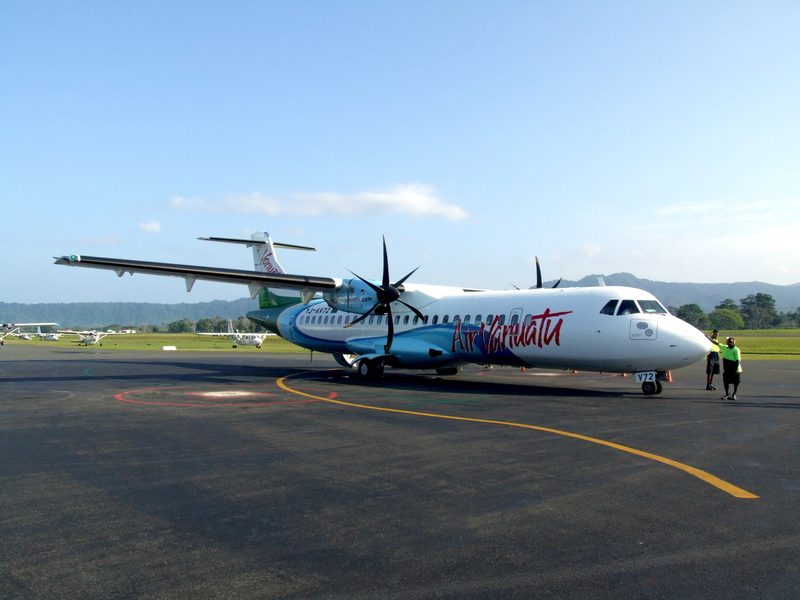
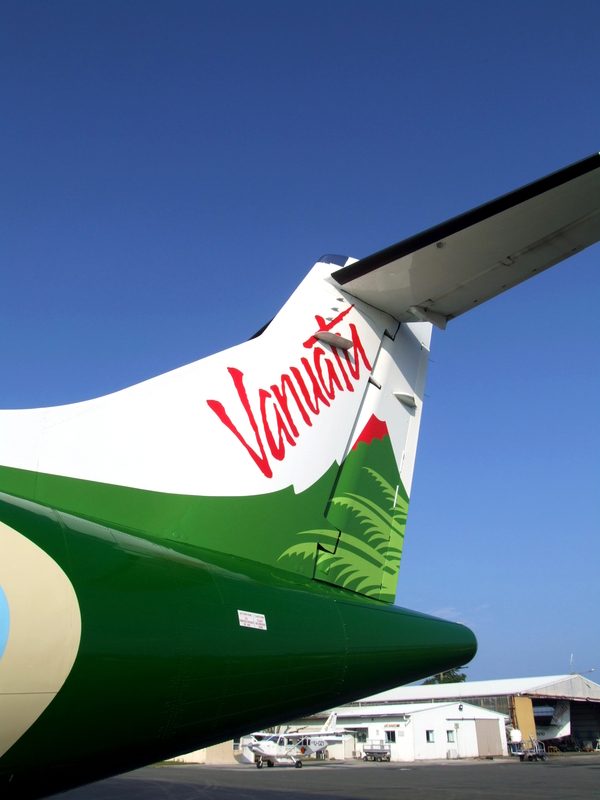
Air Vanuatu’s sole ATR 72-600—the carrier’s higher-capacity turboprop—has remained parked since August 2025 due to maintenance issues. With that aircraft sidelined, Air Vanuatu has had to preserve inter-island connectivity using its DHC-6-300 Twin Otters and wet-leased aircraft, particularly focused on maintaining service on the VLI–SON trunk.
That context makes the ATR 42 conversation more than theoretical. Adding a second, smaller-gauge ATR would introduce redundancy and a more precise capacity step between 19-seat Twin Otter flying and 70+ seat ATR 72 missions—while lowering the “single aircraft, single point of failure” risk that can disrupt an island network.
Governance: “rebuilt differently” is the real headline
Koanapo used the aircraft arrival at VLI to deliver a broader warning: Air Vanuatu must be “rebuilt differently,” and the “undisciplined past” and weak oversight that contributed to prior struggles cannot return.
For industry readers, that’s the key operational takeaway. Fleet choices matter—but they only work when dispatch reliability, maintenance planning, vendor discipline, and financial controls are stable. If the government follows through with a structured lease model, clear performance expectations, and tighter oversight, the airline’s rebuild has a better chance of holding.
Bottom Line
Vanuatu’s plan for Air Vanuatu (NF) is taking shape as a phased rebuild from Port Vila (VLI): immediate resilience through two additional DHC-6-300 Twin Otters—with YJ-AV15 (msn 481) already delivered on January 21 and another due in March—and a longer-term capacity upgrade that could include an ATR 42 by 2030.
With the ATR 72-600 still grounded since August 2025 and wet-lease capacity filling critical gaps (especially on VLI–SON), the logic is straightforward: restore dependable domestic lift now, then add a larger turboprop that can grow seats sustainably once the operation is stable enough to support it.
Keep reading FlyMag
Get the Daily Brief in the morning or the Route Watch weekly recap on Fridays. Or both.