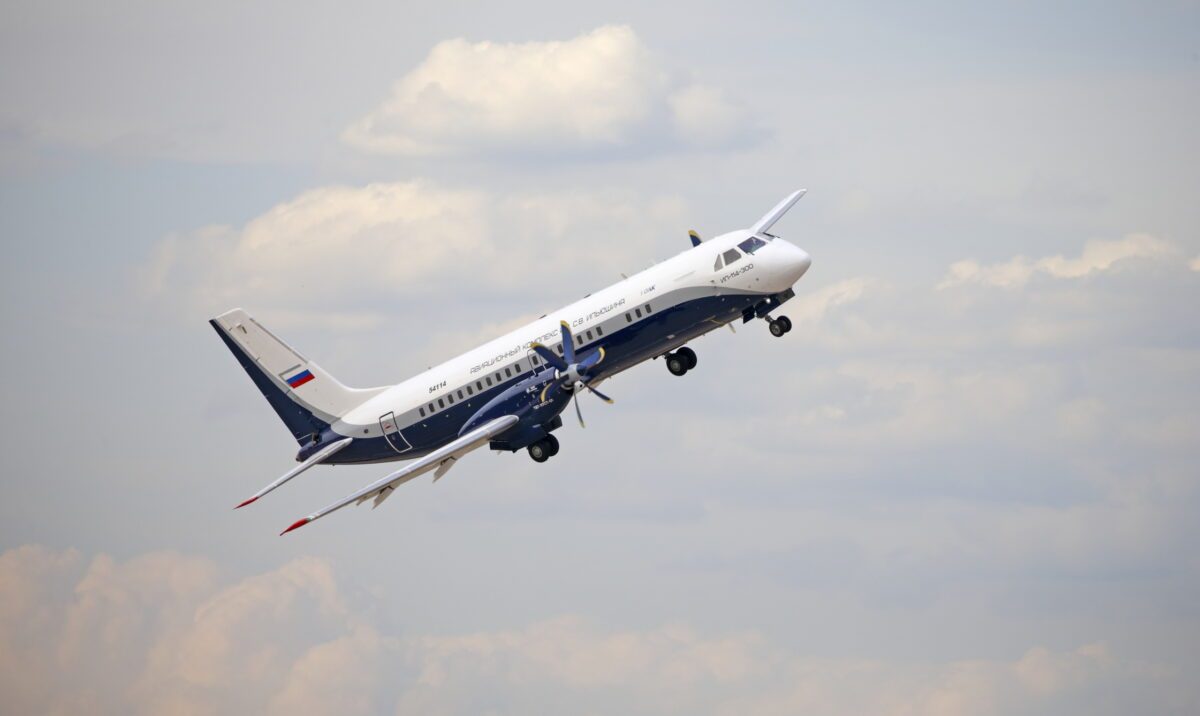
Russia’s United Aircraft Corporation has secured preliminary commitments for 85 Il-114-300 regional turboprops from two prospective Indian operators, giving the newly certified aircraft its largest announced export opportunity.
The agreements were signed on September 10, 2026, during the INNOPROM India exhibition in New Delhi. A letter of intent covers 50 aircraft for Pinnacle Air, while Sleek Aviation signed a memorandum of understanding for 35 aircraft. The Sleek agreement also calls for a training center equipped with a full-flight simulator.
The documents are not firm purchase contracts. UAC said delivery schedules, maintenance arrangements and commitments involving the localization of Il-114-300 components in India will be established through separate agreements with the customers. The manufacturer is targeting its first firm contracts before the end of 2026.
Read our stories in your inbox
Two aviation newsletters. Zero fluff.
Two Agreements With Different Structures
The division of the proposed fleet gives Pinnacle Air the larger share, with 50 aircraft, but Sleek Aviation’s training commitment makes its agreement broader than an aircraft acquisition alone. A simulator center would establish an in-country base for flight crew training and recurrent checks, reducing dependence on facilities in Russia as the Indian fleet grows.
At the Il-114-300’s standard 64-seat capacity, the two agreements represent 5,440 seats. That would create a sizable installed base for a type that only received its Russian type certificate in June and has yet to enter widespread airline service.
UAC is presenting the aircraft as part of a wider industrial package rather than as a stand-alone export. In a briefing before the New Delhi exhibition, the manufacturer outlined potential cooperation covering aircraft supply, production localization, component manufacturing and after-sales support.
That structure matters for an 85-aircraft program. A fleet of that size would require a local supply of consumables and rotables, trained engineering personnel, flight crew capacity and a maintenance system able to support operations at regional bases away from India’s largest airline hubs.
A 64-Seat Turboprop for Short Regional Sectors
The Il-114-300 is a modernized version of the original Ilyushin Il-114. It is powered by two TV7-117ST-01 engines and uses Russian-built avionics and aircraft systems. Final assembly is assigned to UAC’s plant at Lukhovitsy, southeast of Moscow.
According to UAC’s published specifications, the aircraft has a basic 64-seat layout and can accommodate as many as 68 passengers. Its range with a full passenger load is listed at 1,400 kilometers, or about 870 miles, while cruise speed is 450 kilometers per hour.
The manufacturer gives the aircraft a 750-meter takeoff run and a 550-meter landing roll. A built-in passenger stair and the ability to use short or unpaved runways are intended to reduce its dependence on ground infrastructure. Those characteristics place the Il-114-300 squarely in the market for short regional sectors and airports where larger jets would bring unnecessary capacity or infrastructure requirements.
The aircraft has a maximum takeoff weight of 23.5 metric tons and a maximum payload of 6.8 tons. Its digital flight deck uses five multifunction displays and is designed to support Category II operations. UAC also envisages passenger-freight, medical and special-mission derivatives based on the same platform.
Russia’s Federal Air Transport Agency issued the Il-114-300 type certificate on June 5, 2026. At that point, three production aircraft were at various stages of completion in Lukhovitsy. UAC has since completed additional hot-weather testing in Uzbekistan as it works to expand the aircraft’s approved operating envelope.
UAC Links the Aircraft to India’s UDAN Program
The New Delhi signings follow a sustained Indian sales campaign. UAC brought the Il-114-300 to Hyderabad in January for Wings India 2026, marking the type’s first appearance outside Russia. The aircraft was displayed with a passenger interior and participated in the manufacturer’s effort to position both the turboprop and the SJ-100 regional jet for Indian customers.
UAC has tied its Il-114-300 proposal to India’s Regional Connectivity Scheme, commonly known as UDAN. The program uses infrastructure spending, operating concessions and viability gap funding to support service from smaller and previously unserved markets.
India’s government said in July that UDAN had operationalized 679 routes through 95 airports, heliports and water aerodromes. The modified program running from fiscal 2026-27 through 2035-36 has an outlay of ₹28,840 crore, including funding for airline support and the development of 100 airports from existing airstrips.
The Il-114-300’s capacity puts it between small commuter aircraft and larger 70-seat regional turboprops. Its 1,400-kilometer full-passenger range covers the short sectors that dominate regional connectivity programs, while its field performance is aimed at airports with limited runway length and ground services.
The Next Step Is Contract Conversion
The scale of the Pinnacle Air and Sleek Aviation agreements gives UAC a prospective export backlog, but the commercial program now depends on converting those documents into purchase contracts. Production slots, financing, delivery dates and maintenance obligations will determine how quickly the commitments can become an operational fleet.
Indian service would also require the relevant type acceptance and operator approvals from the Directorate General of Civil Aviation. The proposed simulator and training center could become a central part of that process, particularly if it is developed to support both launch operators rather than a single airline.
For UAC, the immediate challenge is matching the size of the Indian commitments with a production system that is only beginning its serial ramp-up. The manufacturer must simultaneously supply Russian customers, establish an export support network and demonstrate reliable utilization as the first aircraft enter service.
Bottom Line
The two Indian commitments give UAC something the Il-114-300 program has lacked: a potential export fleet large enough to justify a dedicated support and training structure. If even part of the 85-aircraft total becomes firm, India could emerge as the type’s most important market outside Russia and influence how UAC organizes maintenance, spares distribution and future localization.
Pinnacle Air and Sleek Aviation would gain access to a newly certified aircraft sized for thinner regional routes, but they would also be early operators of a type without an established international service network. The value of the proposed simulator center and Indian industrial participation will therefore depend less on ceremonial agreements than on whether UAC can provide dependable parts, technical support and production capacity from the first delivery onward.
The next meaningful milestones will be signed purchase contracts, Indian regulatory acceptance and a credible delivery sequence. Progress on those points will show whether the New Delhi agreements are the start of a substantial Indian fleet or an ambitious market-opening framework that remains ahead of the aircraft’s production capability.
Keep reading FlyMag
Get the Daily Brief in the morning or the Route Watch weekly recap on Fridays. Or both.