Singapore Airlines is set to become the first international carrier to serve Western Sydney International Airport (WSI), launching daily nonstop flights from Singapore Changi Airport (SIN) on November 23, 2026.

That makes the route notable immediately. But the real significance goes well beyond one new city pair. This is the first major proof point that WSI will not simply be a spillover airport for greater Sydney. It is being positioned from day one as a serious international gateway with long-haul relevance, 24-hour operating flexibility, and direct access to one of Asia’s most important hubs.
For aviation readers, that is the real story. Singapore Airlines is not just adding another Australian route. It is helping define what Western Sydney International will actually be.
Read our stories in your inbox
Two aviation newsletters. Zero fluff.
This Is A Daily Long-Haul Service From Day One
The new Singapore (SIN)–Western Sydney (WSI) service will operate daily.
The flight schedule is highly deliberate. The outbound departs Singapore at 11:30 a.m. and arrives in Western Sydney at 10:20 p.m. local time. The return leaves WSI at 11:55 p.m. and lands back at SIN at 5:05 a.m. the next morning.
That late-night departure is one of the most strategically important details in the entire announcement.
Sydney Kingsford Smith Airport (SYD) operates under curfew restrictions. Western Sydney International (WSI) will not. That gives airlines a degree of scheduling freedom that Sydney has not had before, particularly on long-haul overnight services where timing can make a huge difference to onward connectivity and aircraft utilization.
In other words, this route does not just add capacity. It shows exactly how WSI’s operating model can complement, rather than simply duplicate, SYD.

The Airbus A350-900 Is The Right Aircraft For This Job
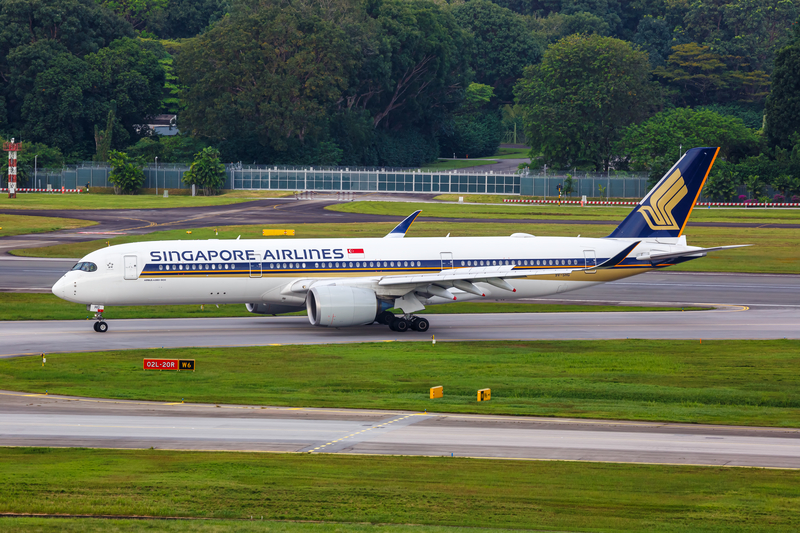
Singapore Airlines will operate the route with its Airbus A350-900 medium-haul aircraft.
That aircraft carries 303 passengers in two classes, with 40 Business Class seats and 263 Economy Class seats. For a route like SIN–WSI, it is a sensible choice. The A350-900 gives Singapore Airlines a modern long-haul platform with strong fuel efficiency, low operating noise, and a premium cabin product that matches the carrier’s brand standards without overcommitting capacity.
That matters because this is not just a symbolic launch. It is a serious daily operation into a completely new airport, and the airline is deploying a widebody that reflects confidence in both the market and the airport.
Western Sydney Becomes Singapore Airlines’ Second Sydney Airport
Singapore Airlines already operates four daily services between Singapore Changi (SIN) and Sydney Kingsford Smith (SYD).
Adding Western Sydney International (WSI) gives the carrier a second airport in the Sydney market and raises its broader Australian footprint to eight destinations: Adelaide (ADL), Brisbane (BNE), Cairns (CNS), Darwin (DRW), Melbourne (MEL), Perth (PER), Sydney Kingsford Smith (SYD), and now Western Sydney (WSI).
That is important because multi-airport strategies are not undertaken lightly. Airlines only do this when they believe the metropolitan market is large enough, diverse enough, and operationally distinct enough to support parallel airport access.
Singapore Airlines clearly believes Sydney now fits that profile.
Why Western Sydney Matters So Much
WSI is not just another airport on the edge of a big city. It is a structural change to how Sydney connects to the world.
Western Sydney is home to a very large and growing population base, and until now it has not had its own major international gateway. Travelers in that catchment have had to rely on Sydney Kingsford Smith (SYD), often with long ground journeys across the metro area. WSI changes that completely.
It also creates a different geography of access. The airport sits closer to western Sydney, closer to fast-growing residential and logistics zones, and nearer to major inland tourism drawcards such as the Blue Mountains. That gives it an identity that is not merely “Sydney’s second airport,” but a different gateway to the region.
Singapore Airlines Gains More Than Local Traffic
For Singapore Airlines, the route is not just about local western Sydney demand.
Changi Airport (SIN) is one of the most powerful connecting hubs in the world, and the timing of the new WSI flights is designed to support onward traffic to more than 130 destinations across the SIA Group network. That means WSI passengers are not just getting a nonstop to Singapore. They are getting a new one-stop gateway to Southeast Asia, India, North Asia, Europe, and beyond.
That is exactly why Singapore Airlines is such an important early win for WSI. The carrier does not just bring seats. It brings network reach.
This Also Sends A Signal To Other Airlines
There is another reason this launch matters: symbolism.
The first major international long-haul airline to commit to a new airport often shapes how the rest of the market views it. In this case, Singapore Airlines is giving WSI a strong vote of confidence before the airport has even opened.
That is likely to matter in conversations with other international carriers, especially those weighing whether Western Sydney can support meaningful long-haul service or whether it should be left to domestic and low-cost operations in its early years. Singapore Airlines’ decision strongly suggests the answer is the former.
Bottom Line
Singapore Airlines’ new daily Singapore Changi (SIN)–Western Sydney International (WSI) route from November 23, 2026 is one of the most significant Australian long-haul route announcements of the year.
Not because the airline is new to Australia, but because the airport is. WSI gets its first major international carrier, and Singapore Airlines gets a second Sydney gateway with true scheduling advantages thanks to the airport’s 24-hour operating model. Operated by the Airbus A350-900, the service gives western Sydney direct long-haul access to one of the world’s best-connected hubs and immediately establishes WSI as something much more serious than a secondary overflow airport.
For aviation readers, that is the main takeaway: this is not just a new route to Sydney. It is the first real sign of how Sydney’s two-airport future will work.