Qantas will launch nonstop flights between Sydney and Cape Town in October 2027, opening the first scheduled passenger route directly linking Australia with the South African city.

The seasonal service will operate three times weekly from October 19, 2027, through March 24, 2028. It will complement Qantas’ existing flights from Sydney and Perth to Johannesburg, while removing the domestic connection currently required for passengers traveling to the Western Cape.
Qantas said the route will add almost 30,000 seats between Australia and South Africa during its first season. Tickets are on sale, with launch-period round-trip Economy fares starting at AUD 2,470.
Read our stories in your inbox
Two aviation newsletters. Zero fluff.
QF89 Will Operate Three Days a Week
According to the airline’s published route schedule, QF89 will leave Sydney (SYD) at 9:15 a.m. and arrive at Cape Town (CPT) at 2:40 p.m. local time. The scheduled westbound flying time is 14 hours and 25 minutes.
Flights will operate on Tuesdays, Fridays and Sundays. The timing gives Qantas a morning departure from its main international and domestic hub, allowing passengers to feed into SYD from elsewhere in Australia and New Zealand before continuing nonstop to Cape Town.
The route is designed around Cape Town’s summer season rather than as an immediate year-round addition. Its October-to-March schedule covers the peak period for Australian leisure traffic to the Western Cape and spreads Qantas’ South African capacity across two gateways.
Qantas currently serves Johannesburg (JNB) from both Sydney and Perth (PER). Passengers traveling onward to Cape Town can connect at JNB on partner Airlink, which operates an extensive Southern African network and carries the Qantas code on selected routes. The airlines’ published partnership network includes Cape Town and several other South African destinations beyond Johannesburg.
The nonstop service changes that proposition for Cape Town traffic. It avoids a transfer at JNB, shortens the airport journey and keeps passengers on a single long-haul sector between Sydney and their final South African gateway. Johannesburg will remain important for travelers connecting elsewhere in the region.
Incoming 787-9s Enable the Route
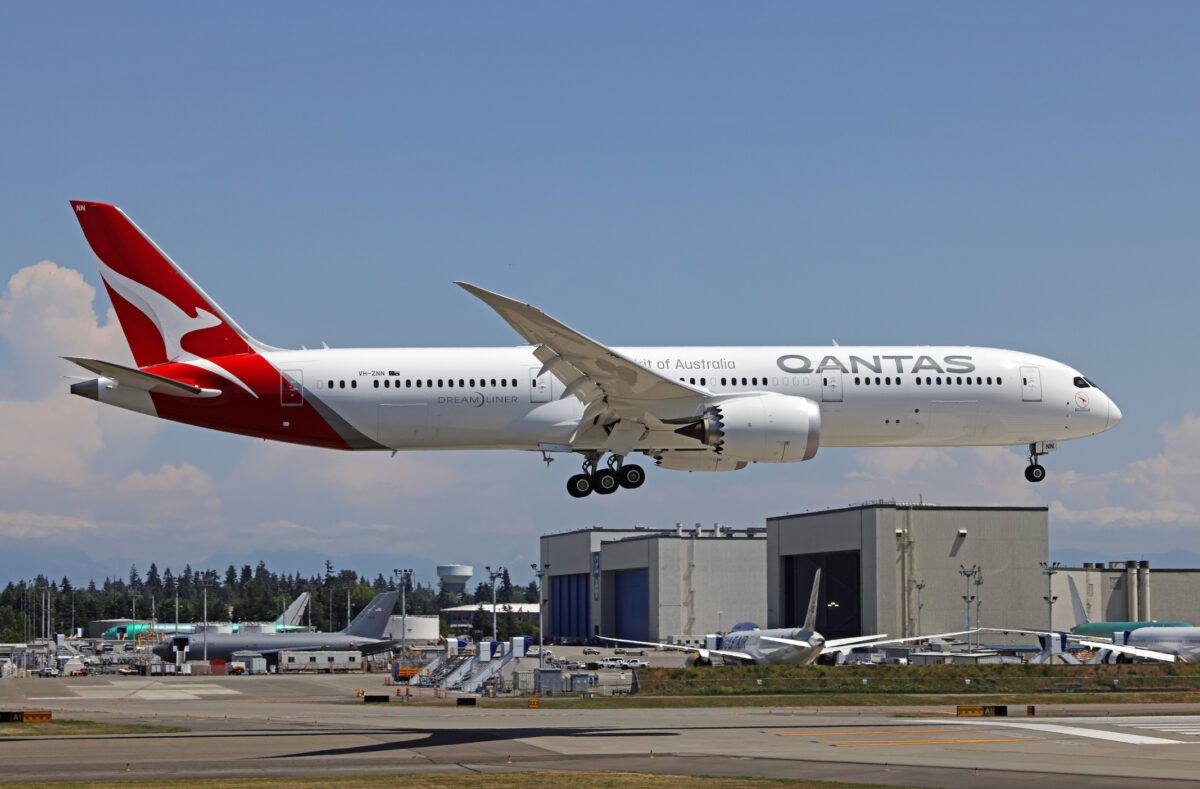
Qantas has tied the Cape Town launch to the arrival of four additional Boeing 787-9 aircraft, with the first of those jets due later in 2027. The airline had 14 787-9s at June 30, 2026, according to its 2026 annual report.
The four aircraft are scheduled within the airline’s 2028 financial-year delivery plan. Qantas Chief Executive Vanessa Hudson told shareholders that they form part of a wider renewal program involving more than 200 aircraft across Qantas and Jetstar.
The 787-9 is already central to Qantas’ long-haul network, including Sydney-Johannesburg. Its combination of range, belly capacity and relatively modest seat count allows the airline to serve long, thinner markets without committing the capacity of an Airbus A380.
Qantas’ published 787-9 configuration has 236 seats: 42 in Business, 28 in Premium Economy and 166 in Economy. Business is arranged 1-2-1, Premium Economy 2-3-2 and Economy 3-3-3. The airline lists a full-payload range of 14,498 kilometers and uses General Electric GEnx engines.

The incoming aircraft will also introduce Qantas’ evolved 787 Business Suite, retaining 42 seats while adding an 80-inch lie-flat bed, a wider footwell and a sliding privacy door. That cabin is particularly relevant on a sector scheduled at more than 14 hours westbound, where premium demand and yield will be important to the route’s economics.
Qantas originally ordered the four additional 787-9s alongside eight larger 787-10s. The airline said the 787-9 offers about a 20% fuel-use improvement against the previous-generation aircraft it is intended to replace. Boeing has also secured certification for a higher maximum takeoff weight option on newly built 787-9s, providing additional payload or range flexibility, although Qantas has not detailed whether its incoming aircraft will activate that capability.
Cape Town Sees an Established but Dispersed Market
Cape Town Air Access, the route-development initiative powered by Wesgro, said two-way traffic between Cape Town and Australia reached a record 80,000 passengers in 2025. The Sydney-Cape Town city pair accounted for about 20,000 of those passengers.
That existing local market is smaller than the capacity Qantas plans to add during the season, so the airline will also depend on connecting passengers, stimulated demand and travelers visiting friends and relatives. Australia has a large South African-born population, while SYD offers connections across Qantas’ domestic and trans-Tasman networks.
Wesgro said Cape Town’s international traffic increased 8% year over year during the first nine months of 2026. It expects the Qantas service to support tourism, trade and investment links between Australia and the Western Cape.
The route also restores a direct Qantas presence in a second South African city 75 years after the airline began its first scheduled service to the country. Qantas’ 1952 Wallaby Route reached Johannesburg via Perth, the Cocos Islands and Mauritius, taking about 66 hours. The new schedule reduces the journey from Sydney to Cape Town to a single flight of less than 15 hours.
Bottom Line
Cape Town is a measured use of Qantas’ incoming 787 capacity. Three weekly flights during the Southern Hemisphere summer give the airline access to a strong leisure and visiting-friends-and-relatives market without imposing the year-round utilization commitment of a daily service. The 236-seat 787-9 is well matched to that approach: large enough to provide meaningful premium and cargo capacity, but smaller than the aircraft Qantas would once have needed for a route of this length.
The development also shows how Qantas intends to deploy its next batch of Dreamliners. Rather than using every additional aircraft simply to add frequency on established trunk routes, the airline can open long-haul city pairs where nonstop service carries a commercial premium. Cape Town joins a network strategy already built around the 787’s ability to connect Australia with destinations that are difficult to support through conventional hubs.
The question after launch will be whether the seasonal operation generates enough local and connecting demand to extend beyond March or return with additional frequencies in the following summer. For Cape Town, the route secures direct access to Australia’s largest connecting gateway. For Qantas, it provides an early test of how much new network growth its four incoming 787-9s can support alongside existing long-haul commitments.