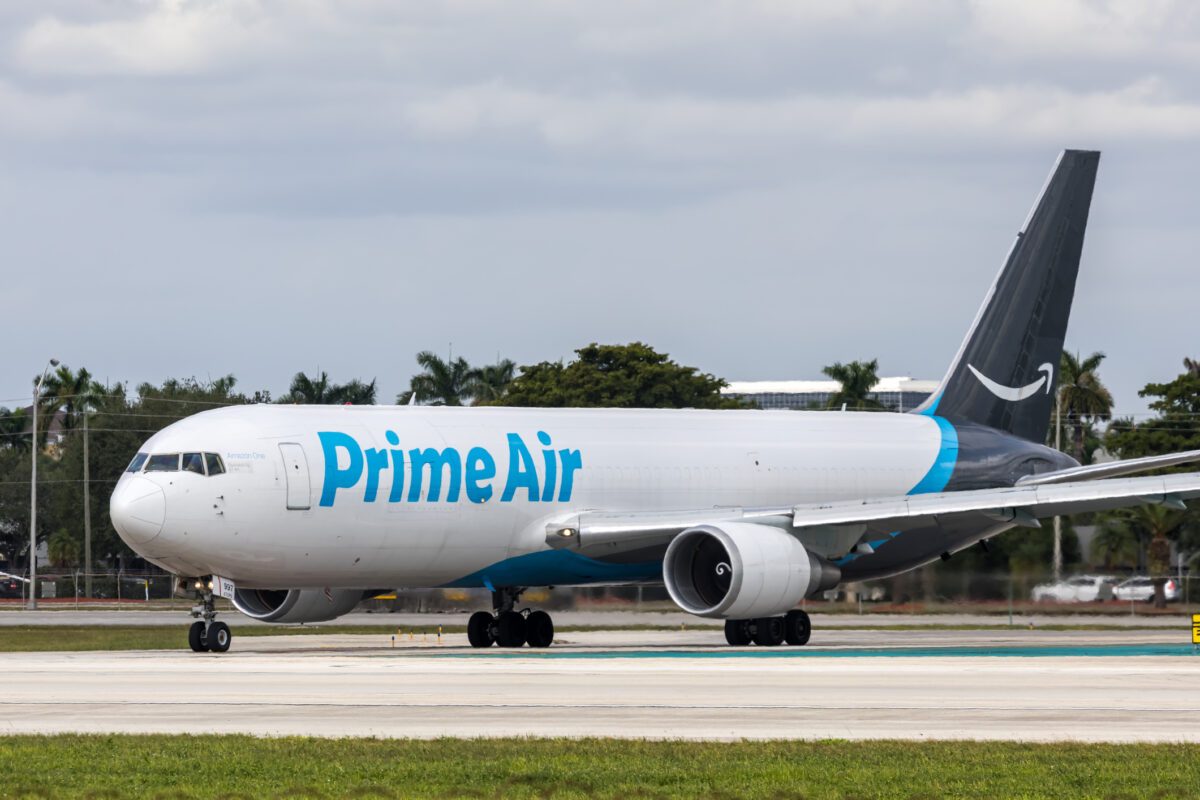
A 21 Air Boeing 767 operating for Amazon Air crossed Miami International Airport’s Runway 30 threshold at 177 knots and did not touch down until it was about 3,750 feet beyond the threshold, according to the National Transportation Safety Board’s preliminary report into the September 6 accident.
The Boeing 767-33A converted freighter, registration N1997A, then crossed the runway’s departure end at 113 knots before striking navigation and approach-lighting equipment, leaving airport property and hitting two vehicles. Five people in a van were killed. Three people on the ground were seriously injured, while the two pilots sustained minor injuries.
The 12-page preliminary report, published October 1, provides the most detailed reconstruction yet of 21 Air Flight 7598’s approach, touchdown and attempted deceleration. The investigation remains active, and the NTSB has not determined a probable cause.
Read our stories in your inbox
Two aviation newsletters. Zero fluff.
The 767 Crossed the Threshold at 177 Knots
Flight 7598 was operating a Part 121 cargo service from San Juan (SJU) to Miami (MIA) on behalf of Amazon.com Services. The captain was the pilot flying and the first officer was monitoring. It was the crew’s second sector of the day and the first day the two pilots had flown together.
Miami tower cleared the flight to land on Runway 30 at about 1:49 p.m., when the aircraft was approximately 12 nautical miles from the displaced threshold. ADS-B and flight-data recorder information showed the 767 crossing that threshold approximately 105 feet above ground level at a groundspeed of 177 knots.
Initial tire marks from the left and right main landing gear began 3,750 feet and 3,820 feet beyond the threshold. The aircraft was traveling at about 160 knots, and 13 seconds had elapsed since it crossed the threshold.
The weight-on-wheels parameter alternated between air and ground for approximately seven seconds. It remained continuously in the ground state only after the aircraft had reached a point with about 2,730 feet of runway remaining.
The NTSB’s recorder summary shows that the first officer warned the captain they were too fast when flaps 20 were called, approximately one minute and 42 seconds before the recording ended. The first officer continued making speed-related comments during the remainder of the approach, without a consistent verbal response.
The enhanced ground proximity warning system generated two “sink rate” alerts. It later produced five “too low terrain” annunciations, including four in succession. The captain called for flaps 30 approximately nine seconds before the sounds associated with touchdown.
A Go-Around Attempt Began With 930 Feet Remaining
Flight-data recorder information shows that the nose and right main landing gear touched down at 158 knots. Manual wheel braking began seven seconds later at 146 knots, followed four seconds later by the left main landing gear registering on the runway at 134 knots.
The crew released the brakes at 120 knots and advanced both throttles to values consistent with go-around thrust. At that point, only about 930 feet of runway remained. The captain’s recorded go-around call came roughly 16 seconds after the initial touchdown sounds.
Four seconds after the throttle advance, the engines were returned to idle and the brakes were reapplied. The 767 was still traveling at 117 knots and had about 415 feet of runway remaining. It passed the end of Runway 30 at 113 knots and struck the localizer and medium-intensity approach-lighting system at approximately 100 knots.
The FDR contained no indication that the speed brakes deployed or that either thrust reverser operated during the landing roll. Investigators found the speed-brake lever in the down position and the thrust-reverser levers in their first detent during the cockpit examination.
The airplane’s flap lever was found in the 25-degree detent. Measurements of the wing’s slat tracks and flap-support rods were also consistent with a flaps 25 configuration.
Changing Winds Were Not Included in the Landing Clearance
Weather at MIA included thunderstorms and a marked wind shift shortly before the accident. At 1:50 p.m., the airport’s automated system recorded wind from 190 degrees at 16 knots, gusting to 24 knots. The 1:53 p.m. observation reported wind from 190 degrees at 17 knots, gusting to 26 knots, with scattered cumulonimbus clouds at 2,000 feet and a broken ceiling at 4,800 feet.
The local controller responsible for Runways 9/27 and 12/30 cleared Flight 7598 to land but did not give the crew wind information. Four minutes earlier, the controller had told another aircraft that the wind was from 190 degrees at 19 knots, gusting to 22 knots. Flight 7598 was not yet on the controller’s frequency.
The preliminary report notes that FAA air traffic control rules required the controller to state wind direction and velocity when authorizing use of a runway with a tailwind component. The report makes no finding at this stage about the wind information’s role in the accident.
The FAA’s published airport data lists Runway 12/30 as approximately 9,360 feet long, but the declared landing distance available on Runway 30 is 7,913 feet. The threshold is displaced by 945 feet.
Aircraft Had Logged More Than 110,000 Hours
N1997A was manufactured in June 1994 and originally entered service as a passenger aircraft. It was converted to a freighter in June 2016 and was powered by General Electric CF6 engines. At the time of the accident, it had accumulated approximately 110,077 flight hours and 24,505 cycles.
The captain had joined 21 Air in April 2026 and received his Boeing 767 type rating on May 18. He reported 7,267 total flight hours, including about 150 hours on the 767. The first officer joined the airline in February 2025 and had approximately 2,800 total hours, including 800 on the 767.
After leaving the runway, the aircraft struck a Ford Econoline van carrying seven people on an airport perimeter road. Five occupants died and two sustained serious injuries. The 767 then broke through the perimeter fence, crossed NW 67th Avenue and hit a Toyota Corolla Cross, seriously injuring its driver.
The aircraft stopped approximately 1,200 feet beyond the paved runway surface after passing through another fence beside a parking lot. A postcrash fire damaged and deformed the right wing, while the right engine was partially separated from its pylon. The captain evacuated through the forward left door, and the first officer exited through the right cockpit window.
Investigators found the nose landing gear displaced aft beneath the fuselage. Both main landing-gear assemblies remained extended and locked, and brake-wear indicators on all eight main wheels showed remaining service life. The NTSB will use the recorder and engineering data to develop an aircraft-performance study as the investigation proceeds.
Bottom Line
The preliminary evidence places energy management and the timing of the crew’s decisions at the center of the investigation. The approach continued through repeated speed comments and terrain-system alerts, followed by a touchdown well beyond the threshold. The subsequent go-around command came after substantial deceleration had already begun and with less than 1,000 feet of runway remaining.
The captain’s limited time on the 767, the crew’s first pairing and the absence of a consistent response to the first officer’s speed warnings will put 21 Air’s training, stabilized-approach criteria and cockpit intervention procedures under scrutiny. Investigators are also likely to examine how Amazon oversees operational safety among the carriers flying within its contracted cargo network.
The next significant evidence will come from the NTSB’s synchronized recorder work, aircraft-performance study and a fuller examination of company procedures and crew training records. The final report will also have to separate the contribution of the approach and landing decisions from the changing wind conditions and the tower’s failure to include wind information in the landing clearance.