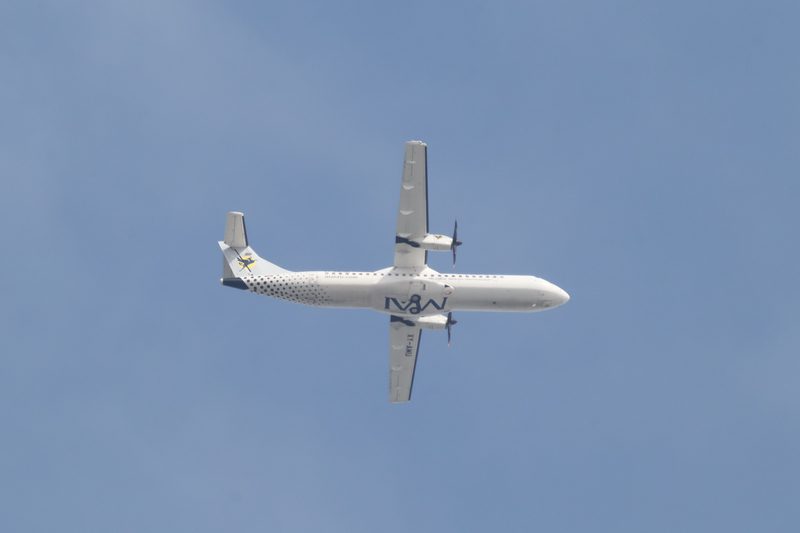
A rare and deeply concerning incident unfolded at Myitkyina Airport (MYT) on the night of February 20, when a Myanmar National Airlines (MNA) ATR 72-600 was struck by explosive-laden, first-person-view (FPV) “one-way” drones while preparing for departure.

The aircraft—ATR 72-600 registration XY-AMI—was boarding for flight UB662 from Myitkyina (MYT) to Mandalay International Airport (MDL) when the strike occurred at approximately 20:12 local time. Multiple reports citing official statements said the damage was minor and limited to shrapnel impacts, and no passengers or crew were injured.
Even so, the event marks an escalation in risk for civilian operations in Myanmar’s conflict-affected regions, and it raises uncomfortable questions for airlines, insurers, regulators, and airport operators about how to protect commercial aircraft during the most vulnerable phase of the mission: on the ground, doors open, passengers boarding, and systems running.
Read our stories in your inbox
Two aviation newsletters. Zero fluff.
What happened at Myitkyina (MYT)
Based on information carried by regional outlets and Myanmar state media, the ATR 72-600 (XY-AMI) was on stand at Myitkyina (MYT) with passengers boarding for the short domestic hop to Mandalay (MDL) when FPV drones impacted near the aircraft.
Official statements describe fragment/shrapnel damage affecting the:

-
Nose section
-
Mid-fuselage
-
Tail area, including tail lighting
Passengers and crew were evacuated as security personnel moved to secure the aircraft and the immediate area. The same reporting indicates explosive devices associated with the drones were subsequently rendered safe.
As with many incidents in active conflict zones, attribution is contested. A government press release circulated to media outlets alleged involvement by armed groups, while a spokesperson for the Kachin Independence Army (KIA) was quoted by international media denying that the group attacks civilian airlines.
For operators, the most operationally relevant fact is straightforward: a passenger aircraft was struck during the boarding window at MYT, and it survived without casualties—an outcome that was far from guaranteed.
The aircraft: why an ATR 72-600 is both capable—and exposed—on domestic Myanmar sectors
The ATR 72-600 (ICAO type designator AT76) is the backbone aircraft for many domestic networks in Southeast Asia precisely because it is optimized for short-haul, high-cycle flying into infrastructure-limited airports.
In ATR’s published performance data, the 72-600 is typically configured around 72 seats, powered by Pratt & Whitney Canada PW127M/N engines driving six-blade Hamilton Standard 568F propellers. In cruise, ATR lists a maximum cruise speed of about 275 KTAS under typical conditions, with sector economics designed around regional stage lengths rather than long-range endurance.
From a runway-performance standpoint, the type is well suited to an airport like Myitkyina (MYT), which has a published runway length of roughly 1,859 meters (6,100 feet). ATR’s own figures show takeoff distances a little over 1,200 meters at maximum takeoff weight in standard conditions—useful margin even before you factor in real-world constraints like temperature, payload, and obstacle environment.
But the same characteristics that make the ATR a reliable domestic workhorse—high utilization, quick turns, and frequent operations into smaller airports—also increase exposure:
-
More time on the ground at outstations
-
More boarding events per day
-
More predictable scheduling patterns
-
Less operational “buffer” when a single airframe goes AOG
When a turboprop like the ATR takes damage on stand, the downstream effects can ripple quickly across a domestic schedule—especially in networks where spare aircraft and spare crews are limited.
“Minor shrapnel damage” can still mean days (or weeks) of inspections
The early descriptions emphasize “minor damage,” but airline maintenance teams know that the phrase is doing a lot of work.
On an ATR 72-600, the nose area includes the radome and forward fuselage structure. Any puncture or deformation there triggers careful inspection—not because the radome itself is structurally critical, but because impacts can damage nearby structure, wiring runs, antennas, and systems housed in that zone.
The mid-fuselage is where “minor” can become complicated. Even small fragments can:
-
nick or deform fuselage skin panels,
-
compromise seals or fairings,
-
damage wiring looms and lighting circuits,
-
and create findings that require non-destructive testing (NDT) before return to service.
The tail section adds its own sensitivities. Aside from lighting assemblies, impacts near the aft fuselage can drive inspections of:
-
tailcone structure,
-
control runs and linkages,
-
empennage skin and fittings,
-
and any heat/scorch indications if a localized fire did occur.
None of that necessarily implies long downtime—but it does mean the airframe won’t simply be “wiped down and dispatched.” A conservative pathway typically includes damage mapping, borescope checks where appropriate, NDT on suspect areas, and manufacturer guidance on allowable limits and repairs.
If an aircraft like XY-AMI is kept at MYT for repair, the logistics layer becomes just as important as the engineering: tooling, parts availability, qualified technicians, and whether the operator can ferry the aircraft to a maintenance base under special flight permits (if needed).
Why Myitkyina (MYT) matters to the domestic network
Myitkyina (MYT) sits in Kachin State in northern Myanmar, a region where overland travel can be challenging and security conditions volatile. In state-media reporting, MYT is framed as a critical air link enabling civilian movement and essential goods flows to larger cities including Mandalay (MDL) and Yangon International Airport (RGN).
That context matters for a basic reason: when surface options deteriorate, the aviation system becomes more than convenience—it becomes connectivity. That makes airports like MYT strategically important, and unfortunately, that can draw them into the conflict dynamic even when the flights are civilian.
For domestic carriers operating from MYT, the risk profile is no longer just meteorology and technical dispatch reliability. It becomes:
-
ground-security assessment,
-
station operating windows,
-
exposure time at the gate/stand,
-
and contingency planning for rapid evacuation and aircraft securing.
The bigger concern: drones are compressing the aviation security timeline
Traditional aviation security threats—while still real—often involve longer timelines: intelligence, screening, suspicious items, perimeter breach detection. FPV “one-way” drones compress that timeline dramatically. The warning window can shrink to minutes, or less, and the threat can approach from angles that conventional airport fencing and patrol patterns were never designed to address.
That is not a Myanmar-only issue. The difference is that in active conflict environments, capability and intent are more likely to coexist.
For airlines, the operational response tends to show up in three places:
-
Station risk reviews (including whether night operations increase vulnerability)
-
Aircraft turn procedures (minimizing exposure time with doors open and passengers staged)
-
Irregular operations playbooks (rapid deplaning, sheltering, and securing the aircraft)
For airports, it raises uncomfortable but unavoidable questions around detection, response coordination, and where civilian infrastructure fits when security resources are stretched.
Bottom Line
Myanmar National Airlines flight UB662 from Myitkyina (MYT) to Mandalay (MDL) never became an airborne emergency—but what happened on the ground is arguably more consequential. An ATR 72-600 (XY-AMI) was struck during boarding at MYT around 20:12 local time and, while early reports describe only minor damage and no injuries, the incident is a stark reminder that the threat environment around certain civilian airports is evolving faster than legacy aviation security assumptions.
For operators, the immediate focus will be airframe inspection and safe return-to-service decisions. For the broader industry, the more troubling takeaway is strategic: when passenger aircraft become viable targets while parked and boarding, the line between “civil aviation operations” and “conflict exposure” becomes much harder to manage—especially at smaller, high-importance domestic airports like MYT.
Keep reading FlyMag
Get the Daily Brief in the morning or the Route Watch weekly recap on Fridays. Or both.