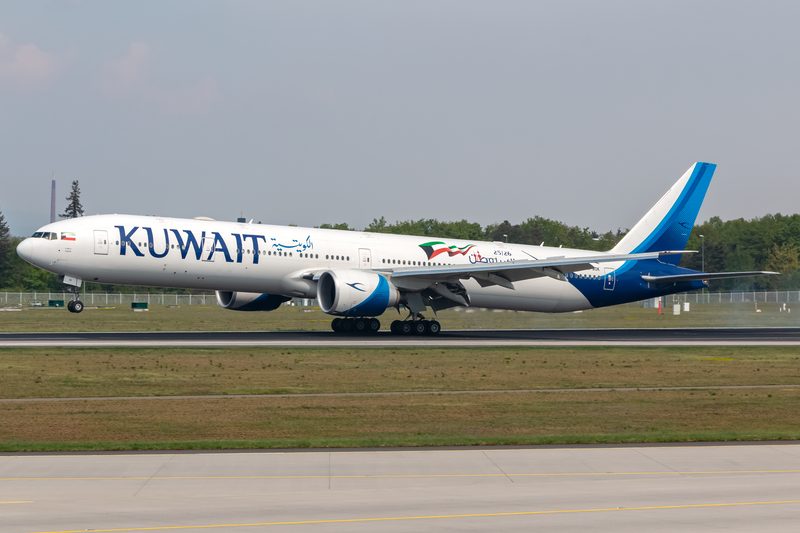
Kuwait Airways’ long-haul link between Kuwait City and New York is the kind of route you’d expect to be a quiet overachiever: a nonstop bridge between Kuwait City and New York City, serving premium government travel, VFR demand, and onward connections across the Gulf and South Asia.

Instead, the numbers being reported for the past year paint a far tougher picture. On paper, this is a classic “looks strategic, flies expensive” route—especially when you’re running it with a high-capacity widebody every day.
The Numbers Behind Kuwait Airways’ JFK Problem
Kuwait Airways’ nonstop between Kuwait International Airport (KWI) and John F. Kennedy International Airport (JFK) is a long sector, typically scheduled at roughly 13 hours westbound and longer eastbound depending on winds. In reporting based on U.S. DOT data, the route averaged an eye-catching ~41% seat load factor over a 12-month period—an unusually low figure for any long-haul service, let alone one that has operated for decades.
Read our stories in your inbox
Two aviation newsletters. Zero fluff.
Even with all the usual caveats—seasonality, directional imbalances, and how different datasets treat capacity—the headline is the same: this route is being described as materially underfilled, and the market has softened year-on-year in the same reporting.
Why A Boeing 777-300ER Is Hard To Fill Here
Aircraft choice matters—especially when you’re trying to sustain daily service at JFK.

Kuwait Airways commonly schedules KWI–JFK as a Boeing 777-300ER (77W) operation. In a 334-seat layout (8 First, 36 Business, 54 Premium Economy, 236 Economy), you’re pushing a lot of seats into a market that, by the reported figures, hasn’t consistently supported them.
That’s the structural challenge with “big metal” in a niche nonstop market:
-
Trip cost vs. seat cost: The 777-300ER’s economics are excellent when you’re filling it. When you aren’t, the trip cost becomes the story—crew, maintenance reserves, airport fees, and fuel burn don’t scale down just because the cabin is empty.
-
Product perception at JFK: New York is a frequency-driven, premium-aware marketplace. Travelers notice aircraft age, cabin polish, and reliability quickly—especially on a nonstop that competes against multiple one-stop options via massive hubs.
-
Operational resilience: A lightly filled flight still consumes a scarce long-haul airframe and a full crew duty cycle. If the airline has limited spare coverage, a single disruption can ripple through the network.
In other words: when a long-haul route is soft, the 777-300ER amplifies the pain.
A Hub That Competes In A Tough Neighborhood
KWI is a capable gateway, but it’s operating in the shadow of some of the most powerful connection hubs on earth. When your competition for New York-area traffic includes enormous, highly optimized bank structures and deep commercial partnerships, you need either:
-
a very strong local market (O&D), or
-
a truly compelling connecting proposition (schedule + price + reliability + product), or
-
a structural advantage (cargo, slots, strategic mandates, etc.)

That’s a tall order when much of the demand in the broader region is extremely price-sensitive and has plenty of alternatives. The New York metro area can reach South Asia, the Gulf, and beyond through multiple routings; if your hub doesn’t offer a cleaner schedule or a clear value proposition, travelers will vote with their wallets.
Connecting Traffic Helps, But It’s Often Low-Yield
This is the part airline planners know well: a low load factor doesn’t automatically mean the route is losing money, and a high load factor doesn’t guarantee it’s making money.
A New York–Kuwait nonstop can function as a flow machine, carrying passengers beyond KWI to South Asia and the Middle East. But in many long-haul connecting markets, especially VFR-heavy corridors, yield pressure is relentless—and it gets worse when competitors have higher frequency, stronger loyalty ecosystems, and larger global networks.
If the cabin is underfilled and the traffic mix is mostly price-led, you’re essentially burning widebody resources to protect connectivity rather than generate strong margin.
Why Add Capacity If The Cabin Is Half Empty?
Here’s where the story gets interesting: despite the weak-looking load factor, Kuwait Airways has signaled daily service patterns in schedules, with KU117/KU118 commonly shown as a daily operation with 777 equipment.
Airlines don’t usually add frequency into a vacuum—so what could explain it?
1) JFK presence can be strategic, not purely commercial
Maintaining a New York nonstop can matter for government travel, corporate credibility, and brand positioning. Some flag carriers accept weaker performance on “prestige routes” because the network value extends beyond route P&L.
2) Cargo can quietly carry the route
Even when passenger demand is soft, belly cargo can be meaningful on long-haul sectors—especially if freight rates or specific commodity flows are favorable. A 777-300ER offers substantial lower-deck capability, and cargo revenue often behaves differently than passenger demand.
3) Schedule utility can improve with daily service
A five-weekly operation can be awkward for connections and corporate travel. Going daily can tighten connection windows, stabilize travel routines, and reduce the “I’ll just route via somewhere else” effect—though it only works if the rest of the network banks properly around it.
4) Fleet and utilization realities
Sometimes the aircraft you have—and the utilization you need—pushes a schedule as much as demand does. If widebody flexibility is limited, the “least bad” use of an aircraft can still be a daily long-haul that anchors a bank structure.
What To Watch Through 2026
If you want to track whether this route is stabilizing or deteriorating, watch a few signals that airline pros care about more than headlines:
-
Gauge changes: Any shift away from the 777-300ER (77W) to a smaller widebody is a strong indicator the carrier is optimizing risk.
-
Cabin inventory behavior: If premium cabins are protected while deep discounting appears in economy, that’s often a tell on yield strategy.
-
Operational reliability: Underfilled flights can be kept alive if they’re consistent and cargo-friendly. Frequent disruptions usually accelerate “quiet exits.”
-
Partnership moves: Any interline or codeshare deepening that improves feed on either end can change the route’s trajectory quickly.
Bottom Line
A reported ~41% load factor on a daily, long-haul KWI–JFK (KWI/JFK) nonstop is the kind of metric that makes network planners flinch—because it suggests a structural mismatch between aircraft size, competitive positioning, and demand quality.
But this isn’t just a “bad route” story. It’s a case study in how long-haul flying can persist for reasons that don’t show up in a single statistic: cargo contribution, hub strategy, brand presence, and fleet utilization all matter. The big question for 2026 is whether Kuwait Airways can reshape the economics—either by improving the revenue mix or right-sizing capacity—before the route becomes an expensive habit.
Keep reading FlyMag
Get the Daily Brief in the morning or the Route Watch weekly recap on Fridays. Or both.