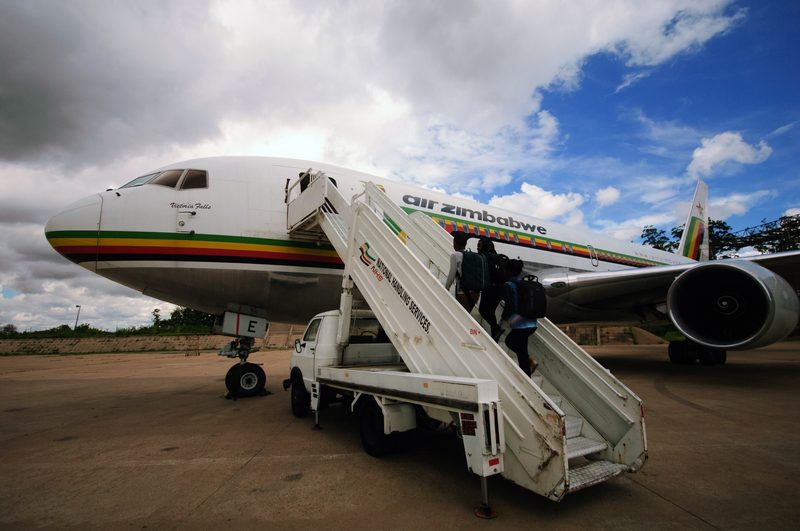
Air Zimbabwe is under renewed parliamentary scrutiny after lawmakers said the airline’s financial statements failed to properly reflect aircraft tied to its operations, raising fresh concerns over ownership, asset control, tax compliance, and the broader state of governance at the struggling flag carrier.

For an airline that has spent years battling debt, fleet decay, and operational instability, this is more than a bookkeeping issue. If aircraft are being used, parked, or otherwise associated with the airline without being clearly captured in the accounts, the problem quickly shifts from poor administration to possible legal and financial exposure.
That is why this matters. The issue is not only whether Air Zimbabwe’s books are incomplete. It is whether the airline still has a clear grip on some of its own assets and obligations.
Read our stories in your inbox
Two aviation newsletters. Zero fluff.
Parliament Is Questioning Aircraft Missing From The Books
The trigger for the latest criticism was a report by Zimbabwe’s Public Accounts Committee reviewing Air Zimbabwe’s 2020 audited accounts.
According to the findings, some aircraft connected to the airline were not properly reflected in the financial statements, and lawmakers explicitly raised concerns that the ownership status of certain airframes remained unclear. In airline terms, that is a serious finding. Aircraft are among the most important assets a carrier has, and uncertainty around who owns them, controls them, or carries liability for them can create problems across accounting, maintenance, insurance, and international legal compliance.

For a financially distressed flag carrier, that kind of ambiguity can be particularly dangerous.
The Grounded A320 In Johannesburg Is Central To The Dispute
One aircraft highlighted in the parliamentary report is Airbus A320-200 Z-WPM, which has been grounded for years at Johannesburg O.R. Tambo International Airport (JNB).
That aircraft has become symbolic of the wider problem because it appears to sit at the intersection of unresolved ownership questions, incomplete accounting treatment, and long-running operational neglect. Z-WPM was part of a 2012 arrangement intended to support Air Zimbabwe’s fleet, but unlike its sister aircraft, it never entered active commercial service and has remained stranded in South Africa for years because the airline lacked funds for major repairs and maintenance.
That history would already make it a complicated asset. Once lawmakers say such an aircraft is not properly reflected in the books, the issue becomes much more serious.
The South African Exposure Is What Makes This So Risky
One of the most important parts of the parliamentary concern is that unresolved legal and financial issues surrounding the aircraft could expose Air Zimbabwe to action under South African rules and wider international aviation obligations.
That matters because an aircraft parked abroad for years is not just a dormant asset. It can still create liability if fees, maintenance obligations, legal title, or compliance responsibilities remain unclear. Even if the immediate risk of seizure is not yet realized, the fact that parliament is raising the issue at all shows that the asset has become more than a fleet relic. It has become a legal vulnerability.
Air Zimbabwe told lawmakers it had engaged SAA Technical to clarify the aircraft’s status and said no parking fees were currently owed. That may reduce some short-term pressure, but it does not solve the deeper problem if the aircraft’s ownership and accounting treatment remain unresolved.
The Tax Findings Suggest A Wider Governance Breakdown
The aircraft questions are serious on their own, but the tax findings make the picture worse.

The parliamentary committee also said Air Zimbabwe failed to compute income tax and deferred tax obligations in 2019 and did not submit quarterly returns. That shifts the story from one about a difficult aircraft record to one about broader control failure.
A struggling airline can sometimes recover from weak revenue or a shrinking fleet if its governance remains disciplined. It is far harder to recover when asset visibility, tax compliance, and financial reporting all appear weak at the same time. At that point, the airline is not just fighting commercial pressure. It is fighting its own administrative disorder.
This Fits A Much Longer Pattern At Air Zimbabwe
The latest findings do not emerge in isolation.
Air Zimbabwe has spent years shrinking, parking aircraft, attempting asset sales, and trying to keep a minimal operation functioning amid chronic financial distress. In that context, the discovery of unclear aircraft records does not look like a one-off anomaly. It looks like part of a longer pattern in which fleet deterioration and weak governance have gone hand in hand.
That is what makes this story more troubling than a technical audit dispute. It suggests that even now, after years of distress, the airline may still not have fully restored control over some of the most basic parts of airline administration.
Parliament’s August Deadline Is A Real Test
The Public Accounts Committee has now recommended that Air Zimbabwe submit outstanding financial statements to the Auditor-General by August 31, 2026, and has urged stricter oversight of senior management through performance contracts.
That creates a meaningful test. Either the airline begins to rebuild basic accountability and financial visibility, or the same concerns will continue to deepen. For aviation professionals, this is often where struggling flag carriers either begin to stabilize or sink further into institutional dysfunction.
Clear records, credible audits, and properly recognized assets are not glamorous, but they are essential. Without them, any restructuring effort sits on very weak foundations.
Bottom Line
Air Zimbabwe’s latest parliamentary scrutiny is about much more than one grounded Airbus A320 in Johannesburg. It is about whether the airline still has credible control over its fleet records, financial reporting, tax obligations, and legal exposure.
The findings suggest a carrier whose problems go well beyond weak commercial performance. If Air Zimbabwe cannot clearly account for aircraft tied to its fleet history and restore basic financial discipline, then any talk of restructuring will remain fragile. In that sense, the missing aircraft record issue is not just an audit problem. It is a warning about the condition of the airline itself.
Keep reading FlyMag
Get the Daily Brief in the morning or the Route Watch weekly recap on Fridays. Or both.