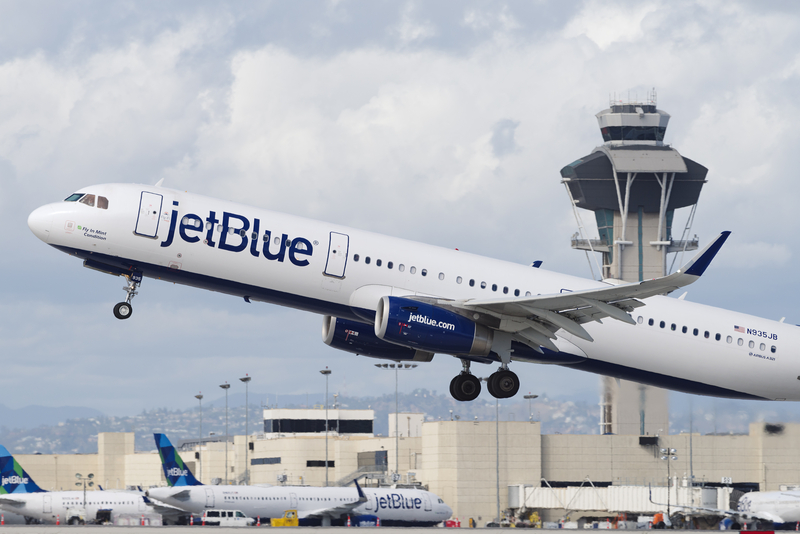
JetBlue is wasting little time in Fort Lauderdale-Hollywood International Airport (FLL), moving aggressively to expand after Spirit Airlines’ shutdown left one of the biggest sudden capacity gaps the U.S. market has seen in decades.

The headline is not subtle. JetBlue has already announced plans to add 11 new destinations from Fort Lauderdale, while internal crew-base changes reported by multiple industry sources suggest the airline wants a much larger long-term footprint there. That does not mean JetBlue will simply replace Spirit flight for flight. But it does mean the airline sees a rare opportunity to strengthen a hub where it already had meaningful scale and where the economics may now look materially better without Spirit’s ultra-low fare pressure.
For airline professionals, that is the real story. This is not just opportunistic backfilling. It is a strategic attempt to turn Fort Lauderdale into something bigger.
Read our stories in your inbox
Two aviation newsletters. Zero fluff.
Fort Lauderdale Is The Airport That Matters Most After Spirit
If Spirit’s collapse was going to reshape one airport more than any other, it was always going to be Fort Lauderdale-Hollywood International Airport (FLL).
Spirit had roughly 30% market share there, making it the airport’s largest airline. JetBlue was next, at around 20%, with Delta, Southwest, and United all trailing behind. When an airline with that kind of local concentration disappears overnight, the effects are immediate: gates open up, schedules vanish, fares shift, and rival carriers begin recalculating what the airport can now support.
That is exactly what JetBlue appears to be doing.

JetBlue’s Public Expansion Plan Is Already Significant
The clearest confirmed move is JetBlue’s official Fort Lauderdale growth plan.
The airline has announced 11 new destinations from FLL, a substantial addition that shows management is not treating Spirit’s collapse as a short-term anomaly. It is treating it as a network opportunity. That is important because route launches require more than spare airplanes. They require confidence that the airport can support more capacity, more local traffic, and stronger yields than before.
JetBlue clearly believes that is now possible in South Florida.
The Internal Crew Moves Suggest Something Bigger
The public route announcement is only part of the picture.
Industry reporting on JetBlue’s internal flight attendant base planning suggests Fort Lauderdale is one of the bases the airline now wants to grow most aggressively. Reports indicate the carrier is targeting a major increase at FLL, with similar growth also planned for San Juan Luis Muñoz Marín International Airport (SJU), while several other bases are being reduced.
That matters because crew-base moves usually tell you something airlines do not always say outright: where they think future flying is going to matter most.
A larger base does not automatically equal twice as many flights. But it does suggest a much stronger commitment to an airport’s long-term role inside the network.
Fort Lauderdale Could Become JetBlue’s Strongest “True” Airport Position
There is another reason this matters strategically for JetBlue.
At John F. Kennedy International Airport (JFK) and Boston Logan International Airport (BOS), JetBlue remains a major player, but not a completely dominant one in the way some airlines control fortress hubs. Fort Lauderdale gives the airline the chance to become something it has not really had at a major airport: the clear number-one carrier by local presence.
That is useful both commercially and structurally. Being the leading airline at a major airport improves pricing leverage, gate access, local brand visibility, and schedule appeal. It also gives the airline a cleaner place to build a distinct identity without being constantly judged against a larger incumbent’s home-field advantage.
The Economics Are Different Without Spirit
A fair question is obvious: if Spirit was hemorrhaging money at Fort Lauderdale, why would JetBlue want to add more flying there?
The answer is that Spirit’s collapse changes the pricing environment.
Spirit was one of the most aggressive fare suppressors in the U.S. market. Its presence did not just affect its own tickets. It pressured fares for everyone else. With Spirit gone, airlines serving Fort Lauderdale do not have to match the same level of ultra-low-price competition to fill airplanes. That does not make every route instantly profitable, but it can materially improve the revenue picture.
JetBlue is not expanding into the same Fort Lauderdale that Spirit was struggling to survive in. It is expanding into a Fort Lauderdale with one major fare disrupter suddenly gone.
The Airport’s Gate Situation Will Be Crucial
The next big question is not just whether JetBlue wants to grow. It is how quickly Fort Lauderdale can support that growth physically.
FLL is not slot controlled in the way some major airports are, but gate availability still matters enormously. Spirit’s collapse creates an opening, yet how quickly gates can be reassigned, temporarily or permanently, will shape which airline gets to scale up fastest. That means airport infrastructure and gate real estate may end up being just as important as demand.
For JetBlue, this is where speed matters. Declaring an expansion strategy is one thing. Securing the operational platform to execute it is another.
JetBlue Will Not Be The Only Airline Interested
JetBlue may be moving first and loudest, but it is unlikely to be the only airline studying Fort Lauderdale closely.
United has long shown interest in expanding its Florida footprint. Delta could choose to strengthen its position opportunistically, even if South Florida has not traditionally been one of its core expansion targets. Frontier, as the remaining ultra-low-cost specialist, also has obvious reasons to push harder into markets where Spirit once dominated. And Southwest never ignores a chance to grow in a large leisure-heavy airport if the economics improve enough.
That means the battle for Fort Lauderdale may not be about whether JetBlue expands. It may be about how much of the post-Spirit vacuum it can capture before rivals move in more forcefully.
San Juan Also Deserves Attention
One of the more overlooked parts of the internal base-resize reporting is San Juan.
JetBlue appears to want very significant growth at Luis Muñoz Marín International Airport (SJU) as well, which suggests the carrier is not only focused on South Florida. It is also looking at the broader Caribbean and near-Latin network that Spirit once competed heavily in. Fort Lauderdale and San Juan together form a powerful pair of leisure and VFR-oriented markets where JetBlue already has brand strength and where Spirit’s disappearance creates fresh openings.
That makes the expansion story bigger than Florida alone.
Bottom Line
JetBlue’s response to Spirit’s collapse is not subtle and it is not tentative. With 11 new destinations announced from Fort Lauderdale-Hollywood International Airport (FLL) and internal staffing changes pointing toward a much larger South Florida footprint, the airline is clearly trying to turn Spirit’s exit into a structural advantage.
Whether that succeeds will depend on gates, competitor reactions, and whether JetBlue can grow without simply recreating the margin pressure that doomed Spirit. But the strategic logic is clear. Fort Lauderdale now offers something JetBlue rarely gets at a major airport: the chance to become the clear leading airline in a market that just became much more open.
Keep reading FlyMag
Get the Daily Brief in the morning or the Route Watch weekly recap on Fridays. Or both.