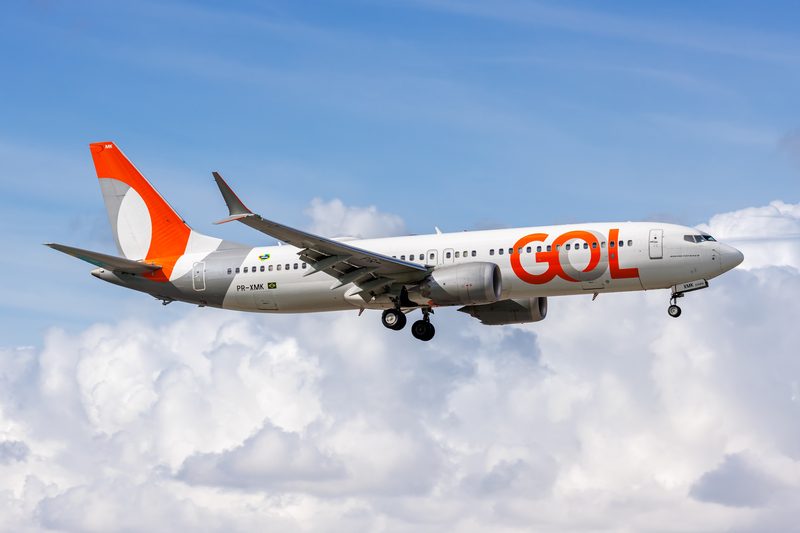
GOL Linhas Aéreas (G3) has confirmed it will launch nonstop flights between Asunción (ASU) and Miami (MIA) in the first half of June 2026, operating four times weekly with the Boeing 737 MAX. At roughly 6,154 km and an estimated eight-hour block time, the route is set to become GOL’s longest-ever 737 MAX sector, surpassing the airline’s previous length benchmark on Brasília (BSB)–Orlando (MCO).
It’s also a major connectivity milestone for Paraguay: ASU–MIA is positioned to be the country’s only nonstop service to the United States, restoring a direct link that has been absent for most of the last two decades and giving Paraguay a single-hop connection into one of North America’s biggest airline hubs.
The route: ASU–MIA goes long-haul on a narrowbody
GOL is entering territory that airlines approach carefully—true long-haul flying on a single-aisle jet. ASU–MIA sits near the upper edge of what a 737 MAX can do efficiently, especially when you account for seasonal winds and reserve fuel requirements.
Read our stories in your inbox
Two aviation newsletters. Zero fluff.
That’s why this announcement matters beyond the press-release glow. For a network planner, a four-weekly long sector like this is a very specific bet:
-
High utility: Miami is a powerful gateway for onward connections and diaspora traffic.
-
Contained risk: Four weekly frequencies are easier to protect than daily flying if early performance is variable.
-
Right-sized capacity: The 737 MAX lets GOL test demand without committing a widebody it doesn’t operate.
While GOL hasn’t publicly pinned the route to a specific MAX sub-variant in the announcement language, its long-haul international flying to Florida has historically aligned with the 737 MAX 8, a type built around extended range capability, improved fuel burn, and high-density economics compared with older 737NG aircraft.
Aircraft and performance: what the 737 MAX brings to an eight-hour mission
The Boeing 737 MAX family is powered by CFM LEAP-1B engines and features aerodynamic upgrades (including the distinctive split-tip winglet) that materially improve fuel efficiency. Those gains are exactly what make an eight-hour narrowbody plausible in commercial service—at least on the right days, with the right payload, and with the right operational planning.
But long narrowbody missions aren’t just about range on a brochure. They’re about payload-range reality:
-
Westbound vs. eastbound performance can diverge sharply based on winds.
-
Cargo may be limited on heavier days if the airplane needs more fuel margin.
-
Temperature and runway performance at ASU can influence takeoff weight and dispatch options.
The key operational advantage GOL has is simplicity: it runs a highly standardized narrowbody fleet, meaning training, spares, and crew utilization are built around one core aircraft family—useful when you’re asking the airplane to do something at the edge of its mission profile.
Why Miami: MIA is the connectivity engine
Miami (MIA) isn’t just a destination. It’s a distribution point.
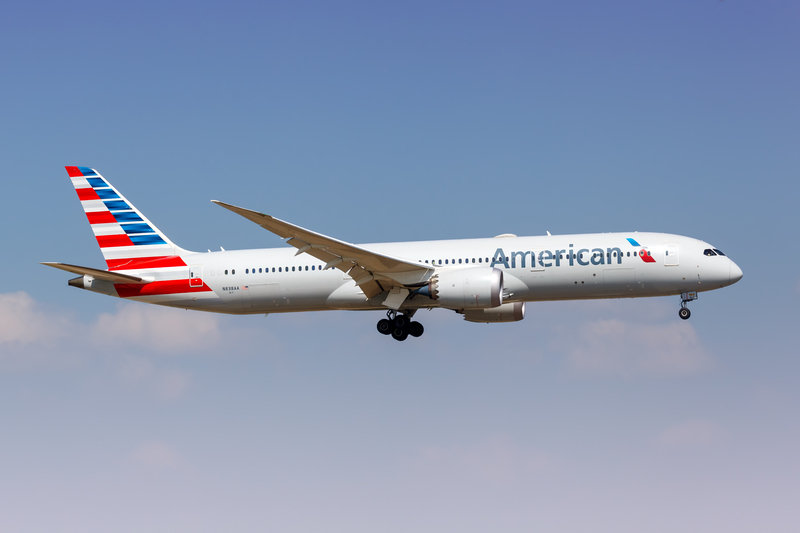
GOL says it will maintain its strategic alliance with American Airlines (AA) at MIA, which is the practical backbone of the route’s connectivity story. For passengers, that means ASU–MIA can function as more than “Paraguay to Florida.” It becomes a one-stop pathway onward across:
-
the U.S. domestic network,
-
Canada,
-
and select long-haul connections beyond.
For Paraguay, that matters because a single nonstop flight is helpful—but a nonstop into a hub with deep onward options is transformative.
Paraguay’s U.S. access: from one-stop dependence to a nonstop option
Today, Paraguay–U.S. travel is largely a one-stop proposition, commonly routed via major hubs such as:
A nonstop to Miami won’t eliminate those options—many travelers will still choose the best fare and schedule—but it introduces a new benchmark: a direct flight that removes connection risk, reduces total journey time for many itineraries, and makes Miami a practical first-stop for corporate and institutional travel.
It also carries symbolic weight. American Airlines previously served Asunción years ago, and other operators have dipped in and out since. A stable ASU–MIA schedule backed by a major hub partnership would be the first modern attempt to make the link stick with a large-scale distribution plan behind it.
Product angle: GOL “Premium Economy” on a MAX, built for long sectors
GOL plans to sell the route with its GOL Premium Economy offering—an important detail when you’re asking passengers to spend eight hours on a narrowbody.
GOL’s Premium Economy concept is not a separate cabin with new seats. It’s a smart, low-complexity upgrade: a blocked middle seat that creates shoulder-space and a calmer experience, paired with enhanced service elements that can include hot meals on longer routes. It’s a familiar playbook in global short-haul “business class” markets—except here it’s being deployed to make a long narrowbody sector more tolerable for travelers who won’t pay lie-flat fares but still want breathing room.
That’s commercially relevant because ASU–MIA will be competing not just on price, but on the overall “cost of fatigue” versus one-stop itineraries on widebodies.
The real test: reliability, reserves, and customer expectations
Long narrowbody routes can succeed—but they need disciplined execution. The biggest variables to watch after launch are:
-
Operational reliability: on-time performance and completion factor are everything on a four-weekly schedule.
-
Fuel planning and alternates: Caribbean and Florida weather can drive holding and diversion scenarios that squeeze reserve margins.
-
Weight restrictions: if payload limits appear regularly, the economics and customer experience can shift fast.
-
Connection integrity at MIA: tight misconnect handling matters when your entire proposition is “simpler travel.”
If GOL can keep the operation clean, ASU–MIA becomes a strong, defensible niche: Paraguay’s direct link to the U.S., tied into a major hub, flown with a cost-efficient narrowbody that can make the route viable without widebody economics.
Bottom Line
GOL’s new Asunción (ASU)–Miami (MIA) nonstop—launching in June 2026 with four weekly 737 MAX flights—is a meaningful swing at both connectivity and capability. At around 6,154 km and roughly eight hours, it’s poised to become GOL’s longest 737 MAX route, and it would make ASU Paraguay’s only nonstop gateway to the United States. The partnership connectivity at MIA, plus a comfort-focused upsell like GOL Premium Economy (blocked middle seat and upgraded service), gives the route a fighting chance against well-established one-stop options—provided the airline can keep performance disciplined on a mission that pushes the MAX close to its practical long-range envelope.
Keep reading FlyMag
Get the Daily Brief in the morning or the Route Watch weekly recap on Fridays. Or both.
Share this story
Composed for each network — click to share, or copy the composed text for your own timing.