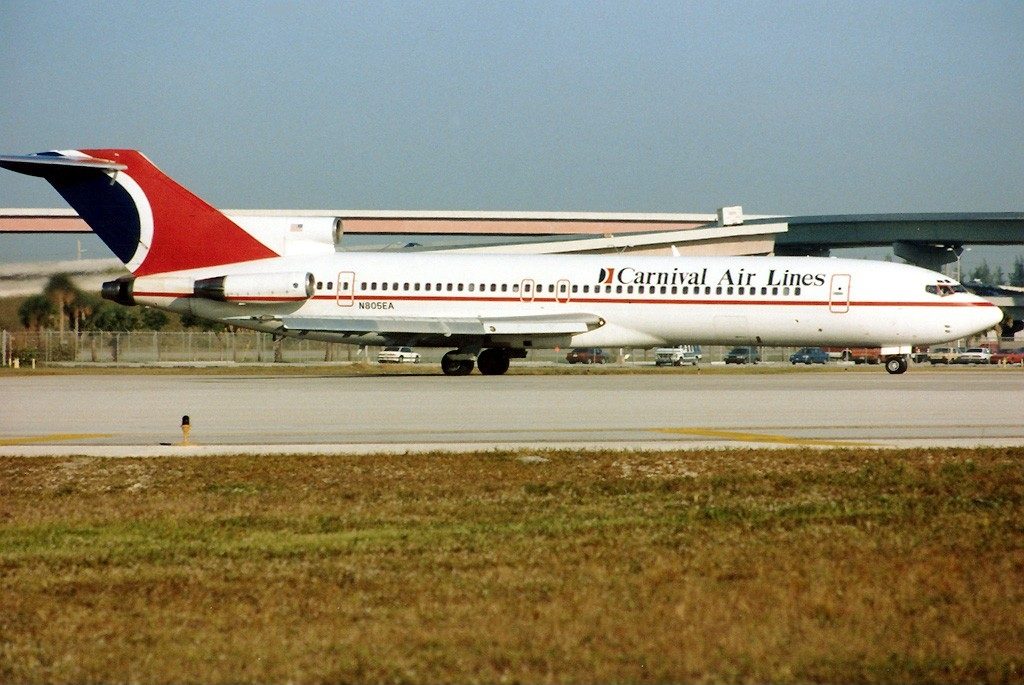
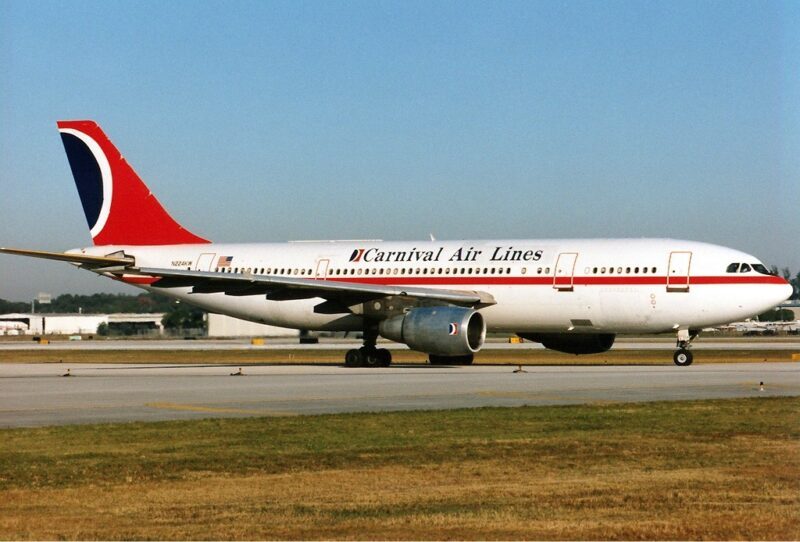
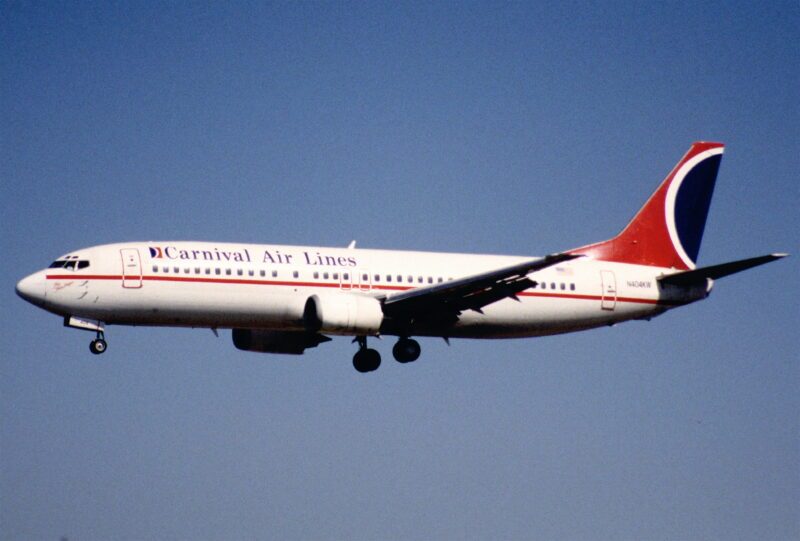
Before boarding one of Carnival’s “Fun Ships,” travelers could once begin their vacation aboard a “Fun Jet.” During the 1990s, the familiar Carnival name appeared not only on cruise ships but also on airliners, complete with a red fuselage stripe and a tail design inspired by the cruise brand’s distinctive funnel. This was Carnival Air Lines, an airline whose identity promised that the vacation could begin before passengers reached the port.
Yet the airline became much more than a way to deliver people to ships. It developed a scheduled passenger business, operated both narrowbody and widebody aircraft, and eventually became entangled in an attempt to revive another famous transportation name: Pan Am. Its story is an unusual intersection of cruise-industry ambition and the unforgiving economics of commercial aviation.
From Charter Flights to Carnival Colors
Carnival Air Lines’ roots stretched back to 1984, when Pacific Interstate Airlines was established in Las Vegas. The small charter operator subsequently became Pacific Inter Air and, in 1987, Bahamas ExPress, shifting its attention toward flights between the eastern United States and the Bahamas. Following its acquisition in 1988, the operation passed through another proposed identity, Fun Air, before the Carnival Air Lines name emerged in 1989.
Read our stories in your inbox
Two aviation newsletters. Zero fluff.
Scheduled service under the Carnival name began in August 1989, initially serving New York, Miami, and Nassau. The branding deliberately connected the airline with its seagoing counterpart: “Fun Jets” complemented “Fun Ships,” while the aircraft’s red, white, and blue markings made the relationship immediately recognizable.
There was, however, an important distinction behind the shared branding. Carnival Air Lines was associated with the Arison family rather than simply functioning as a department of the publicly traded cruise company. Contemporary Cruise Industry News reporting explicitly described Micky Arison’s airline as a separate entity from Carnival Corporation. The connection was real, but the two businesses were not interchangeable.
More Than a Shuttle to the Ship
The connection between air travel and cruising offered an obvious commercial opportunity. A cruise vacation often begins with a flight, and an affiliated airline could participate in that part of the journey rather than leaving it entirely to other carriers.
The broader vacation business mattered, too. Histories of Carnival Air Lines identify Nassau’s Crystal Palace Resort and Casino as another attraction the airline helped feed. The concept therefore extended beyond moving passengers between an airport and a cruise terminal: it also connected travelers with land-based leisure destinations.
But passengers did not need a cruise reservation to fly Carnival. By 1997, contemporary industry coverage emphasized that the airline did not specifically cater to the cruise operation’s need for seats. It had become a business serving the wider air-travel market, despite carrying a name strongly associated with vacations at sea.
That distinction is central to understanding its history. Carnival Air Lines was not merely a charter arrangement or a promotional livery. It had to attract passengers, compete on fares, and sustain an airline network in its own right.
A Network Built Around Florida and the Northeast
Carnival’s November 1995 route map illustrates the scale of that network. Florida was its center of gravity, with service at Fort Lauderdale–Hollywood International Airport (FLL), Miami International Airport (MIA), Orlando International Airport (MCO), Tampa International Airport (TPA), and other points in the state. A dense collection of routes connected Florida with the Northeast.
The airline served major gateways, including New York’s John F. Kennedy International Airport (JFK), but also reached travelers through smaller airports. Long Island MacArthur Airport (ISP), Westchester County Airport (HPN), and Stewart International Airport (SWF) all appeared on the map. These were not simply different dots around New York: they offered ways to reach passengers closer to where they lived.
Its reach extended well beyond the mainland’s eastern corridor. Los Angeles International Airport (LAX) anchored the western end of the network, while Puerto Rico had three destinations: Luis Muñoz Marín International Airport (SJU) in San Juan, Rafael Hernández Airport (BQN) in Aguadilla, and Mercedita Airport (PSE) in Ponce. Nassau and Port-au-Prince also appeared on the published network.
The result was an airline with a recognizable regional focus, but considerably more ambition than its cruise-oriented image might suggest.
Boeing Trijets, Newer 737s, and Airbus Widebodies
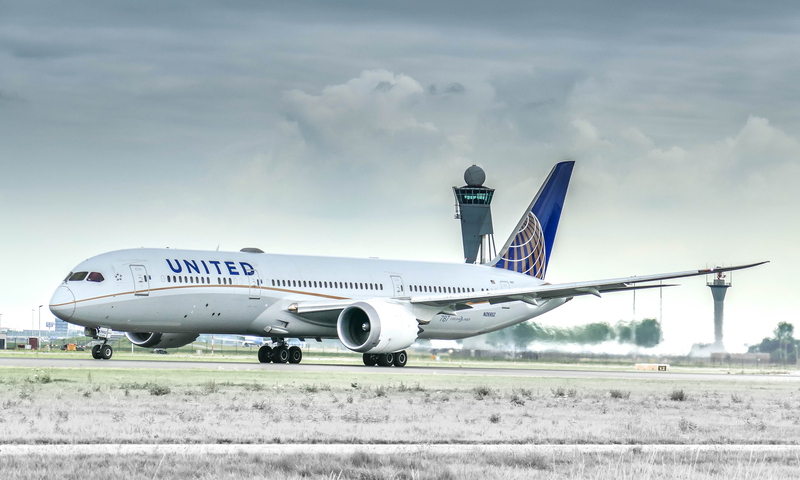
Carnival’s aircraft were equally varied. Its fleet history included Boeing 727-100s and 727-200s, Boeing 737-200s, and the newer Boeing 737-400. Airbus A300B4 widebodies joined in 1994, adding another aircraft family to an already diverse operation.
The airline was not exclusively a collection of older, secondhand jets. Beginning in October 1992, it took brand-new Boeing 737-400s on lease from International Lease Finance Corporation. Seven longer-term aircraft carried registrations from N401KW through N407KW, alongside additional short-term leased examples.
Carnival also established relationships that placed it within international passengers’ itineraries. An agreement with Iberia connected the Spanish airline’s arriving passengers at Miami International Airport (MIA) with Carnival service to Los Angeles International Airport (LAX). The cruise-associated carrier was therefore doing work familiar to much larger airlines: carrying connecting traffic for an overseas partner.
By March 1997, Carnival operated 27 jets and had generated approximately $270 million in revenue during the previous year.
A New Pan Am Offers a Way Forward
The Pan Am that approached Carnival was not the original global airline continuing uninterrupted. That company had stopped flying in 1991. A new venture, commonly called Pan Am II, launched in September 1996 using the famous name, with Airbus A300 aircraft and a much smaller network.
For the revived Pan Am, Carnival offered an established operation and a substantially larger fleet. A renewed acquisition agreement was announced in March 1997 after an earlier attempt had fallen through. As part of the arrangement, Arison committed $30 million and was to receive approximately 42% of Pan Am. Regulatory approval followed in September.
The problem was that Carnival was already under financial pressure. A later federal appeals court opinion documented that aircraft lessor Pacific Harbor Capital sued the airline in June 1997 after it fell behind on payments. The difficulties were not merely a consequence of the eventual merger; they were evident while the transaction was still being completed.
Combining the businesses did not produce a financial recovery. The Associated Press subsequently reported that the two airlines together lost more than $127 million during the first nine months of 1997. A famous name and a larger network were not enough to overcome the cash shortage.
Bankruptcy and the Last Scheduled Flights
On February 26, 1998, Pan Am and Carnival filed for Chapter 11 bankruptcy protection and stopped scheduled operations. According to contemporary Associated Press coverage, the business had approximately $50 million in assets against $147 million in debts. About 1,450 employees faced losing their jobs. Most of the 14 jets still operating at the shutdown continued to carry Carnival’s name.
One detail captured how abruptly the money had run out. Pan Am Flight 25 from New York to Miami was delayed for three hours on the final night because suppliers were unwilling to fuel the aircraft on credit. For the passengers and crew, the collapse was not an abstract balance-sheet problem; it was unfolding around their flight.
There was an afterlife, although not for the Carnival brand. Limited charter operations resumed using Carnival’s operating certificate, and Guilford Transportation Industries acquired assets from the bankrupt businesses. The reorganized operation emerged in June 1998 under the Pan Am name. In an unusual reversal, the less-famous airline’s certificate helped keep the better-known brand flying.
Bottom Line
Carnival Air Lines deserves to be remembered as more than a cruise-industry curiosity. Behind the familiar vacation branding was a substantial airline, with an extensive Florida-centered network, several aircraft families, and passengers whose journeys had nothing to do with boarding a ship. Its eventual combination with Pan Am added another recognizable name without resolving the underlying financial problems.
Its appeal was easy to understand: a familiar vacation brand could welcome travelers before they ever reached the water. Making that idea work as a sustainable airline proved considerably harder.