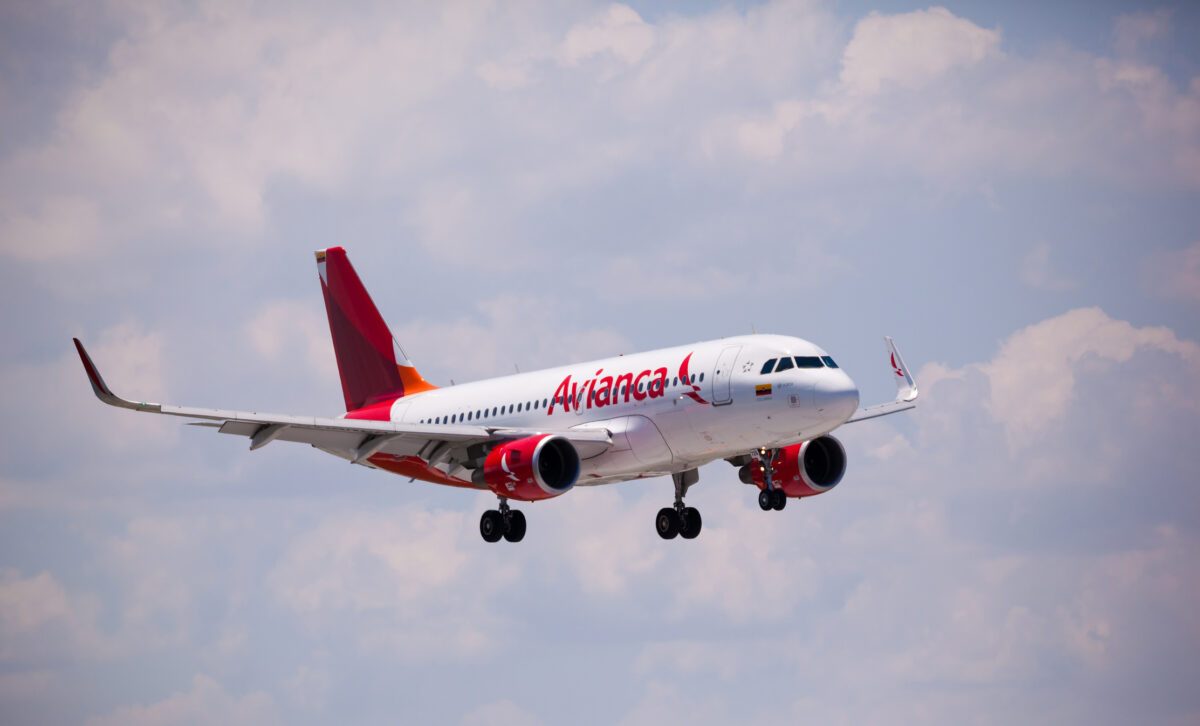
Avianca has restored daily service between Bogotá (BOG) and Caracas (CCS), while adding Maracaibo (MAR) as the third Venezuelan destination in its current network from the Colombian capital.

The Caracas route resumed from Bogotá on September 1, with the return flight beginning September 2. The new daily service between BOG and Maracaibo started on August 28, joining Avianca’s continuing Bogotá–Valencia (VLN) operation.
Together, the three routes give Avianca one daily round trip to each Venezuelan city. The airline said its expanded schedule provides more than 7,500 seats per week between Colombia and Venezuela.
Read our stories in your inbox
Two aviation newsletters. Zero fluff.
Caracas Returns With an Overnight Schedule
Avianca is operating the restored Caracas service as AV122 and AV123. AV122 leaves BOG at 11:20 p.m. and reaches CCS at 2:25 a.m. local time the following morning. AV123 departs Caracas at 4 a.m. and arrives in Bogotá at 5 a.m.
The overnight pattern is the same timing Avianca introduced when it added a second daily Caracas frequency in March. Its early arrival at BOG positions passengers for onward morning departures, while the late-night outbound flight can collect traffic arriving in Bogotá during the day.
Caracas had returned to Avianca’s network on February 12, initially with one daily round trip. That first frequency, AV142 and AV143, operated during the day. Avianca said at the time that the relaunch restored access from Caracas to 83 destinations in 28 countries through its network.
The airline doubled the route from March 28 by adding the overnight rotation. With two daily flights in each direction and 180 seats per departure, Avianca calculated that the Bogotá–Caracas market would receive about 5,040 weekly seats.
That operation was interrupted after CCS temporarily closed during the emergency that followed earthquakes in Venezuela on June 24. Avianca shifted its regular Venezuela flying to Valencia and also used additional charter services to support passenger movements and relief work. The airline said those flights were operated with its A320 fleet.

The resumption at CCS follows what Avianca described as a coordinated assessment of operational and security conditions with the relevant authorities. Caracas returns with one daily frequency rather than the two flown before the disruption, but Valencia remains in the schedule.
Maracaibo Adds a Western Venezuela Gateway
The Maracaibo route operates as AV94 from Bogotá and AV95 in the opposite direction. AV94 departs BOG at 3:05 p.m. and arrives at MAR at 5:40 p.m. local time. The aircraft leaves Maracaibo at 7 p.m., landing back in Bogotá at 7:25 p.m.
Avianca placed the route on sale in May, then launched it on August 28. The carrier said the daily operation would contribute more than 2,500 weekly seats in the Maracaibo market and connect the state of Zulia directly with its Bogotá network.
The schedule also gives Avianca a broader geographic presence in Venezuela. Caracas serves the capital region, Valencia provides an alternative in the country’s central industrial corridor, and Maracaibo opens direct access to western Venezuela rather than requiring passengers to begin an international itinerary through one of the two central gateways.
Maracaibo’s afternoon departure from Bogotá and evening return create a compact rotation, allowing the aircraft to operate other sectors earlier in the day. The timing in Bogotá also places the outbound service after morning and midday arrivals into the hub, while passengers reaching BOG from Maracaibo can connect into selected late departures.
Three Daily A320 Rotations
Valencia remains a daily service under flight numbers AV942 and AV943. The outbound leaves Bogotá at 7:35 a.m. and reaches VLN at 10:35 a.m.; the return departs at 12:25 p.m. and arrives at BOG at 1:10 p.m.
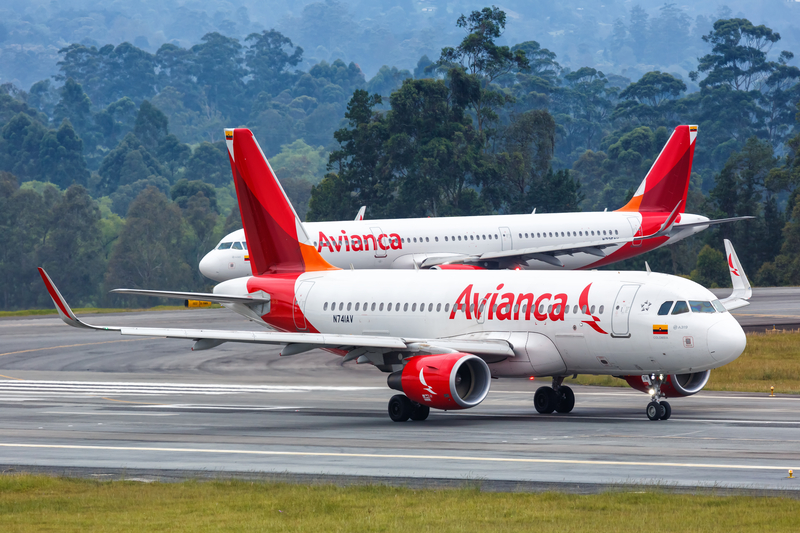
Avianca is assigning 180-seat Airbus A320 aircraft to all three Venezuelan routes. Across six daily sectors, that produces a nominal 1,080 one-way seats each day, or 7,560 seats over a full seven-day schedule.
The 180-seat layout uses the full published capacity of the conventional A320 airframe. Airbus lists the A320ceo with a maximum capacity of 180 passengers, although Avianca has not distinguished between engine variants in announcing the Venezuela schedule. For these short regional sectors, the configuration gives Avianca relatively high gauge while retaining the fleet commonality of its core narrowbody type.
The present network also represents a change in how Avianca distributes its Venezuela capacity. The March plan concentrated roughly 5,040 weekly seats on two daily Caracas rotations. The latest schedule spreads about 7,560 seats across three cities, a nominal 50% increase over that earlier Caracas-only figure while reducing dependence on a single Venezuelan airport.
Avianca said it has served Venezuela for more than six decades. During the recent emergency, the wider group also used its cargo operation to move about 150 tons of humanitarian aid, while donated LifeMiles helped transport more than 134 doctors and rescue workers from 14 organizations.
Bottom Line
Maracaibo is the strategically important addition. It extends Avianca’s reach beyond Venezuela’s central airport system and gives travelers in Zulia direct access to Bogotá’s connecting banks. Daily frequency and a full-size A320 also indicate that Avianca is treating the route as a network market rather than a limited experimental service.
Keeping Valencia after Caracas reopened is equally significant. What began as an operational alternative during the closure of CCS has become part of a three-city schedule, leaving Avianca with a more resilient structure and more total capacity than it offered when two daily flights were concentrated on Caracas.
The next measure of the strategy will be whether demand supports daily service at all three points after the initial recovery period. Caracas previously sustained two daily rotations, so Avianca still has room to restore frequency there if traffic rebounds without sacrificing the new access it has established at Valencia and Maracaibo.
Keep reading FlyMag
Get the Daily Brief in the morning or the Route Watch weekly recap on Fridays. Or both.