Air Niugini plans to restore nonstop flights between Jacksons International Airport (POM) in Port Moresby and Auckland Airport (AKL), reestablishing a direct air link between Papua New Guinea and New Zealand after an absence of approximately 28 years.

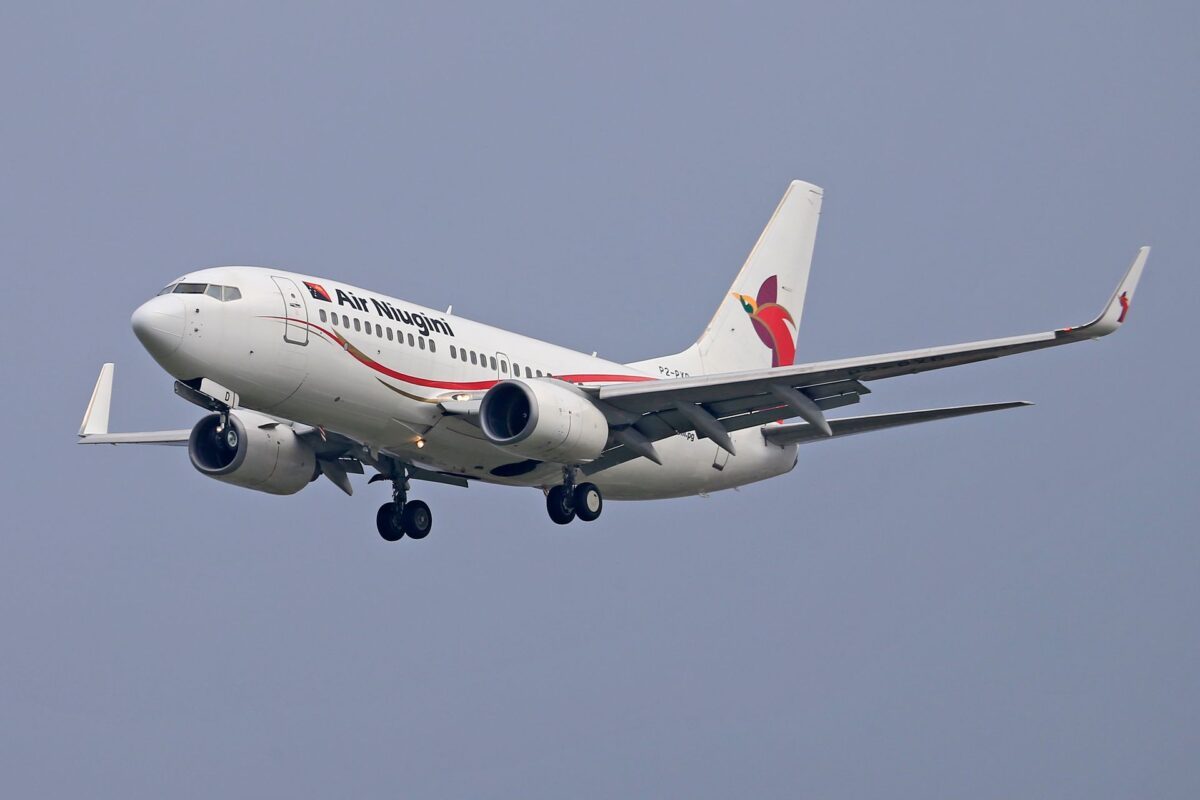
The three-times-weekly service is now scheduled to begin on November 19, 2026, using a Boeing 737-800. Air Niugini will be the only airline operating nonstop between Port Moresby and Auckland, eliminating the need for passengers to connect through Australia or another South Pacific gateway.
The route has been postponed more than once. It was initially filed to begin on June 11, subsequently moved to September 1, and is now planned for mid-November. The most recent schedule describes November 19 as the earliest resumption date, making additional monitoring advisable until flights are fully available across Air Niugini’s reservation channels.
Read our stories in your inbox
Two aviation newsletters. Zero fluff.
Air Niugini’s Proposed Port Moresby–Auckland Schedule
Air Niugini plans to operate flight PX031 from Jacksons International Airport (POM) on Tuesdays, Thursdays, and Saturdays. The return flight, PX032, will leave Auckland Airport (AKL) the following morning on Wednesdays, Fridays, and Sundays.
| Flight | Route | Days | Departure | Arrival | Scheduled Block Time | Aircraft |
|---|---|---|---|---|---|---|
| PX031 | Port Moresby (POM)–Auckland (AKL) | Tuesday, Thursday and Saturday | 9:50 a.m. | 6:30 p.m. | 5 hours, 40 minutes | Boeing 737-800 |
| PX032 | Auckland (AKL)–Port Moresby (POM) | Wednesday, Friday and Sunday | 9:00 a.m. | 12:00 p.m. | 6 hours | Boeing 737-800 |
All times are local. The route covers approximately 2,560 statute miles, or 4,120 kilometers, across the Coral and Tasman seas.
The scheduled flight times require clarification because New Zealand observes daylight saving time in November while Papua New Guinea does not. Auckland will be three hours ahead of Port Moresby when the route begins.
A 9:50 a.m. departure from Jacksons International Airport (POM) and 6:30 p.m. arrival at Auckland Airport (AKL) therefore represents five hours and 40 minutes in the air and on the ground, not four hours and 40 minutes as originally reported. The return schedule similarly produces a six-hour block time rather than five hours.
The Boeing Will Remain in Auckland Overnight
Flight PX031 is scheduled to arrive at Auckland Airport (AKL) at 6:30 p.m., but PX032 will not depart for Jacksons International Airport (POM) until 9:00 the following morning.
That gives the aircraft approximately 14 hours and 30 minutes on the ground in Auckland.
The long overnight stop is unusual from a pure aircraft-utilization perspective. Airlines generally prefer to keep aircraft flying rather than leave them parked away from their primary base for more than half a day.
Air Niugini has not publicly explained its scheduling decision. The timing may allow the operating pilots and cabin crew to receive a full overnight rest in Auckland rather than requiring an augmented crew or an immediate overnight return. It may also be designed around domestic connection banks at Jacksons International Airport (POM).
The morning departure from Port Moresby gives passengers from other Papua New Guinean cities an opportunity to connect into PX031 after arriving early in the day. In the opposite direction, PX032’s noon arrival at Jacksons International Airport (POM) could support afternoon connections to Air Niugini’s domestic and regional network.
Those benefits must be balanced against the cost of keeping a Boeing 737 and its crew in New Zealand overnight three times each week. The airline has not said whether the schedule will be revised after the route becomes established.
The Route Has Already Been Delayed Twice
Air Niugini originally planned to restore the Auckland service on June 11, 2026. That date was later moved to September 1 before the airline filed another schedule change placing the first flight on November 19.
The frequency and operating pattern have remained broadly consistent throughout the changes: three weekly flights with the outbound service operating on Tuesdays, Thursdays, and Saturdays and the aircraft returning the following mornings.
The airline has not publicly attributed the postponements to a particular cause. Fleet availability, regulatory approvals, crew preparation, schedule coordination, airport arrangements, and commercial considerations can all delay the opening of an international route, but none has been confirmed as the reason in this case.
Air Niugini’s website also presents an inconsistent picture.
Auckland has begun appearing on the carrier’s official route map and on a dedicated Port Moresby–Auckland fare page. However, another Air Niugini destination page still contains outdated language stating that the airline does not operate direct flights to Auckland.
The airline will need to align its booking engine, route map, schedules, and passenger information well before November. That is particularly important for a route targeting seasonal workers and international travelers who may be arranging employment, accommodations, and connecting transportation several months in advance.
Air Niugini Last Served Auckland in 1998
Air Niugini last operated regular service between Port Moresby and Auckland in 1998, according to the historical schedule review accompanying the latest filing.
The November 2026 launch would therefore restore the market after approximately 28 years.
The aviation markets of both countries have changed considerably during that period. Air Niugini has expanded its regional and Asian network, while travel between Papua New Guinea and New Zealand has developed around employment, education, tourism, government links, family travel, and trade.
Without a nonstop flight, passengers generally need to connect through an Australian airport or another Pacific gateway. A direct service removes the additional transfer and allows Air Niugini to control the complete passenger journey between the two countries.
The nonstop will also give Air Niugini an advantage over one-stop competitors in journey time. Its weakness will be frequency: three weekly flights are adequate for leisure and planned employment travel but less convenient for business passengers requiring daily flexibility.
The Boeing 737-800 Is the Filed Launch Aircraft
Air Niugini currently plans to operate the route with a Boeing 737-800, the larger and longer-range member of the airline’s established Boeing narrowbody fleet.
The 737-800 is well suited to the approximately 2,230-nautical-mile sector. The route is substantial for a single-aisle aircraft but remains comfortably within the type’s normal capabilities, subject to winds, payload, weather, diversion requirements, and the operating weight of the particular aircraft.
The original report described the aircraft as having 138 seats. That figure appears to refer only to Economy Class.
Air Niugini has previously marketed a Boeing 737-800 configuration with 20 Business Class seats and 138 Economy Class seats, producing a total capacity of 158 passengers. Cabin layouts can change, and the airline has not guaranteed that every Auckland flight will use that exact configuration.
If the 158-seat configuration is used, three weekly flights would provide approximately 474 seats in each direction, or 948 directional seats across the route each week.
That is a relatively cautious level of capacity. Air Niugini can concentrate demand onto three departures rather than attempting to fill a daily aircraft, while still offering enough seats for organized seasonal-worker movements, tour groups, visiting-friends-and-relatives traffic, and connections through Port Moresby.
The 737-800’s smaller capacity also reduces risk compared with launching the route using a widebody aircraft. However, a five- to six-hour single-aisle flight will place greater importance on cabin comfort, catering, seat pitch, inflight entertainment, and the consistency of the Business Class product.
An Airbus A220-300 Switch Is Not Yet Confirmed
The source report states that Air Niugini intends to replace the Boeing 737-800 with an Airbus A220-300 during 2027. That may ultimately happen, but the currently filed Auckland schedule does not confirm an aircraft change.
Air Niugini received its first Airbus A220-300 in September 2025 as part of a major fleet-modernization program. The airline configures the aircraft with 138 seats across two cabins and promotes features including larger windows, wider seats, a quieter cabin, larger overhead storage, and complimentary onboard Wi-Fi.
The A220-300 began Air Niugini’s scheduled international operations to Cairns Airport (CNS) on March 27, 2026, followed by service to Sydney Kingsford Smith Airport (SYD) on March 29. The aircraft is therefore already being used beyond Papua New Guinea rather than being restricted to domestic flying.
From a network-planning standpoint, the A220-300 would be a logical future option for Auckland Airport (AKL).
Its 138-seat cabin would reduce weekly capacity relative to the 158-seat 737-800, while its modern engines and airframe could provide lower fuel consumption and improved economics on a route of this length. The A220’s passenger experience may also be more competitive on a sector scheduled at nearly six hours.
Air Niugini will nevertheless need to receive and introduce enough A220s before assigning one permanently to Auckland. Fleet deliveries, pilot qualification, maintenance support, spare-aircraft coverage, and competing requirements elsewhere in the network will determine when—or whether—the change occurs.
For now, the Boeing 737-800 remains the only aircraft formally identified in the latest schedule.
Seasonal Workers Will Be an Important Passenger Segment
The route is being timed partly around the movement of Papua New Guinean seasonal workers traveling to New Zealand’s horticulture and viticulture industries.
New Zealand’s Recognised Seasonal Employer program allows approved businesses to recruit eligible overseas employees for seasonal jobs including planting, maintaining, harvesting, and packing crops. Workers are generally permitted to remain for up to seven months during an 11-month period, subject to their nationality and visa conditions.
New Zealand government material says thousands of Pacific workers enter the country through the program each year. The scheme’s annual cap was set at 20,750 workers for the 2024–2025 season.
Local reporting has suggested that seasonal workers account for almost one-third of travel between Papua New Guinea and New Zealand. That exact percentage could not be independently confirmed through a publicly available New Zealand or Papua New Guinea government dataset.
Seasonal labor is clearly a meaningful part of the market, but it should not be treated as the route’s only source of demand.
The flight can also carry students, government employees, business travelers, tourists, sports groups, families, and Papua New Guineans living in New Zealand. Auckland’s large domestic network may allow travelers to continue to regional New Zealand destinations, although Air Niugini has not announced a domestic codeshare partner for the route.
A codeshare or interline agreement with a New Zealand carrier could materially expand the service’s reach. Without one, passengers traveling beyond Auckland Airport (AKL) may need separate tickets and could be responsible for collecting and rechecking baggage.
Port Moresby Connections Could Broaden the Market
Air Niugini is positioning Jacksons International Airport (POM) as more than the Papua New Guinea endpoint of the new route.
The airline’s domestic network reaches communities across a country where air transport plays an unusually important role. Port Moresby can aggregate passengers from smaller domestic markets and place them onto one Auckland departure.
The route may also attract New Zealand passengers traveling beyond Papua New Guinea.
Air Niugini promotes connections from Jacksons International Airport (POM) to international destinations including:
- Manila Ninoy Aquino International Airport (MNL)
- Hong Kong International Airport (HKG)
- Singapore Changi Airport (SIN)
- Tokyo Narita International Airport (NRT)
- Honiara International Airport (HIR)
- Bauerfield International Airport (VLI) in Port Vila
- Nadi International Airport (NAN)
The airline restored direct service to Tokyo Narita International Airport (NRT) on July 18, 2026, further expanding the Asian network that could potentially be connected with Auckland.
Whether those connections are commercially useful will depend on the timetable.
A route map can show that two destinations are served through the same hub, but passengers need reasonable connection times, through fares, checked baggage, and protection during disruptions. An itinerary requiring an overnight stay at Jacksons International Airport (POM) will appeal to fewer travelers than a coordinated two- or three-hour transfer.
The noon arrival of PX032 gives Air Niugini the opportunity to offer same-day afternoon departures. The airline has not yet published a complete connection table showing which international flights will reliably connect on Wednesdays, Fridays, and Sundays.
The Nonstop Could Strengthen Tourism in Both Directions
New Zealand is likely to be the larger outbound market, but the route creates tourism opportunities in both directions.
Papua New Guinea offers diving, trekking, fishing, cultural festivals, historical tourism, and access to destinations that remain difficult to reach from many international markets. A direct Auckland flight removes one connection for New Zealand travelers and could make organized Papua New Guinea tours easier to package.
Auckland and the wider New Zealand market offer a different demand profile for Papua New Guinean passengers. Travel may center on employment, education, family visits, shopping, medical appointments, major events, and conventional leisure tourism.
Three weekly flights allow tour operators and employers to build fixed travel programs around predictable departure days. The Tuesday, Thursday, and Saturday outbound pattern provides more flexibility than a once-weekly leisure route, although it remains less convenient than daily service.
Air Niugini will need to promote more than the nonstop itself. Demand will depend on competitive fares, reliable operations, distribution through New Zealand travel agencies, digital booking availability, baggage allowances, and effective connections beyond Port Moresby.
The Overnight Schedule May Support Crew Operations
The Auckland overnight creates an operational tradeoff.
Parking a Boeing 737-800 at Auckland Airport (AKL) for 14-and-a-half hours reduces aircraft utilization and generates expenses involving parking, crew accommodations, ground handling, and technical support.
It may also simplify the operation.
A same-evening return would likely require a lengthy crew duty day or an additional set of pilots and flight attendants. By keeping the aircraft overnight, Air Niugini can allow the outbound crew to rest before operating PX032 the next morning, depending on the airline’s approved rostering and flight-time limitations.
The schedule also avoids a very late-night arrival at Jacksons International Airport (POM). Instead, passengers reach Port Moresby at noon, when domestic connections, ground transportation, and airport services are more readily available.
The final decision may therefore prioritize passenger connections and crew legality over maximizing the number of hours the aircraft flies each day.
Three Weekly Flights Create Recovery Challenges
Limited-frequency international routes are particularly vulnerable to disruption.
If a daily flight is canceled, an airline may be able to move some passengers onto the following day’s service. A cancellation on a three-times-weekly route could leave travelers waiting two or three days for the next nonstop departure.
Air Niugini could potentially reroute passengers through Brisbane Airport (BNE), Cairns Airport (CNS), Sydney Kingsford Smith Airport (SYD), or another partner gateway. That would depend on available seats, ticketing agreements, immigration requirements, and the reason for the disruption.
The carrier’s relatively small narrowbody fleet also provides less substitution flexibility than the fleets of larger airlines. A technical problem involving the scheduled 737-800 could affect several routes if another aircraft is not immediately available.
The repeated postponement from June to September and then November does not prove that the route will be operationally unreliable. It does demonstrate why passengers should wait for a fully confirmed reservation, ticket number, and airline notification before arranging nonrefundable supporting travel.
Air Niugini will need dependable spare-aircraft coverage, maintenance support in Auckland, and clear passenger-reaccommodation procedures if it wants the service to develop a strong reputation.
The Route Gives Air Niugini a Distinctive Network Position
Air Niugini has traditionally focused its international operation on Australia, Asia, and nearby Pacific markets.
Adding Auckland Airport (AKL) creates another southern anchor in the network and gives the airline nonstop service to major airports in both Australia and New Zealand.
The carrier serves Australian gateways including Brisbane Airport (BNE), Cairns Airport (CNS), and Sydney Kingsford Smith Airport (SYD). Auckland will extend that regional footprint while allowing Air Niugini to compete for connecting traffic that currently flows through Australian hubs.
The route also supports a broader fleet strategy.
The Boeing 737-800 can open the service using an established and proven aircraft. The Airbus A220-300 may later allow Air Niugini to reduce capacity, improve the passenger experience, and lower operating costs once the new fleet is sufficiently mature.
That phased approach would be commercially sensible: establish the market with available equipment, measure demand, and then assign the aircraft that best matches the route’s long-term traffic and revenue.
Bottom Line
Air Niugini now plans to restore nonstop service between Jacksons International Airport (POM) and Auckland Airport (AKL) on November 19, 2026, reconnecting Papua New Guinea and New Zealand after approximately 28 years.
The route will operate three times weekly with a Boeing 737-800. Flight PX031 will leave Port Moresby on Tuesdays, Thursdays, and Saturdays at 9:50 a.m. and arrive in Auckland at 6:30 p.m. PX032 will return the following mornings at 9:00 and reach Port Moresby at noon.
Because Auckland is three hours ahead of Port Moresby in November, the actual scheduled block times are five hours and 40 minutes outbound and six hours on the return—not the shorter durations originally reported.
The service has already moved from June to September and now November, while parts of Air Niugini’s website remain inconsistent. The latest date should therefore be regarded as the airline’s current target rather than an irreversible launch commitment.
Seasonal-worker demand will be important, but the route’s long-term prospects will also depend on tourism, family traffic, education, business travel, domestic feed within Papua New Guinea, and connections to Air Niugini’s Asian and Pacific network.
A future Airbus A220-300 operation would be technically and commercially logical, particularly given the type’s 138-seat cabin and improving presence within Air Niugini’s international network. It is not yet confirmed for Auckland, and the current schedule remains assigned to the Boeing 737-800.
If Air Niugini can deliver reliable operations and well-timed connections at Jacksons International Airport (POM), Auckland could become more than a restored point-to-point route. It could give the airline a valuable new source of regional traffic while providing the only nonstop air link between Papua New Guinea and New Zealand.
Keep reading FlyMag
Get the Daily Brief in the morning or the Route Watch weekly recap on Fridays. Or both.