Turkish Airlines Adds Seven Leased A321neos as 2027 Fleet Expansion Accelerates
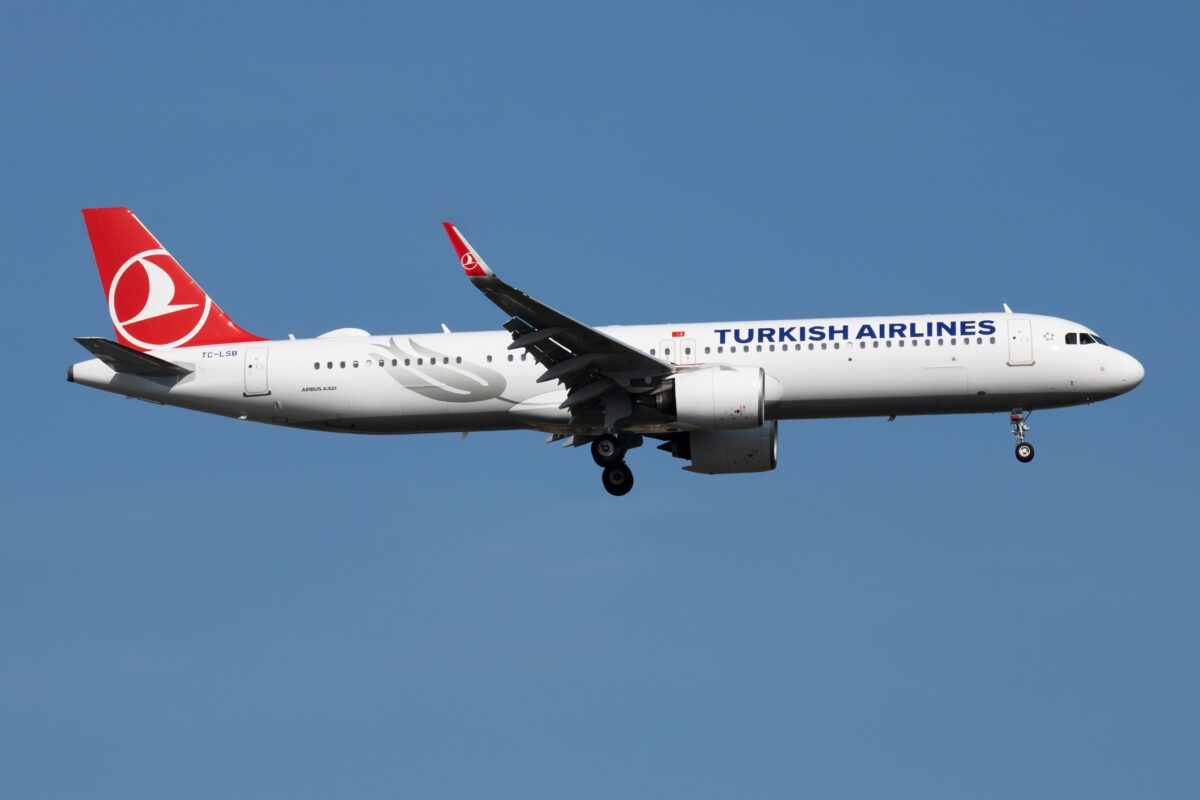
Turkish Airlines has agreed to lease seven new Airbus A321neo aircraft from China Aircraft Leasing Group Holdings, better known as CALC, as the carrier continues expanding and renewing its narrowbody fleet.
The agreement was announced at the Farnborough International Airshow on July 20, 2026, and represents the first commercial partnership between Turkish Airlines and the Hong Kong-based aircraft leasing company.
Deliveries are scheduled to begin in 2027, although the airlines have not disclosed when all seven aircraft will arrive. The aircraft will be powered by Pratt & Whitney PW1133GA-JM geared turbofan engines and will support Turkish Airlines’ continued growth from its primary hub at Istanbul Airport (IST).
Read our stories in your inbox
Two aviation newsletters. Zero fluff.
The deal adds relatively near-term capacity without requiring Turkish Airlines to wait for aircraft from its own direct order positions. CALC will supply the new-build A321neos through its portfolio and retain ownership while Turkish Airlines operates them under long-term leases.
Deliveries Will Begin in 2027
The seven aircraft are scheduled to begin joining Turkish Airlines in 2027.
CALC has not revealed the complete delivery sequence, meaning the jets could arrive over several months or across multiple years. Lease duration, financial terms, aircraft serial numbers and the Airbus production facilities responsible for final assembly were also not disclosed.
Turkish Airlines Senior Vice President of Investment Management Murat Baş said the agreement supports the carrier’s fleet-renewal program and its commitment to operating modern, fuel-efficient aircraft.
For CALC, the transaction adds one of the world’s largest international airlines to its customer portfolio. CALC President and Chief Commercial Officer Winnie Liu described the agreement as the beginning of a strategic partnership rather than a one-time placement.
That language suggests the companies could pursue additional transactions as Turkish Airlines moves toward a fleet of more than 800 aircraft under its broader Vision 2033 growth strategy.
Turkish Airlines Already Operates 75 A321neos
The A321neo is already one of the most important aircraft in the Turkish Airlines fleet.
According to current ch-aviation fleet data, the carrier operates 74 aircraft listed as A321-200NXs, including 34 leased from outside aircraft owners. Turkish Airlines also operates one leased A321-200N, bringing its current A321neo-family fleet to 75 aircraft.
Assuming no aircraft are returned to lessors or removed from service before the CALC deliveries are completed, the agreement could increase the fleet to 82 A321neo-family aircraft.
The seven CALC jets would also increase the role of leasing within the fleet. Approximately 46% of Turkish Airlines’ current 74-aircraft A321-200NX subfleet is leased. Adding the CALC aircraft would raise that figure to just over 50%, based on the present fleet structure.
Those percentages will likely change before the new aircraft arrive because Turkish Airlines continues to receive, lease and potentially return aircraft from several sources. Nevertheless, the transaction demonstrates that leasing remains an important part of the airline’s growth strategy.
Leasing Provides Faster Access to Aircraft
Airlines typically use a combination of purchased and leased aircraft rather than relying exclusively on one ownership model.
Direct purchases can provide lower long-term ownership costs, particularly when an airline plans to operate an aircraft for most of its useful life. However, securing delivery positions directly from Airbus or Boeing can require waiting several years because production slots for popular narrowbody aircraft are heavily committed.
Leasing allows an airline to obtain aircraft through delivery positions already controlled by a lessor. In this case, Turkish Airlines is gaining access to seven new A321neos through CALC rather than placing a separate order and joining the back of Airbus’ order queue.
Leases can also provide greater fleet flexibility. Aircraft can potentially be returned at the end of the contract, replaced with newer equipment or retained through an extension, depending on demand and market conditions.
The tradeoff is that Turkish Airlines will make regular lease payments without acquiring ownership of the aircraft. Lease contracts may also contain restrictions covering maintenance condition, utilization and the state in which each aircraft must be returned.
For an airline expanding as rapidly as Turkish Airlines, the ability to secure near-term capacity may be more important than owning every aircraft outright.
The A321neo Fits Turkish Airlines’ Istanbul Hub
The Airbus A321neo is the largest conventional member of the A320neo family and is particularly well suited to Turkish Airlines’ connecting network at Istanbul Airport (IST).
Airbus lists typical two-class capacity at between 180 and 220 passengers, with a maximum certified capacity of 244 seats in a high-density configuration. Turkish Airlines has not announced the cabin layout for the seven CALC aircraft or confirmed whether they will match the airline’s existing A321neos.
The manufacturer advertises a maximum range of up to 4,000 nautical miles, or approximately 7,400 kilometers, depending on the aircraft specification, passenger load and operating conditions.
That gives Turkish Airlines the flexibility to deploy the type throughout Europe, North Africa, the Middle East and Central Asia, as well as on selected longer routes from Istanbul Airport (IST).
The A321neo’s capacity is valuable on routes that have outgrown smaller Airbus A320s and Boeing 737s but do not require a twin-aisle Airbus A330, Airbus A350 or Boeing 787.
It can also replace older A321ceos while providing additional seats without requiring another departure slot at congested airports. That is increasingly important where Turkish Airlines wants to increase capacity but cannot easily add another daily frequency.
These Are Not Confirmed A321LRs or A321XLRs
The aircraft have been described in fleet databases as A321-200NXs, while CALC refers to them more broadly as Airbus A321neos.
No announcement identifies the seven aircraft as A321LRs or A321XLRs.
The distinction matters because the A321LR and A321XLR are specialized longer-range members of the A321neo family. They incorporate additional fuel capacity and structural changes that allow airlines to operate longer missions than the standard aircraft.
Turkish Airlines could still use the incoming jets on comparatively long routes within the standard A321neo’s capabilities. However, there is no evidence that this particular transaction is intended to open narrowbody transatlantic services or other missions requiring the A321XLR.
The more likely role is high-capacity service from Istanbul Airport (IST) across Turkish Airlines’ short- and medium-haul network, although no routes have been assigned publicly.
Pratt & Whitney Engines Preserve Fleet Commonality
CALC confirmed that the aircraft will use Pratt & Whitney PW1133GA-JM engines, part of the PW1100G-JM geared turbofan family developed for the Airbus A320neo family.
This aligns the new aircraft with the Pratt & Whitney-powered A321neos already operated by Turkish Airlines.
The geared turbofan architecture places a reduction gearbox between the fan and the low-pressure turbine. This allows the large front fan and internal turbine components to rotate at different optimal speeds, improving fuel efficiency and reducing noise.
Maintaining the same engine family across a large fleet can simplify pilot procedures, maintenance training, spare-parts inventories and technical support.
Turkish Airlines will already have established maintenance programs, engineering experience and operational data for the PW1100G-JM family by the time the CALC aircraft arrive.
The carrier’s current A321neo product includes individual inflight entertainment screens, onboard connectivity on equipped aircraft and separate Business and Economy Class cabins. Turkish Airlines has not said whether the seven leased aircraft will receive an identical interior or introduce an updated cabin.
Fuel Efficiency Matters at Turkish Airlines’ Scale
Airbus says the A321neo provides approximately 20% lower fuel consumption and carbon dioxide emissions per seat than previous-generation competing aircraft.
The exact savings depend on the aircraft being replaced, cabin density, route length, passenger load and operating conditions. A new A321neo replacing an older A321ceo will generally produce a more meaningful improvement than one simply adding new capacity.
Even relatively small reductions become significant across an airline as large as Turkish Airlines.
A narrowbody aircraft may operate several flights each day. Over a full year, seven aircraft can collectively complete thousands of sectors. Lower fuel consumption across that level of utilization can reduce operating expenses while also limiting emissions growth as the airline expands.
The A321neo also gives Turkish Airlines more seats per departure than smaller members of the A320 family. That can reduce fuel consumption per passenger when demand is sufficient to support the larger aircraft.
The economic advantage weakens when an aircraft operates with too many empty seats, making route selection and capacity management critical. Turkish Airlines’ connecting hub at Istanbul Airport (IST), however, gives it access to passenger flows from hundreds of city pairs rather than relying only on local demand for each route.
Istanbul’s Connecting Model Favors Larger Narrowbodies
Turkish Airlines’ network is built around combining passengers at Istanbul Airport (IST).
A traveler flying from a smaller European city to Central Asia, for example, may connect through Istanbul rather than traveling point to point. The airline can combine passengers from numerous origins and destinations onto the same flight, helping support larger aircraft and higher frequencies.
That hub structure makes the A321neo especially useful.
On a route with strong local and connecting demand, Turkish Airlines can deploy the A321neo instead of adding another frequency with a smaller aircraft. On thinner routes, the airline can continue using an Airbus A320, Boeing 737 or regional capacity provided by its wider group.
Fleet diversity allows Turkish Airlines to match aircraft size more closely to demand, although operating many different models also increases maintenance, crew-training and scheduling complexity.
Expanding an aircraft family already present in large numbers is less complicated than introducing a completely new type. The airline can integrate the seven CALC aircraft into existing A321neo pilot, cabin crew and maintenance operations at Istanbul Airport (IST).
Seven Aircraft Are Small Within the Broader Strategy
A seven-aircraft lease is meaningful, but it represents only a small part of Turkish Airlines’ long-term fleet plan.
The airline wants to operate more than 800 aircraft by its centennial year in 2033. Reaching that target will require a combination of direct orders, operating leases, finance leases and extensions involving aircraft already in service.
Turkish Airlines has made major commitments covering both narrowbody and widebody aircraft from Airbus and Boeing. It must also replace older aircraft while adding enough capacity to support new routes and additional frequencies.
As a result, not every delivery will translate directly into seven additional aircraft. Some incoming jets will replace older aircraft or aircraft being returned to leasing companies.
The CALC agreement gives Turkish Airlines another source of fleet capacity and reduces its dependence on delivery positions controlled by a single manufacturer, financier or lessor.
It also begins a relationship with a lessor that may be able to provide additional aircraft if Turkish Airlines requires more capacity before its own order book can meet demand.
Bottom Line
Turkish Airlines will lease seven new Airbus A321neos from CALC, with deliveries scheduled to begin in 2027.
The agreement is the first between the two companies and will introduce another lessor into Turkish Airlines’ increasingly diversified fleet-financing strategy. The aircraft will be powered by Pratt & Whitney PW1133GA-JM engines, providing commonality with A321neos already operating from Istanbul Airport (IST).
Turkish Airlines currently operates 75 A321neo-family aircraft. If the existing fleet remains unchanged, the CALC agreement could increase that total to 82 aircraft once all seven jets have been delivered.
No routes, cabin configuration, lease duration or complete delivery timetable have been announced. The aircraft have also not been identified as A321LRs or A321XLRs.
Rather than opening an entirely new operational category, the seven aircraft will strengthen a fleet type that is already central to Turkish Airlines’ network. The A321neo provides the capacity, range and per-seat efficiency required to support continued growth at Istanbul Airport (IST) without introducing the cost of a widebody on every high-demand regional route.
Keep reading FlyMag
Get the Daily Brief in the morning or the Route Watch weekly recap on Fridays. Or both.