Pope Leo XIV Switches Aircraft After Iberia A320 Engine Issue In Tenerife
Pope Leo XIV’s return from Spain took an unexpected turn on Friday after the Iberia aircraft scheduled to fly him from Tenerife to Rome could not depart because of a technical issue.

The Pope and his delegation had already boarded the Airbus A320 at Tenerife Norte-Ciudad de La Laguna Airport (TFN), also known as Los Rodeos.
The flight was due to carry him back to Rome after a weeklong apostolic visit to Spain.
Read our stories in your inbox
Two aviation newsletters. Zero fluff.
Instead, the aircraft remained on the ground. According to reports from the scene, the crew told passengers that one of the engines had failed to start, likely because of strong wind conditions at the airport.
Maintenance teams tried to resolve the issue. When that was not possible quickly, the Pope disembarked.
Spain’s King Felipe VI, who had just said farewell to the Pope, then offered an aircraft used by the Spanish state. Pope Leo XIV and a smaller group of aides later departed Tenerife (TFN) on a Falcon jet bound for Rome.
The Problem Happened Before Departure
The incident happened before takeoff.
That is important.
This was not an in-flight emergency. It was a ground technical issue during departure preparation at Tenerife Norte (TFN).
The Pope had boarded the Iberia aircraft at around 4:00 p.m. local time. The aircraft was already delayed because of the technical problem.
After the first engine-start attempt failed, maintenance teams reportedly recommended repositioning the aircraft into the wind for another attempt.
That did not solve the issue.
The flight was then cancelled for the papal group, and passengers were told to leave the aircraft.
Strong Winds Were A Factor
Tenerife Norte (TFN) is known for challenging weather.
The airport sits in the northern part of Tenerife, close to higher terrain and exposed to changeable winds and cloud. It has a long operational history and is very different from Tenerife South Airport (TFS), which handles more long-haul and holiday traffic.
On Friday, strong winds were reported at the airport.
Reuters reported that the Iberia captain told passengers the engine had likely failed to start because of wind. Spanish reporting also described strong gusts around the aircraft, including during the farewell ceremony.
Engine start issues linked to wind are unusual from a passenger point of view. But they can occur if airflow conditions interfere with a normal start sequence.
In that situation, the safest response is simple: stop the process and troubleshoot on the ground.
The Aircraft Was An Airbus A320
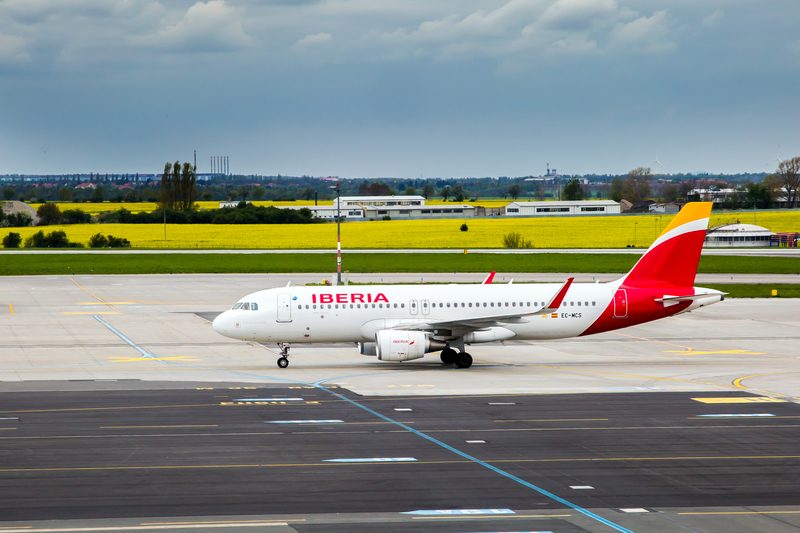
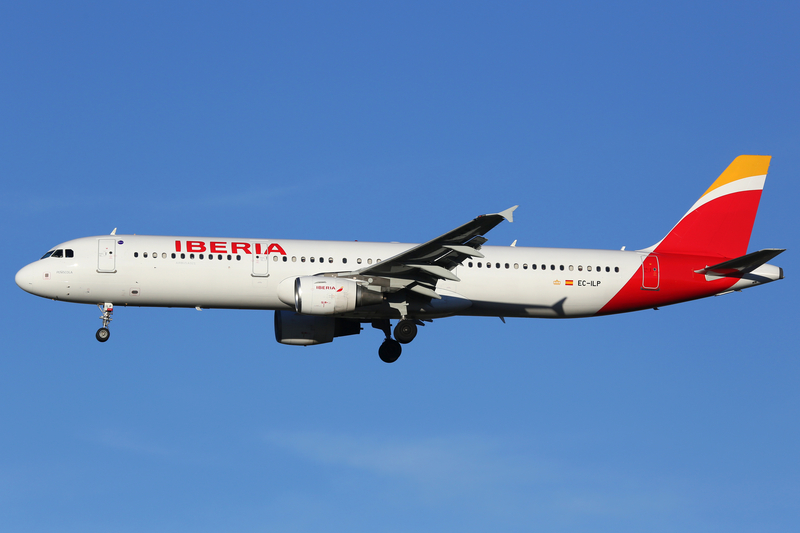
Iberia had assigned an Airbus A320-family aircraft to the papal flight.
The A320 is a short- and medium-haul narrowbody aircraft. It is widely used across Europe for domestic and international flights.
Iberia’s A320 and A320neo fleet is used on routes across Spain, Europe, and North Africa. Iberia lists its A320neo aircraft with 180 to 186 seats, a length of 37.57 meters, and a wingspan of 34.10 meters.
That makes the type a practical aircraft for the Pope’s Spain visit.
Iberia had already planned several papal sectors for the trip. Its schedule included Madrid (MAD) to Barcelona (BCN), Barcelona (BCN) to Las Palmas (LPA), Las Palmas (LPA) to Tenerife North (TFN), and Tenerife North (TFN) to Rome.
The final sector was the one affected.
King Felipe VI Offered A Falcon Jet
The situation changed quickly because King Felipe VI was still at the airport.
The Spanish monarch had just taken part in the official farewell ceremony. After the Iberia aircraft was unable to depart, he offered a Falcon aircraft used by the Spanish state.
Vatican News said Pope Leo XIV returned to Rome aboard an aircraft made available by the King of Spain.
The aircraft departed shortly after 6:00 p.m. local time.
It was a smaller aircraft than the Iberia A320. As a result, it could not carry the full papal delegation and press corps.
Only the Pope, close aides, and senior Holy See officials were able to travel on the Falcon.
The Rest Of The Delegation Stayed Behind
The aircraft swap created a capacity problem.
The Iberia A320 had been carrying Vatican officials, members of the Church, staff, security personnel, and about 80 journalists.
A Falcon business jet cannot carry that many people.
So the rest of the group remained in Tenerife.
Iberia said it would send a replacement aircraft from Madrid to carry the remaining Vatican staff and journalists to Rome later that day.
That split operation was not ideal. But it allowed the Pope to return to Rome without waiting for the original aircraft to be repaired.
Why The Falcon Was Suitable
The aircraft provided by Spain was reported as a Falcon jet operated for the Spanish state.
The Dassault Falcon 900LX family is a long-range trijet business aircraft. Dassault lists the Falcon 900LX with a range of 4,750 nautical miles.
That is far more than enough for a Tenerife (TFN) to Rome flight.
A Falcon also needs fewer passengers, less ground handling, and less boarding time than an airline narrowbody. That made it a useful solution for a small VIP group.
However, it was not a replacement for the full papal aircraft.
That is why Iberia had to arrange a separate aircraft for the rest of the delegation.
A Rare Papal Travel Disruption
Papal flights are highly planned operations.
They involve airlines, state protocol, security teams, airport authorities, the Holy See, and local governments.
A change of aircraft after boarding is therefore highly unusual.
The Associated Press reported that this was the first time in decades that a papal flight suffered a problem serious enough to require the Pope to change aircraft.
There have been other travel complications in papal history. Weather and operational issues have affected previous papal journeys.
But this case was unusual because the Pope had already boarded the aircraft and then had to disembark.
Why Host-Country Airlines Often Fly The Pope Home
The Iberia flight also fits a normal pattern for papal travel.
On many apostolic journeys, the Pope flies from Rome with the Italian carrier, now ITA Airways. For the return, the host country’s flag carrier often operates the flight.
That is why Iberia was operating the Spain sectors.
Iberia had promoted its role in the visit ahead of time. The airline said it would provide an aircraft for the Holy See and prepare the cabin with details linked to the papal journey.
That included the papal coat of arms near the forward door and special headrest covers with the Vatican emblem.
The technical issue in Tenerife did not change that broader tradition. It simply forced an unusual backup plan.
The A320 Issue Does Not Suggest A Broader Safety Problem
There is no indication that this incident points to a wider safety issue with Iberia or the Airbus A320.
Engine start failures can happen for several reasons. These can include environmental conditions, starter-system issues, engine-control logic, or other technical factors.
In this case, the crew did the right thing.
They did not depart with an unresolved technical problem. They kept the aircraft on the ground and allowed maintenance teams to assess it.
That is how the system is supposed to work.
A technical delay can be frustrating. But it is far better than trying to continue when an engine start sequence has not completed normally.
Tenerife’s Weather Added To The Drama
The weather made the scene more memorable.
Spanish reporting described strong gusts during the farewell at Tenerife Norte (TFN). The red carpet reportedly had to be secured because of the wind.
That same environment appears to have been part of the aircraft issue.
Tenerife Norte has long been more weather-sensitive than Tenerife South (TFS). Its location near the city of La Laguna and its exposure to local wind and cloud patterns can make operations more complex.
That does not make the airport unsafe. But it does mean flight crews must manage local conditions carefully.
On Friday, those conditions helped turn a formal papal departure into an unexpected aircraft change.
Bottom Line
Pope Leo XIV’s return from Spain was delayed after the Iberia Airbus A320 scheduled to fly him from Tenerife Norte (TFN) to Rome could not depart because of a technical issue.
The Pope had already boarded the aircraft when the problem became clear. Reports from the aircraft said one engine failed to start, likely because of strong winds at Tenerife Norte.
After maintenance teams could not resolve the issue quickly, the Pope disembarked.
King Felipe VI then offered a Falcon aircraft used by the Spanish state. Pope Leo XIV and a smaller group of aides departed Tenerife shortly after 6:00 p.m. local time.
The rest of the Vatican delegation and the journalists traveling on the papal flight remained behind and were due to continue on a replacement Iberia aircraft from Madrid.
The incident was rare, but the safety decision was straightforward. If an engine start issue cannot be resolved on the ground, the aircraft does not depart. Even on a papal flight, the answer is the same: fix it first, or use another aircraft.
Keep reading FlyMag
Get the Daily Brief in the morning or the Route Watch weekly recap on Fridays. Or both.