AirAsia X Drops A330neo Order As Bahrain-London Launch Slips To Late Summer
AirAsia X has taken another step away from its former widebody growth plan.

The Malaysian long-haul low-cost carrier has cancelled its remaining order for 15 Airbus A330-900 aircraft, according to Airbus order data reported by Aviation Week.
The move had been expected. Earlier this year, AirAsia executives said the group no longer planned to take the remaining A330neo jets.
Read our stories in your inbox
Two aviation newsletters. Zero fluff.
At the same time, AirAsia X has delayed the launch of its planned Bahrain International Airport (BAH) hub.
The airline had planned to begin Kuala Lumpur (KUL)–Bahrain (BAH)–London Gatwick (LGW) flights in June 2026. That launch is now expected in August or September, depending on market and operational conditions.
Together, the two developments show a major strategy shift.
AirAsia X still wants to grow long-haul flying. But it wants to do so with fewer widebodies and more long-range narrowbody aircraft.
The A330neo Order Is Gone
AirAsia X was once one of the most important customers for the A330neo.
In 2019, Airbus said AirAsia X had increased its total A330neo order book to 78 aircraft. At the time, the airline promoted the type as the future of its long-haul low-cost model.
That plan has now changed.
Most of the order was already removed during AirAsia X’s post-pandemic restructuring. The remaining 15 aircraft have now also been cancelled.
That leaves a clear message. AirAsia X is no longer building its future around the A330neo.
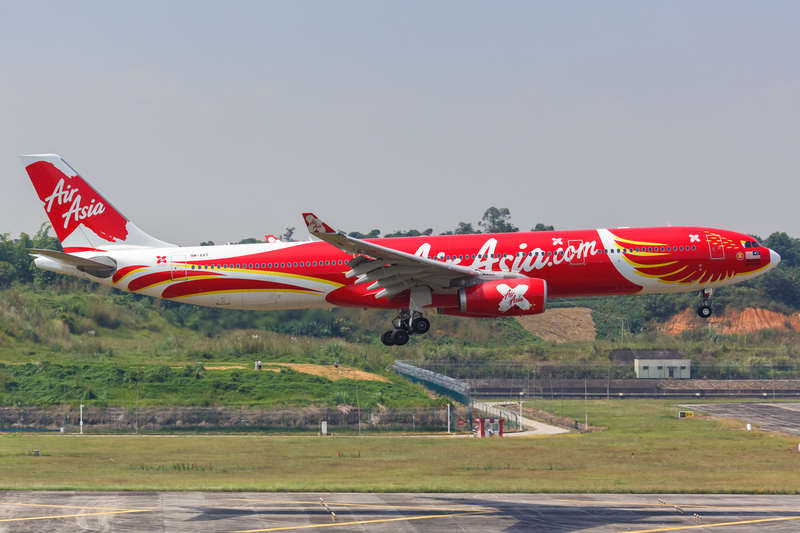
The airline may still use widebody aircraft where they make sense. It continues to operate Airbus A330-300 aircraft on long-haul services. But the group’s new growth focus has shifted toward smaller long-range jets.
Why AirAsia Is Moving Toward Narrowbodies
The biggest reason is flexibility.
A widebody aircraft can carry more passengers. It also offers strong cargo capacity. But it comes with higher trip costs.
That matters for a low-cost airline.
Long-haul low-cost flying works best when aircraft are full and costs stay low. If demand weakens, a large widebody can become difficult to fill profitably.
A long-range narrowbody gives AirAsia a different tool.
The Airbus A321XLR can fly up to 4,700 nautical miles. Airbus markets it as a route opener for long, thin markets that do not need a widebody.
That fits AirAsia’s new plan.
The group signed an agreement in 2025 for 50 A321XLR aircraft, with rights for 20 more. Deliveries are scheduled to begin from 2028 through 2032.
AirAsia says the aircraft will support a new low-cost narrowbody network model.
The A321XLR Changes The Economics
The A321XLR is important because it reduces the risk of long-haul expansion.
Airbus says the aircraft offers up to 11 hours of flight time. It also says the A321XLR can deliver 30% lower fuel burn and CO₂ emissions per seat compared with previous-generation aircraft.
For AirAsia, the aircraft could open routes from Asia to the Middle East, Central Asia, and parts of Europe.
That does not mean the A321XLR replaces every A330 mission. It does not have the same cargo space or passenger capacity as a widebody.
But it can serve routes that would be too thin for an A330.
That is the point.
AirAsia can test more city pairs with less capacity risk. It can also build a multi-hub network without needing every route to support a large widebody aircraft.
Bahrain Hub Delayed By Middle East Conflict
The aircraft order change is only one part of the story.
AirAsia X has also delayed its planned Bahrain hub.
In February, AirAsia X announced a major new route from Kuala Lumpur International Airport (KUL) to Bahrain (BAH), then onward to London Gatwick Airport (LGW).
The route was due to begin on June 26, 2026.
It was designed to return AirAsia X to London while making Bahrain its first strategic hub outside Asia.
That launch has now been postponed.
Reuters reported that AirAsia X expects the service to begin in August or September. The airline cited the conflict in the Middle East and said it needed a measured approach.
London Return Still Matters
The delayed route is still strategically important.
AirAsia X has not served London for years. A return to the UK would be a major milestone for the carrier.
London Gatwick (LGW) is also a logical airport for the AirAsia X model. It has a strong leisure base and supports long-haul low-cost operations better than slot-constrained Heathrow (LHR).
The Bahrain stop is equally important.
A Kuala Lumpur (KUL)–London (LGW) nonstop is a long sector for a low-cost carrier. A stop in Bahrain (BAH) allows AirAsia X to break the route into two more manageable legs.
It also creates fifth-freedom opportunities.
That means AirAsia X can carry passengers between Bahrain (BAH) and London Gatwick (LGW), not just between Malaysia and the UK.
Bahrain Is More Than A Fuel Stop
AirAsia X has described Bahrain as a strategic hub.
That is important. The airline is not only using Bahrain as a technical stop.
Bahrain gives AirAsia X a possible platform between Southeast Asia, the Middle East, and Europe.
It could help the carrier connect traffic from Malaysia, Indonesia, Thailand, Australia, and other parts of Asia to Bahrain and onward to Europe.
Over time, AirAsia X has also spoken about wider opportunities in the Middle East and Africa.
That is why the delay matters.
The Bahrain plan is central to AirAsia X’s new long-haul network strategy. Pushing the launch back slows the first major test of that strategy.
A330-300s Will Still Operate The Route
The initial Kuala Lumpur (KUL)–Bahrain (BAH)–London Gatwick (LGW) service is expected to use the Airbus A330-300 rather than the A321XLR.
That makes sense.
The A321XLR aircraft ordered by AirAsia are not due to arrive until 2028. Until then, AirAsia X must rely on its existing widebody fleet for long-haul flying.
The A330-300 can carry far more passengers than an A321XLR. It also gives AirAsia X the premium flatbed product it has promoted on longer routes.
However, the A330-300 is not the future growth aircraft in the new strategy.
It is the bridge.
AirAsia X can use A330s to launch and prove long-haul markets now. Later, A321XLRs may allow the group to open thinner routes with lower risk.
This Is A Major Strategy Reset
The cancellation of the A330neo order confirms a wider reset at AirAsia.
Before the pandemic, AirAsia X was heavily tied to the widebody low-cost model. The airline used A330s to connect Southeast Asia with Australia, North Asia, the Middle East, and other long-haul markets.
That model was hit hard during the pandemic.
AirAsia X went through restructuring. Demand patterns changed. Fuel prices moved sharply. Aircraft financing became more complex.
Now the group is choosing a different path.
Instead of growing mainly through large widebodies, AirAsia wants to become a low-cost narrowbody network carrier.
That is a very different concept.
It means more hubs, more mid-sized routes, and more aircraft flexibility.
Why The A330neo No Longer Fits
The A330neo is a strong aircraft. It offers long range, lower fuel burn than previous-generation widebodies, and a modern cabin.
Airbus lists the A330-900 with up to 7,350 nautical miles of range. It is powered by Rolls-Royce Trent 7000 engines.
For many airlines, the A330neo is a useful long-haul aircraft.
But AirAsia’s needs have shifted.
The airline now wants aircraft that can serve smaller markets more often. It also wants lower trip costs and the ability to build new routes without filling a large widebody on every departure.
That is where the A321XLR is more attractive.
It is not a better aircraft in every way. It is simply a better fit for the model AirAsia now wants to build.
The Middle East Remains A Risk
The Bahrain delay also shows the risk of building a new hub in a volatile region.
AirAsia X said it remains committed to Bahrain. But the airline also said it needs the operating environment to better match its commercial and operational goals.
That is cautious language.
Airspace issues, insurance costs, fuel volatility, passenger confidence, and crew planning can all affect long-haul operations in the region.
For a low-cost carrier, the margin for error is smaller.
If operating costs rise too quickly, or if demand weakens, a new route can become difficult before it has time to mature.
That is why AirAsia X is delaying instead of forcing the launch.
Passengers Will Be Rebooked Or Refunded
AirAsia X said affected passengers will be offered refunds or rescheduled bookings.
That is important because the delay affects a high-profile launch route.
Passengers who booked the first wave of Kuala Lumpur (KUL)–Bahrain (BAH)–London Gatwick (LGW) flights now face changed travel plans.
The airline will need to manage that carefully.
A delayed launch can be understood if the reason is safety and operational risk. But passengers still expect clear communication and practical alternatives.
For AirAsia X, the handling of affected bookings will shape early customer perception of the route.
Bottom Line
AirAsia X has formally moved away from its remaining A330neo commitment.
The cancellation of 15 Airbus A330-900 orders confirms that the airline no longer sees the A330neo as the center of its future long-haul growth.
Instead, the wider AirAsia Group is shifting toward long-range narrowbody aircraft, especially the Airbus A321XLR.
At the same time, AirAsia X has delayed the launch of its planned Kuala Lumpur (KUL)–Bahrain (BAH)–London Gatwick (LGW) route. The service was due to begin in June 2026, but is now expected in August or September, subject to conditions in the Middle East.
The strategy is still ambitious.
AirAsia X wants to rebuild long-haul low-cost flying with a new hub model and more flexible aircraft. But the A330neo cancellation and Bahrain delay show that the airline is being more careful than it was in the past.
The widebody growth plan is fading. The long-range narrowbody plan is now taking its place.
Keep reading FlyMag
Get the Daily Brief in the morning or the Route Watch weekly recap on Fridays. Or both.