Norwegian 737 MAX Diverts To Athens After Cabin Pressure Alert On Rhodes-Stavanger Charter
A Norwegian-operated charter flight carrying TUI holidaymakers from Rhodes to Stavanger diverted to Athens on Saturday after the crew received a cabin pressurization warning and the aircraft’s passenger oxygen masks deployed.
Flight DY9317 was operating from Rhodes “Diagoras” International Airport (RHO) to Stavanger Airport, Sola (SVG) on June 6, using a Boeing 737 MAX 8 registered LN-FGG. The aircraft was scheduled to fly north from the Greek island to Norway, a typical summer leisure-sector profile for Norwegian’s 737 fleet. Instead, the flight was cut short when the crew initiated a descent and diverted to Athens International Airport (ATH).
The aircraft landed safely at Athens (ATH), where passengers were eventually transferred to the terminal. A replacement Norwegian Boeing 737-800, registered LN-NIH, was later positioned to continue the journey from Athens (ATH) to Stavanger (SVG), allowing the disrupted TUI passengers to reach Norway shortly after midnight.
Read our stories in your inbox
Two aviation newsletters. Zero fluff.
While the diversion caused a long and uncomfortable delay for passengers, the crew’s response was consistent with how airlines treat cabin-pressure indications: descend, stabilize the situation, and divert to a suitable airport rather than continue a multi-hour flight with an unresolved pressurization issue.
Cabin Pressure Warning Triggered The Diversion
Norwegian described the event as a pressurization issue that caused a safety system to deploy the aircraft’s oxygen masks. The airline said the pilots descended to a lower altitude and diverted as a precaution.
That distinction matters. A cabin pressure warning does not necessarily mean the aircraft suffered a dramatic or explosive decompression. It can involve a gradual pressurization problem, a system fault, or a cockpit indication showing that the cabin altitude is not being maintained as expected. In any of those cases, flight crews are trained to treat the warning conservatively.
At normal cruise altitude, a 737 cabin is pressurized so passengers and crew can breathe comfortably even though the outside air is too thin for normal human function. If the system detects that cabin altitude has risen beyond safe limits, passenger oxygen masks may deploy automatically. The purpose of those masks is not to allow the aircraft to continue for hours at high altitude, but to protect passengers while the flight crew descends to an altitude where supplemental oxygen is no longer needed.
That appears to be the sequence on DY9317. Passengers reported pressure in their ears and heads before the diversion, and cabin crew reportedly explained that continuing the flight could have resulted in more severe discomfort. For the pilots, the immediate priority would have been to get the aircraft to a lower altitude and then select the most suitable diversion airport.
Athens (ATH) was the logical choice. The aircraft was still in Greek airspace after departing Rhodes (RHO), and Athens offers long runways, extensive airline handling capability, maintenance resources, passenger facilities, and the infrastructure needed to manage a full narrowbody diversion during the peak summer travel season.
The Aircraft Was A Norwegian Boeing 737 MAX 8
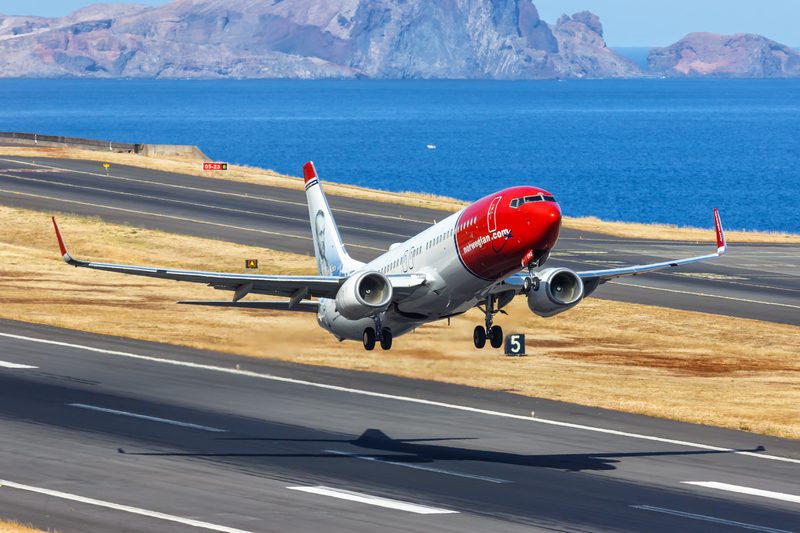
The aircraft operating the original Rhodes (RHO)–Stavanger (SVG) flight was LN-FGG, a Boeing 737 MAX 8 in Norwegian service. The MAX 8 is the newer-generation 737 variant in Norwegian’s fleet and is used heavily across the airline’s European and leisure network.
Norwegian’s MAX 8s are configured with 189 seats and powered by CFM International LEAP-1B engines. The type also features advanced technology winglets and other aerodynamic improvements compared with earlier 737NG aircraft. For Norwegian, the MAX 8 is a central part of its fuel-efficient narrowbody fleet strategy, particularly on longer leisure sectors from Scandinavia to Southern Europe, the Canary Islands, and the Mediterranean.
The Rhodes (RHO)–Stavanger (SVG) market fits that profile. It is not a short intra-Scandinavian hop; it is a sector of roughly four hours, depending on routing and winds, linking a major Greek holiday island with Norway’s west coast. In that role, the 737 MAX 8 gives Norwegian the range and economics needed to operate seasonal holiday flying with a single-aisle aircraft.
In this case, however, the aircraft’s range and performance were not the issue. The flight was interrupted by a pressurization alert, and once the masks deployed, continuing all the way to Stavanger (SVG) would not have been appropriate unless the crew could fully resolve and verify the issue. Diverting to Athens (ATH) reduced risk and placed the aircraft at a major airport where the technical condition could be assessed.
Replacement 737-800 Continued The Journey To Stavanger
After DY9317 landed in Athens (ATH), TUI arranged a replacement aircraft to complete the journey to Stavanger (SVG). The continuation flight was operated by LN-NIH, a Boeing 737-800.
The 737-800 is part of the 737 Next Generation family and remains a major workhorse in Norwegian’s fleet. Norwegian lists its 737-800 aircraft with either 186 or 189 seats, depending on configuration, and the type is powered by CFM56-7B26 engines. Like the MAX 8, it is a single-aisle aircraft, but it belongs to the earlier 737NG generation rather than the newer MAX family.
The replacement aircraft departed Athens (ATH) later in the evening and operated north to Stavanger (SVG), completing the disrupted charter movement in the early hours of the following morning. For passengers, the diversion turned a routine holiday return into a long travel day. For the airline and tour operator, the priority became twofold: remove the affected aircraft from passenger service for inspection and arrange onward transport as quickly as practical.
That is often the most challenging part of a diversion involving holiday traffic. The technical decision to land is straightforward when safety margins require it. The passenger recovery operation can be more complicated, especially during summer weekends, when aircraft, crews, airport gates, buses, hotel rooms, and handling agents are already under pressure.
Passengers Reported Heat, Limited Water And Poor Information
Several passengers later complained about conditions after the landing in Athens (ATH). Reports from Norwegian media described passengers remaining on board for around an hour after arrival, with some saying the cabin became extremely hot and that water supplies were limited.
Those complaints are worth noting because diversions do not end when the wheels touch down. Once an aircraft lands away from its planned destination, the airline, airport, ground handler, and tour operator must coordinate parking, stairs or jet bridge access, passenger buses, immigration requirements if applicable, terminal space, catering, crew duty limits, and the onward recovery plan.
In a technical diversion involving a full 737, the situation can become uncomfortable quickly if the aircraft is parked remotely, auxiliary power or air conditioning is limited, or ground equipment is not immediately available. Athens (ATH) is well equipped to handle irregular operations, but peak summer heat and a sudden unscheduled arrival can still create a difficult passenger experience.
The communication issue is also familiar across airline disruptions. Passengers generally understand that a safety diversion is necessary. What frustrates them is uncertainty after landing: whether the aircraft will continue, whether another aircraft is coming, whether bags will be offloaded, whether vouchers will be issued, and whether the delay will stretch into an overnight stay.
In this case, TUI arranged a replacement Norwegian aircraft the same day, which prevented the disruption from becoming an overnight stranding for the full group. Even so, the delay, heat, and lack of timely information appear to have left many travelers frustrated.
A Precautionary Diversion, Not A Catastrophic Event
The deployment of oxygen masks can understandably alarm passengers. It is one of the more dramatic cabin events travelers may experience, and it immediately signals that the flight is no longer proceeding normally.
From an operational standpoint, however, the important fact is that the aircraft landed safely. The crew descended, diverted to a major airport, and removed the aircraft from service rather than continuing to Norway with a pressurization issue. That is exactly the conservative decision-making passengers should want in this type of event.
The incident also highlights the difference between passenger perception and flight deck procedure. To those in the cabin, masks dropping from the overhead panels can feel like an emergency with little context. To pilots, it triggers a trained sequence of actions: don oxygen if required, run the appropriate checklist, descend to a safe altitude, coordinate with air traffic control, and select a suitable diversion airport.
The aircraft involved, LN-FGG, did not complete the Rhodes (RHO)–Stavanger (SVG) sector. Instead, the replacement 737-800 LN-NIH handled the onward Athens (ATH)–Stavanger (SVG) flight later that evening. That operational separation is important. The affected MAX 8 could be inspected and addressed at Athens (ATH), while passengers were carried onward on a different aircraft.
Bottom Line
Norwegian flight DY9317 from Rhodes (RHO) to Stavanger (SVG) diverted to Athens (ATH) after a cabin pressurization warning led to the deployment of passenger oxygen masks. The Boeing 737 MAX 8 involved, LN-FGG, landed safely, and passengers were transferred to the terminal before a replacement Boeing 737-800, LN-NIH, continued the journey to Stavanger (SVG).
For passengers, the diversion meant a long delay, uncomfortable conditions after landing, and frustration over communication. For the flight crew, the decision was clear: once a pressurization issue and mask deployment occurred, continuing a multi-hour sector to Norway was not the right option.
The incident is a reminder that diversions are disruptive, but they are also part of the safety system working as intended. Norwegian’s crew brought the aircraft down, selected a suitable airport, and landed safely at Athens (ATH). The inconvenience was significant, but the operational priority was the correct one.
Keep reading FlyMag
Get the Daily Brief in the morning or the Route Watch weekly recap on Fridays. Or both.