Air Central has cleared an important regulatory hurdle in its long-haul expansion, winning approval from the U.S. Department of Transportation to operate scheduled and non-scheduled cargo services between China and the United States.
The authority took effect on April 20, 2026 and runs initially through April 20, 2027, giving the Zhengzhou-based cargo airline a formal pathway into the U.S. market just as it prepares to launch transpacific freighter operations.
For cargo aviation professionals, this is a meaningful step. DOT approval does not guarantee commercial success, but it does move Air Central from ambition to actionable market entry. That alone makes the development notable in a transpacific freight environment that remains highly competitive, politically sensitive, and operationally demanding.
Read our stories in your inbox
Two aviation newsletters. Zero fluff.
The Approval Opens The Door To Scheduled U.S. Cargo Flying
The U.S. exemption gives Air Central the right to operate both scheduled and ad hoc freight services from China to the United States and beyond.
That matters because gaining U.S. operating authority is a major threshold for any Chinese cargo airline trying to establish regular transpacific flying. Regulatory access, traffic rights, and operational permissions are often just as important as aircraft availability when a new entrant is building an international cargo network.
For Air Central, the approval means it now has the legal framework needed to move ahead with its first planned U.S. services rather than simply discussing them.
Chicago And Los Angeles Are The First Two Target Markets
In its March 2026 application, Air Central said it intends to begin scheduled cargo flights from Zhengzhou Xinzheng International Airport (CGO) to Chicago O’Hare International Airport (ORD) and Los Angeles International Airport (LAX) from July 2026.
Those are logical first choices.
Chicago O’Hare Airport (ORD) is one of the most important cargo gateways in North America, with deep onward distribution links into the U.S. Midwest and broader domestic freight system. Los Angeles International Airport (LAX), meanwhile, remains one of the strongest transpacific cargo markets in the country, supported by consumer imports, high-value freight, and broader Southern California logistics demand.
Together, ORD and LAX give Air Central two very different but strategically valuable U.S. entry points: one inland hub, one Pacific gateway.
Zhengzhou Is A Serious Cargo Origin, Not A Random Choice
The choice of Zhengzhou Xinzheng International Airport (CGO) is also central to the strategy.
CGO has become one of China’s most important cargo airports, thanks to its central location, logistics infrastructure, and role in e-commerce and export-driven freight flows. For a cargo airline, that gives Zhengzhou a strong natural base for long-haul freighter operations.
This is what makes Air Central’s plan more credible than a simple paper expansion. The airline is not trying to force intercontinental cargo service from a secondary airport with limited freight relevance. It is building from one of China’s established cargo centers, which immediately improves the route logic.
The Boeing 747-400F Remains The Workhorse For This Kind Of Mission
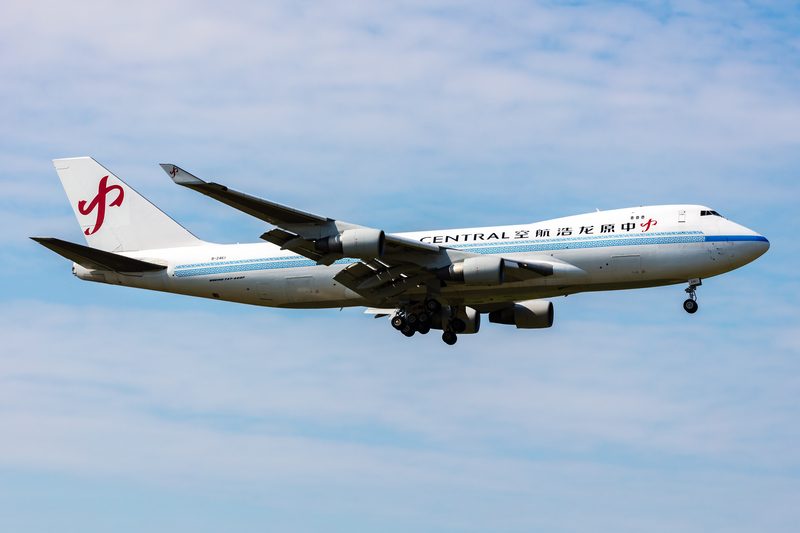
Air Central says the new services will use Boeing 747-400 freighters.
That is a telling fleet choice. The 747-400F remains one of the defining aircraft of long-haul cargo aviation because of its payload capability, nose-loading flexibility, and suitability for dense intercontinental routes. Even in an era of newer-generation freighters, the aircraft still makes sense on major trade lanes where volume and range matter more than the absolute newest fuel-burn profile.
For a new entrant into U.S.-China cargo flying, the 747-400F offers enough capacity to matter immediately, while also signaling that Air Central is targeting serious freight markets rather than niche or feeder-scale operations.
This Is A Regulatory Win, But Commercial Execution Will Matter More
Getting the DOT nod is important, but it is only the first step.
What matters next is whether Air Central can turn the authority into a viable operation. That means securing enough freight demand, maintaining dependable aircraft utilization, handling the economics of long-haul freighter flying, and navigating the political and competitive realities of U.S.-China aviation.
The transpacific cargo market can still be attractive, but it is not forgiving. Load factors, pricing, and route economics can shift quickly, especially when geopolitical issues and regulatory conditions remain part of the operating backdrop.
That is why this development is best understood as a launchpad rather than an arrival.
Bottom Line
Air Central’s new U.S. DOT exemption is a significant milestone for the Zhengzhou-based cargo airline, giving it the authority to operate freight services between China and the United States through April 2027.
The carrier’s planned July 2026 launch of Boeing 747-400F services from Zhengzhou Xinzheng International Airport (CGO) to Chicago O’Hare International Airport (ORD) and Los Angeles International Airport (LAX) would give it two highly strategic U.S. cargo gateways from day one. The approval gets Air Central to the start line. The next question is whether it can build a durable transpacific cargo operation once the flying actually begins.
Keep reading FlyMag
Get the Daily Brief in the morning or the Route Watch weekly recap on Fridays. Or both.