United 767 Crossed New Jersey Turnpike At Just 19 Feet Before Newark Pole Strike
The National Transportation Safety Board’s preliminary report into United Airlines Flight UA169 gives the clearest picture yet of how close the Boeing 767 came to highway traffic before landing at Newark Liberty International Airport (EWR).

The May 3 incident involved United Flight UA169, a Boeing 767-424ER registered N77066, arriving from Venice Marco Polo Airport (VCE) in Italy. The aircraft was on final approach to Runway 29 at Newark (EWR) when it struck a 15-foot light pole near the New Jersey Turnpike. Debris from the pole then hit a southbound tractor-trailer, causing minor injuries to the driver.
The aircraft continued to land safely at Newark (EWR), taxied to the gate, and all 220 passengers, three flight crew members, and eight cabin crew members deplaned without injury.
Read our stories in your inbox
Two aviation newsletters. Zero fluff.
The preliminary report also corrects an important early assumption. Although initial video and reports suggested the aircraft itself may have hit the truck, investigators found no evidence of tire marks on the tractor or trailer. The NTSB says the truck was struck by debris from the light pole, not directly by the aircraft.
UA169 Was On Final Approach To Newark Runway 29
United Flight UA169 was nearing the end of a scheduled transatlantic service from Venice (VCE) to Newark (EWR) when the incident occurred.

The aircraft, a Boeing 767-424ER, had originally been planned for Runway 4R at Newark. During descent, the crew’s runway assignment changed to Runway 22L, then changed again to Runway 29. The crew was assigned the RNAV W approach to Runway 29.
That runway change matters because Runway 29 is a very different arrival environment from Newark’s longer parallel runways. It is a shorter runway, lacks a precision ILS approach, and uses RNAV guidance followed by a visual segment. The NTSB report notes that the RNAV approach provides lateral and vertical guidance until the published visual guidance fix, after which pilots continue by visual reference.
Runway 29 also places arriving aircraft low over the New Jersey Turnpike immediately before crossing the airport boundary. Low approaches over the highway are part of the geometry of the runway environment, but UA169 was lower than expected in the final seconds before touchdown.
The NTSB’s flight path figure shows the aircraft at roughly 19 feet above ground level as it crossed the Turnpike area, with the highway itself about five feet higher than the runway elevation.
The Aircraft Was A Boeing 767-424ER
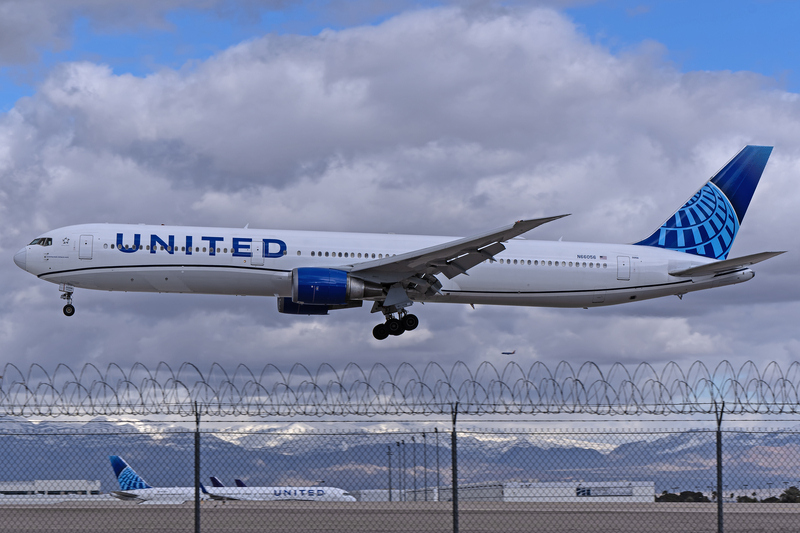
The aircraft involved, N77066, is a Boeing 767-424ER.
The 767-400ER is the largest passenger variant of the Boeing 767 family. It was originally developed for Continental Airlines and Delta Air Lines and remains a relatively rare aircraft type compared with the more common 767-300ER. United inherited its 767-400ER fleet through the Continental merger, which is why the aircraft carries Boeing’s -424 customer code.
The 767-400ER is a stretched, twin-engine widebody with raked wingtips and General Electric CF6 engines. In United’s long-haul network, the type is used on transatlantic and other international services where the airline needs widebody capacity but not the larger gauge of a Boeing 777 or 787.
That makes the Venice (VCE)–Newark (EWR) assignment normal for the aircraft. The 767-400ER is well within its intended mission profile on a transatlantic route of this length.
What was not normal was the aircraft’s final few seconds before landing.
The NTSB Says The Truck Was Hit By Debris, Not The Aircraft
One of the most important findings in the preliminary report is that investigators found no physical evidence that the Boeing 767 directly struck the tractor-trailer.
Early video made the event appear as though the aircraft’s landing gear or underside hit the truck. The NTSB’s examination points to a different sequence. The aircraft struck the light pole, and debris from that pole subsequently impacted the southbound tractor-trailer on the Turnpike.
The truck had windshield damage and impact marks on the forward upper left corner of the trailer. It also had punctures in the aluminum siding. However, investigators found no tire marks on the tractor cab or trailer.
That distinction matters. The aircraft was still far too low over highway infrastructure, and the driver was still injured by debris from an aircraft-related impact. But the difference between an aircraft striking a vehicle and light-pole debris striking a vehicle is important for understanding the event accurately.
The aircraft itself was damaged significantly. The NTSB found three punctures in the left lower aft fuselage, along with dents and creases. The No. 1 tire on the left main landing gear showed slash marks.
The report classified the aircraft damage as substantial.
The Approach Became Slow And Low
The crew interviews summarized in the NTSB report show how quickly the final approach became unstable.
The captain was the pilot flying for the return leg from Venice (VCE) to Newark (EWR), while the first officer was the pilot monitoring. The captain told investigators that he disconnected the autopilot and autothrottles at approximately 880 feet MSL, near the AXELL fix.
He said that while turning the aircraft into the headwind, he “got fast” and pulled the power levers back to compensate. The aircraft then returned to a stable airspeed, according to his account, but the report states that airspeed later began to decay as the aircraft descended.
The first officer recalled calling, “hey you are slow,” and moments later, “you are still slow and a little low.” The first officer then looked outside and thought the aircraft was low, but said he did not process the information quickly enough to verbalize a go-around callout before the aircraft was about to touch down.
The captain reported hearing a thump just before touchdown. The first officer recalled a mild jolt near the threshold, and the relief officer heard an audible thump as the aircraft crossed the airport boundary. After landing, aft flight attendants reported hearing a loud bang shortly before touchdown.
The aircraft then landed, taxied to the gate, and passengers deplaned normally.
Runway 29’s Visual Segment Is Central To The Investigation
The NTSB report spends significant attention on Runway 29’s approach environment.
Runway 29 at Newark (EWR) does not have an ILS. The available RNAV approach provides guidance until the visual guidance fix, after which the crew is expected to fly visually to the runway. Visual guidance lighting then becomes important.
The report also notes that the Precision Approach Path Indicator, or PAPI, for Runway 29 is located on the right side of the runway. PAPIs normally give pilots a visual glidepath reference using red and white lights. A standard on-path indication is two red and two white. More red lights indicate the aircraft is low; more white lights indicate it is high.
The captain told investigators that he expected to fly the final portion of the approach with a “three red, one white” PAPI indication. The NTSB noted that the cockpit voice recorder did not capture any discussion of the Runway 29 PAPI lights before landing.
That detail is likely to receive more attention as the investigation continues. A “three red, one white” sight picture is already below the standard two-red/two-white glidepath indication. In an approach environment with road traffic, light poles, a short runway, and a visual segment close to the airport boundary, even small deviations can matter quickly.
Weather Added Workload
Weather was also a factor in the crew’s workload.
The last METAR before landing reported wind from 290 degrees at 19 knots, gusting to 30 knots, with 10 miles visibility and an altimeter setting of 29.88 inches of mercury. The wind direction was closely aligned with Runway 29, but the gusts created a more dynamic approach environment.
The captain described “moderate turbulence” from the wind gusts. The report also notes that the aircraft did not receive any windshear alerts, and all three altimeters were accurately set to the reported altimeter setting.
This is an important point. The NTSB does not suggest that a bad altimeter setting caused the aircraft to be low. The report specifically says the captain’s, first officer’s, and standby altimeters were correctly set.
That pushes attention back toward the visual segment of the approach, flight path management, airspeed control, and crew monitoring in the last seconds before landing.
The Aircraft Crossed The Turnpike At Extremely Low Altitude
The report’s flight path figures are striking.
As UA169 crossed the New Jersey Turnpike area, the aircraft descended to about 19 feet AGL, then 18 feet AGL, before continuing toward the runway. The 15-foot light post was positioned near the aircraft’s path, and the NTSB notes that the Turnpike is five feet higher than the runway.
That means the physical clearance margins were extremely small.
For airline professionals, the more important issue is not simply the number “19 feet.” It is the combination of factors: a heavy widebody aircraft, a visual final segment, a short runway, gusty wind, decaying airspeed, a low flight path, and obstacles just outside the airport boundary.
A Boeing 767-400ER is not a small aircraft. Its main landing gear, lower fuselage, and wing structure all occupy significant vertical and lateral space. A few feet of vertical margin can be the difference between a normal low approach and contact with infrastructure.
The NTSB’s graphic makes that reality unavoidable.
United Issued Safety Guidance After The Incident
United issued internal safety guidance to pilots after the accident.
According to the NTSB preliminary report, United Flight Operations issued an operations alert specific to Newark (EWR) arrivals and RNAV vertical guidance for Runway 29. The alert reminded pilots that the visual glideslope indicator is designed to provide safe obstruction clearance within 10 degrees of the runway centerline up to four nautical miles.
United also issued a pilot bulletin on short-runway landing guidance. The bulletin identified the pilot technique of shifting below electronic or visual glidepath indications, sometimes called “ducking under,” as a hazard that can contribute to low approach altitudes during the visual segment into certain airports and runways.
The guidance emphasized that approaches should be flown so touchdown occurs 1,500 feet from the runway threshold, but not before 1,000 feet from the threshold, in accordance with United’s flight manual.
That safety action is one of the most important parts of the story. It shows the airline did not treat the event as an isolated scrape. It identified approach technique, runway-specific procedures, and touchdown-zone discipline as immediate safety issues requiring pilot attention.
Why “Ducking Under” Matters
“Ducking under” is a familiar risk in visual approach flying.
The term generally refers to a pilot intentionally or unintentionally flying below a normal glidepath to achieve an earlier touchdown, manage perceived runway length, improve spacing, or adjust the aircraft’s position visually. On some approaches, pilots may be tempted to descend below a glidepath after acquiring the runway visually, especially if the runway appears short or if they want to ensure landing distance.
The danger is that visual perception can be misleading.
A runway’s surrounding terrain, lighting, displaced threshold, visual guidance location, roadways, obstacles, and approach angle can all distort what “looks right” from the flight deck. At night or in poor visibility, those risks are obvious. In daylight, they can be more subtle, but still present.
At Newark Runway 29, the final segment passes over a highway and airport boundary infrastructure. A technique that might seem to create a desirable touchdown point can erode obstacle clearance before the runway.
That is precisely why visual glidepath guidance exists.
The Damage Was More Serious Than “Minor”
Early reports described damage to the aircraft as minor, but the NTSB classified it as substantial.
Investigators found three punctures in the left lower aft fuselage. The forward puncture was about six inches long and one inch wide. The middle puncture was much larger, about 46 inches long and four inches wide. The aft puncture was about 8.5 inches long and one inch wide. The surrounding skin also had dents and creases.
The report states that the total size of the holes was larger than the outflow valve and that the damage affected all three elements of the fuselage structure, making the aircraft damage substantial.
The No. 1 tire on the left main landing gear also had slash marks.
That level of damage is significant on a pressurized widebody aircraft. Any puncture in the fuselage requires careful inspection and repair, particularly when the damage affects structural elements. The aircraft cannot simply be returned to long-haul service after a quick external look.
The fact that the aircraft landed safely and passengers deplaned normally should not minimize the seriousness of the impact.
A Serious Accident With No Onboard Injuries
The outcome could have been far worse.
The aircraft was carrying 231 people, including passengers and crew. It was seconds from touchdown after a transatlantic flight. It struck airport-adjacent infrastructure while flying over one of the busiest highways in the region. Debris hit a truck, injuring the driver. The aircraft sustained substantial fuselage damage.
Yet the 767 landed safely, taxied to the gate, and everyone onboard exited without injury.
That is why this event sits in an unusual category. It was not a catastrophic accident, but it was far more serious than a routine hard landing or runway incident. It involved a large passenger aircraft contacting ground infrastructure before the runway threshold while vehicles were traveling below.
For the public, the video was alarming. For aviation professionals, the NTSB’s preliminary data is more alarming because it shows how little clearance remained.
What The Final Report Will Need To Answer
The NTSB preliminary report does not assign probable cause. It is an initial factual summary, and the investigation is ongoing.
The final report will likely examine several questions.
How did the aircraft’s flight path diverge below the desired visual profile in the final segment? Why did the crew not initiate a go-around after the first officer recognized the aircraft was slow and low? How did runway changes and compressed approach briefings affect crew workload? What role did gusty wind and airspeed management play? Were Runway 29’s visual guidance, obstacle environment, and published procedures adequate? Did United’s training and guidance for the approach sufficiently address the risk of flying below the visual glidepath?
Those questions matter not only for United but for every operator flying into Newark (EWR) on Runway 29.
The final report may also address airport infrastructure. If a normal or slightly low visual approach can place a widebody close to highway light poles, investigators may examine obstacle clearance, road lighting, approach geometry, and whether additional mitigations are warranted.
The Human Factors Are Important
The crew comments in the NTSB report highlight a familiar human-factors problem: recognizing a deviation is not the same as acting on it in time.
The first officer saw the trend. He called the aircraft slow and then slow and low. He later told investigators he thought the aircraft was low but did not process the information fast enough to call for a go-around before touchdown.
That is the kind of cockpit moment safety systems are designed to address. A go-around call must be timely, assertive, and expected when approach criteria are not met. But in the final seconds before landing, crews can face intense time pressure, high workload, and confirmation bias if the runway is directly ahead and touchdown feels imminent.
This is why stabilized approach criteria exist. They are intended to remove ambiguity before the aircraft reaches the point where the crew is effectively committed.
The NTSB’s final analysis will likely look closely at crew resource management, callout discipline, approach monitoring, and go-around decision-making.
Bottom Line
The NTSB’s preliminary report shows that United Flight UA169 was extremely low over the New Jersey Turnpike before landing at Newark (EWR), crossing the highway area at about 19 feet AGL and striking a 15-foot light pole on final approach to Runway 29.
The aircraft, a Boeing 767-424ER registered N77066, was arriving from Venice (VCE) with 220 passengers, three flight crew members, and eight cabin crew members. No one onboard was injured. The driver of a tractor-trailer on the Turnpike sustained minor injuries after debris from the light pole hit the vehicle.
The report also clarifies that investigators found no evidence the aircraft itself struck the truck. The aircraft did, however, sustain substantial damage, including three punctures to the left lower aft fuselage and slash marks on the No. 1 left main landing gear tire.
The preliminary facts point to a low and slow final segment in gusty wind conditions, with the first officer recognizing the problem but not verbalizing a go-around call in time. United has since issued safety guidance for Newark Runway 29 arrivals and short-runway approach technique, including warnings about “ducking under” the glidepath.
The investigation is still ongoing, and the final NTSB report will determine probable cause. But the preliminary record already makes one thing clear: UA169 came far closer to highway traffic and infrastructure than any passenger aircraft should on final approach.
Keep reading FlyMag
Get the Daily Brief in the morning or the Route Watch weekly recap on Fridays. Or both.