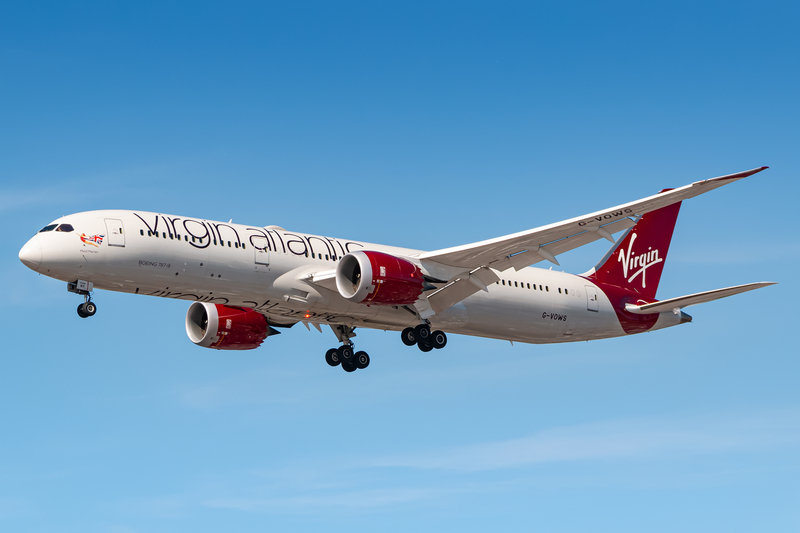
Virgin Atlantic has formally entered the South Korean market with daily service between London Heathrow Airport (LHR) and Incheon International Airport (ICN), giving the airline a long-awaited foothold in one of Asia’s most commercially important markets.
The route, which launched on March 29, 2026, matters for more than simple network growth. For Virgin Atlantic, Seoul is not just another long-haul destination from Heathrow (LHR). It is a strategic addition that strengthens the airline’s reach in Northeast Asia, adds new belly-cargo potential, and gives it a more meaningful eastbound proposition through its partnership with Korean Air and the broader SkyTeam network.
A daily 787-9 operation with a clear strategic role
Virgin Atlantic is operating the Heathrow (LHR) to Incheon (ICN) service with the Boeing 787-9, the same aircraft type it has long relied on for thinner long-haul markets where premium demand, leisure traffic, and cargo all need to work together.
Read our stories in your inbox
Two aviation newsletters. Zero fluff.
On this route, that aircraft choice is significant. Virgin’s 787-9 carries 258 passengers across three cabins, with 31 Upper Class seats, 35 Premium seats, and 192 Economy seats. That gives the airline enough premium density to chase corporate and higher-yield demand, while still keeping the aircraft right-sized for a market that is developing for the carrier rather than already mature in its network.
For aviation readers, the 787-9 is the logical tool here. Seoul Incheon (ICN) is a major global gateway, but Virgin does not need a larger-gauge aircraft to make the route credible. The 787-9 offers the range, cargo capability, and lower trip-cost profile that make a daily Heathrow (LHR) to Incheon (ICN) operation commercially sensible.
This is as much a connectivity play as a Seoul route
The nonstop link itself is important, but the bigger network story sits behind Incheon (ICN).
Virgin Atlantic is using Seoul as a new connection point into the wider Asia-Pacific region through Korean Air and SkyTeam partners. That means the route is not only about traffic between London Heathrow (LHR) and Seoul Incheon (ICN). It is also about giving Virgin customers a stronger one-stop option deeper into Japan, Australia, New Zealand, Vietnam, Hong Kong, and other parts of Northeast and Southeast Asia.
That makes the service more valuable than a standalone point-to-point launch. Heathrow (LHR) to Incheon (ICN) becomes both an origin-and-destination market and a feeder into a broader regional network that Virgin could not replicate on its own metal. In that sense, Seoul is doing for Virgin Atlantic what strong alliance gateways are supposed to do: extend relevance beyond the endpoint on the ticket.
Cargo is part of the equation, not an afterthought
Passenger traffic will draw most of the headlines, but the cargo dimension is just as important.
South Korea remains one of the world’s most significant high-value export markets, with strong flows tied to technology, manufacturing, beauty, and advanced consumer goods. For a carrier like Virgin Atlantic, that matters because a daily Boeing 787-9 from Heathrow (LHR) to Incheon (ICN) is not simply selling seats. It is also adding dependable lower-deck cargo capacity into a market where speed and network reliability matter.
That helps explain why the airline has framed the route as both a passenger and cargo play. In practical terms, Seoul gives Virgin Atlantic a better position in a trade lane where the premium cabin matters, but so does the freight underneath it.
Virgin is filling a real gap in the UK market
The route also gives Virgin Atlantic something commercially useful at home: distinctiveness.
Rather than adding another frequency in a market already crowded with UK competitors, the airline has entered a city pair where it can stand out. Virgin Atlantic is currently the only UK airline offering a nonstop link between the UK and South Korea, which gives the carrier a cleaner competitive message than it enjoys on many of its more established long-haul routes.
That matters at Heathrow (LHR), where differentiation is often as valuable as raw scale. Virgin does not win by out-sizing larger rivals across every market. It wins by choosing routes where its premium brand, partner network, and schedule proposition can carry more weight.
Seoul Incheon (ICN) fits that model well.
A wider Asia push is taking shape
The Seoul launch also says something bigger about Virgin Atlantic’s network direction.
For years, the airline’s long-haul identity was heavily tilted toward the North Atlantic. That remains central to the business, but the addition of Seoul Incheon (ICN) shows the carrier is still serious about building a stronger eastbound profile from London Heathrow (LHR). This is not a random one-off. It fits with Virgin’s broader effort to deepen its presence across Asia and the wider Asia-Pacific region using a mix of direct flying and alliance-fed connectivity.
That matters strategically because it gives the airline more balance. A stronger Asia proposition helps diversify traffic flows, broadens cargo opportunities, and gives Heathrow (LHR) a more credible onward network on Virgin’s side of the equation.
Bottom Line
Virgin Atlantic’s new daily service between London Heathrow (LHR) and Incheon International Airport (ICN) is more important than the usual “new route” headline suggests.
The Boeing 787-9 is the right aircraft for the job, giving the airline a balanced mix of premium seating, economy capacity, and cargo potential. Seoul Incheon (ICN) also works as more than a destination. Through Korean Air and SkyTeam, it becomes a gateway into a much wider Asia-Pacific network that Virgin Atlantic could not efficiently build alone.
For airline professionals, that is the real takeaway. This is not just Virgin adding South Korea to the map. It is Virgin using Seoul to become more relevant across Northeast Asia, both above the floorboards and below them.
Keep reading FlyMag
Get the Daily Brief in the morning or the Route Watch weekly recap on Fridays. Or both.