A United Airlines flight from Houston to Los Angeles returned to the gate after an unauthorized passenger allegedly boarded the aircraft with a fraudulent boarding pass and was discovered in a lavatory as the flight was preparing to depart.
The incident occurred on May 18 at Houston George Bush Intercontinental Airport (IAH) aboard United Flight UA469, bound for Los Angeles International Airport (LAX). Court-record reporting identifies the suspect as 25-year-old Abdulrahman Oluwatumike Oriyomi, who is accused of passing through airport security, attempting to scan an invalid boarding pass at multiple gates, and eventually slipping past distracted gate agents before boarding the United aircraft.
The flight had already pushed back and begun taxiing when flight attendants became aware that an unauthorized person was onboard. The aircraft returned to the gate, passengers were deplaned, and law enforcement conducted a security sweep. No explosives were found.
Read our stories in your inbox
Two aviation newsletters. Zero fluff.
The episode delayed the full flight by about three hours and has raised questions about how a person without a valid ticket was able to pass through multiple airport security layers at one of United’s largest hubs.
Ticketless Passenger Allegedly Boards UA469
According to court-record reporting, Oriyomi first encountered trouble at the TSA checkpoint in Terminal C at Houston Intercontinental (IAH). Investigators said he appeared distracted by his phone, had difficulty with his boarding pass, was escorted to another TSA booth, had his photograph taken, and was ultimately allowed through security.
Once inside the secure area, he allegedly moved around the terminal and attempted to board at more than one gate. At one point, he tried to scan a boarding pass for a Los Angeles-bound flight but was unsuccessful. He was reportedly turned away after an interaction with a United employee.
He later appeared near another gate where United Flight UA469 was boarding for Los Angeles (LAX). Investigators say he waited while gate agents were occupied with other passengers, pretended to present a boarding pass, and walked down the jet bridge without authorization.
That is the first major failure point. The TSA checkpoint is designed to keep unticketed or improperly cleared individuals out of the sterile area. The gate scan is the second major barrier. In this case, according to court records, both layers failed to prevent the passenger from reaching the aircraft.
Flight Attendants Discover The Problem During Taxi
Once onboard, Oriyomi allegedly sat next to a passenger but appeared unsure whether the seat was his. He later moved around the cabin and went to a lavatory. After another passenger took the seat he had first occupied, he reportedly went to a different lavatory toward the rear of the aircraft.
By then, United Flight UA469 had pushed back and begun taxiing.
A passenger alerted a flight attendant that someone was in the lavatory. The flight attendant knocked and instructed Oriyomi to return to his seat. According to court records, he gave the name “Mr. Lopez,” but flight attendants could not match that name to the passenger manifest.
The flight was full, and there was no open seat. Oriyomi allegedly asked to sit in a flight attendant jump seat, which immediately made the situation even more concerning.
At that point, the crew had the information it needed: there was a person onboard who did not appear on the manifest, did not have an assigned seat, and could not be accounted for in the normal passenger reconciliation process.
The aircraft returned to the gate.
A Major Security Response At IAH
Once the aircraft returned to the gate at Houston (IAH), the response was significant.
Houston Police, the FBI, TSA, Houston Airport Systems, and an explosive-detection K9 unit responded. Passengers were removed from the aircraft while officers swept the cabin and checked for explosives. No explosives were found.
That level of response was appropriate. An unauthorized person onboard an aircraft is not a minor boarding error. It creates several immediate security questions. Was the individual screened properly? Was the boarding pass genuine? Was baggage involved? Did the person place anything onboard? Did he have a valid reservation? Did he bypass airline or federal security checks? Were other passengers at risk?
Those questions cannot be answered while the aircraft continues toward the runway.
Returning to the gate allowed the crew, law enforcement, and airport security personnel to resolve the situation in a controlled environment before the flight departed for Los Angeles (LAX).
The Boarding Pass Was Reportedly Fake
Investigators later determined that the boarding pass image recovered from Oriyomi’s phone appeared fraudulent.
The document was reportedly missing key information and did not contain a valid QR code. United employees also determined that he had made a reservation, but that the reservation had been canceled because it was never paid.
That distinction is important. This was not simply a passenger boarding the wrong aircraft or going to the wrong seat. The allegation is that the suspect did not hold a valid boarding pass for the flight and was not authorized to be onboard.
He was later charged with felony impairing or interrupting the operation of a critical infrastructure facility. The charge reflects the seriousness of disrupting both airport and airline operations, especially after an aircraft has pushed back and begun taxiing.
The Aircraft: Reported Boeing 737 MAX 9
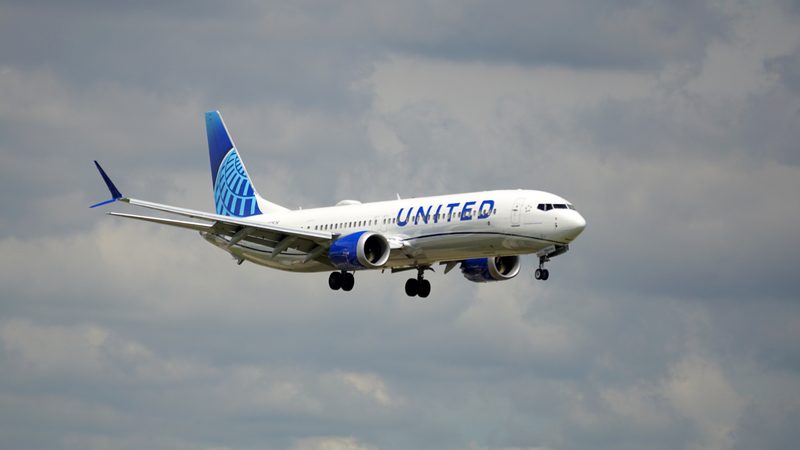
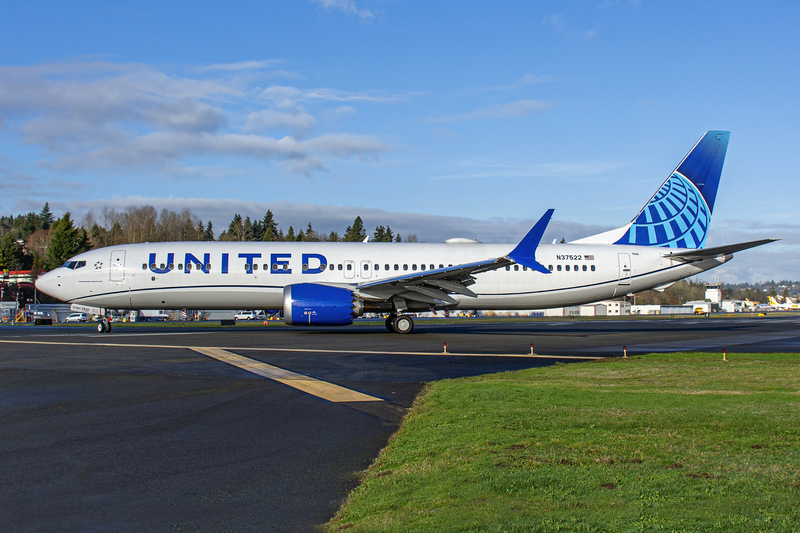
The aircraft operating UA469 was reported as a Boeing 737 MAX 9, one of United’s core domestic narrowbody aircraft.
United uses the 737 MAX 9 on medium- and longer-haul domestic routes, including transcontinental and high-density hub routes. The type typically seats 179 passengers in United’s configuration, with 20 First Class seats and the remainder split between Economy Plus and standard Economy.
Houston (IAH) to Los Angeles (LAX) is the kind of route where the MAX 9 fits well. The sector is roughly 1,370 miles and links one of United’s largest hubs with a major West Coast market. A full or near-full MAX 9 means roughly 170 to 180 people can be affected by a security event before departure, even if the aircraft never leaves the ground.
In this case, the aircraft type is secondary to the security failure, but it adds scale. A full mainline United narrowbody returning to the gate, deplaning, undergoing a security sweep, and then restarting the departure process creates a significant operational disruption.
Why This Is More Serious Than A Boarding Mistake
Airlines deal with seat-assignment confusion, boarding errors, and passengers going to the wrong gate every day. This was different.
An unauthorized passenger who bypasses the gate scan and reaches the cabin undermines the final reconciliation step before departure. Airlines must know who is onboard. The passenger manifest is used for safety, security, weight-and-balance processes, customs and border requirements where applicable, emergency response, and post-incident accountability.
If someone is onboard but not on the manifest, the airline has a security problem.
The timing made it worse. The aircraft had already left the gate and begun taxiing. Once an aircraft is moving under its own operation, resolving a security discrepancy becomes more disruptive. The flight deck has to coordinate with ground control, return to the gate, involve airline operations, and allow law enforcement to handle the passenger and aircraft.
That is why the incident triggered a multi-agency response rather than a simple customer-service correction.
The TSA And Gate-Agent Questions
The incident raises two separate security questions.
The first concerns TSA screening. Reports say Oriyomi passed through a TSA checkpoint despite problems with his boarding pass. TSA procedures are designed to verify identity and travel authorization before a person enters the secure side of the airport. If a passenger had no valid ticket, investigators will want to understand how he was permitted through.
The second question concerns the boarding gate. Gate agents are the airline’s final access-control point before a passenger reaches the aircraft. Boarding passes must scan successfully, names must match the flight, and exceptions must be resolved before a person walks down the jet bridge.
According to court records, Oriyomi had already failed to scan a boarding pass at another gate. He then allegedly waited for gate agents at UA469 to be distracted and moved past them while they were checking other passengers.
That sequence suggests a breakdown in situational awareness and physical control at the boarding door.
For a busy hub like Houston (IAH), those moments matter. Boarding is crowded, time-sensitive, and often stressful. But the gate threshold is still a security boundary, not just a customer-service station.
Why The Crew Response Worked
The failure happened before departure. The recovery happened in the cabin.
Flight attendants identified that something was wrong, checked the passenger’s name, found no matching entry on the manifest, and notified the flight deck. That sequence prevented the aircraft from taking off with an unauthorized person onboard.
That is an important point. The system failed at earlier layers, but the cabin crew caught the issue before the flight became airborne.
Had the aircraft departed Houston (IAH) and the passenger been discovered at cruise altitude, the situation would have become more complicated. The crew would have had to decide whether to continue to Los Angeles (LAX), return to Houston, or divert to another airport. Law enforcement response would have been delayed until landing, and the security uncertainty would have remained onboard for hours.
Instead, the aircraft returned before takeoff. That was disruptive, but it kept the incident contained on the ground.
Passenger Impact Was Significant
Passengers on UA469 reportedly faced a delay of about three hours.
For a transcontinental-style domestic flight from Houston (IAH) to Los Angeles (LAX), that is a substantial disruption. Travelers may have missed onward connections, work commitments, family plans, or ground transportation. The delay also affected United’s aircraft and crew schedule.
A return-to-gate event is not as simple as opening the door and restarting boarding. Once a security incident occurs, the aircraft may need to be cleared. Passengers may need to deplane. Law enforcement may interview witnesses. Bags may need to be reconciled. The cabin may need to be checked. The crew must coordinate with dispatch, airport operations, and gate staff before the flight can leave again.
The operational cost is therefore larger than the time shown on the departure board.
A Familiar Problem For U.S. Airlines
The Houston incident comes after several high-profile unauthorized-boarding cases involving U.S. airlines.
In some cases, passengers have boarded the wrong aircraft. In others, individuals have allegedly bypassed security or gate checks entirely. One of the most publicized recent cases involved a repeat stowaway who boarded international flights without authorization and was discovered only after departure.
These cases differ in detail, but the underlying issue is the same: airport security depends on multiple layers working together. TSA screening, identity verification, boarding-pass validation, gate-agent control, cabin crew awareness, and manifest reconciliation all have to align.
If one layer fails, another should catch the problem. In Houston, several layers appear to have failed before the flight attendants identified the unauthorized passenger.
That is why the incident will likely result in internal reviews by the airline, TSA, and airport authorities.
What Investigators Will Want To Know
Investigators will likely focus on several questions.
How did Oriyomi pass through TSA screening if his reservation was canceled? What did TSA personnel see when his boarding pass failed or appeared problematic? Why was he allowed to enter the secure area after being escorted for additional processing? What happened at the first gate where he allegedly tried and failed to scan a boarding pass? How did he physically pass the UA469 boarding gate without a valid scan? Did gate agents follow United procedures? Was staffing, crowding, or distraction a factor?
The boarding pass itself will also matter. Investigators reportedly found it lacked key information and did not have a valid QR code. If true, that should have made it difficult to use at a modern airline boarding system.
The central question is not simply how he got onboard. It is how he got through each step before the cabin crew discovered him.
Bottom Line
United Flight UA469 from Houston Intercontinental (IAH) to Los Angeles (LAX) returned to the gate after an unauthorized passenger was discovered onboard as the aircraft began taxiing for departure.
Court-record reporting says 25-year-old Abdulrahman Oluwatumike Oriyomi allegedly passed through TSA screening, attempted to scan an invalid boarding pass at multiple gates, slipped past distracted United gate agents, and boarded the aircraft without authorization. Once onboard, he moved around the cabin and was eventually found after entering lavatories. Flight attendants checked the manifest, found no matching passenger, and the aircraft returned to the gate.
The response was serious. Passengers deplaned, Houston Police, the FBI, TSA, Houston Airport Systems, and an explosive-detection K9 unit responded, and the aircraft was searched. No explosives were found.
Oriyomi has been charged with felony impairing or interrupting the operation of a critical infrastructure facility. The allegations remain subject to the legal process.
For United and the airport, the incident exposes a chain of failures across passenger screening, gate control, and boarding verification. For the crew, the key success was catching the problem before takeoff. The result was a three-hour delay instead of an airborne security event.
Keep reading FlyMag
Get the Daily Brief in the morning or the Route Watch weekly recap on Fridays. Or both.