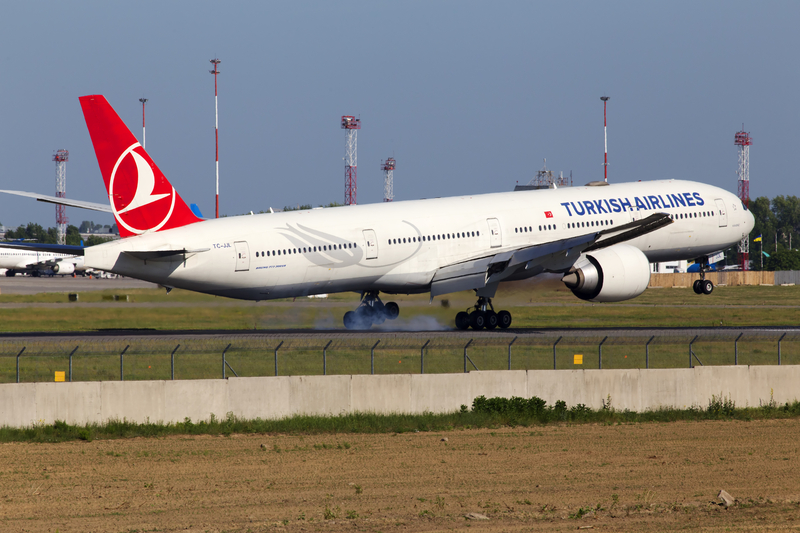
Turkish Airlines (TK) long-haul flight TK75 from Istanbul (IST) to Vancouver (YVR) diverted to Vienna (VIE) on February 26, 2026 after the crew declared an in-flight emergency roughly two hours into the journey.
The aircraft was a Boeing 777-300ER (B77W), registration TC-LJJ—Turkish Airlines’ long-range, high-capacity workhorse for intercontinental sectors. Flight-tracking data shows the crew selected the universal emergency transponder code 7700, prompting priority handling and a diversion into Vienna, an airport well-equipped to take an arriving, fully fueled widebody and support whatever comes next: medical response, engineering checks, passenger handling, and onward planning.
The aircraft landed safely at VIE under precautionary emergency response positioning. Early information did not indicate any immediate injuries among passengers or crew.
Read our stories in your inbox
Two aviation newsletters. Zero fluff.
Why Vienna (VIE) is a logical “big-jet” alternate
When a long-haul aircraft declares 7700 over Europe, the “nearest runway” isn’t the only consideration. Dispatch and crews need a field that can reliably support a widebody arrival with minimal friction:
Vienna (VIE) checks the boxes:
-
Runway capability: Two long runways (3,500 m and 3,600 m) provide margin for heavy landings, braking, and adverse-weather performance.
-
Full emergency posture: Dedicated airport fire and medical teams can be positioned quickly, and the airport has the procedures and space to manage an emergency arrival without paralyzing the operation.
-
Handling depth: Widebody-rated stands, equipment, and a mature ground-handling ecosystem make it easier to park, service, and—if needed—deplane and re-accommodate passengers.
-
Technical support options: While not every diversion requires maintenance intervention, a large international hub offers a better platform for inspections, parts access, and operational decision-making than a smaller regional field.
In short, VIE is the kind of alternate airlines prefer when the situation is still developing and the priority is to get on the ground safely, quickly, and with options.
The airplane: what the 777-300ER brings to an IST–YVR mission
Turkish’s 777-300ER fleet is built for exactly this kind of long stage length: high payload, long range, and robust ETOPS operating margins on routes that cross large oceanic and remote regions.
Key points aviation professionals will recognize:
-
The 777-300ER is a twin-engine long-haul platform designed for high reliability and dispatch performance on extended missions.
-
It has the systems redundancy and performance to safely manage abnormal events, and crews train repeatedly for diversion decision-making, abnormal checklists, and time-critical scenarios.
-
On a long-haul flight departing heavy, crews also have landing-weight considerations. Depending on circumstances, that can mean a short hold to burn fuel or other manufacturer-approved procedures before landing—another reason a large, ATC-capable airport like VIE is a smart choice.
What “squawk 7700” actually means for ATC and the cabin
A 7700 code doesn’t automatically reveal the cause. It simply tells air traffic control: “We have an emergency and need priority.”
From that moment, the playbook is consistent:
-
ATC clears airspace around the aircraft and sequences it ahead of other traffic.
-
The crew stabilizes the situation using checklists and cockpit resource management, then chooses the best nearby airport for a safe landing.
-
Emergency services stage at the destination as a precaution—because even if the issue resolves, the safest outcome is on the ground with support ready.
Turkish Airlines had not publicly disclosed the specific nature of the emergency at the time initial reports circulated. Some real-time tracking communities suggested a medical-related event, but without an airline statement, the cause remains unconfirmed.
Did the flight continue to Vancouver (YVR)?
Flight tracking indicates the aircraft later continued from Vienna (VIE) to Vancouver (YVR) after the diversion. That’s a noteworthy operational detail: it often suggests the triggering issue was resolved on the ground without requiring a lengthy aircraft downtime—though diversions can still create significant passenger disruption, crew legality challenges, and downstream schedule impacts.
Bottom Line
Turkish Airlines TK75 from Istanbul (IST) to Vancouver (YVR) diverted to Vienna (VIE) after the crew declared an in-flight emergency and squawked 7700 about two hours after departure. The flight landed safely, emergency services were positioned as a precaution, and no immediate injuries were reported.
For airline operations, the story is less about drama and more about disciplined decision-making: a 777-300ER over Europe has plenty of diversion options, and Vienna (VIE) is a high-capability choice that maximizes safety and operational flexibility—exactly what you want when you need to get a fully loaded widebody on the ground quickly.
Keep reading FlyMag
Get the Daily Brief in the morning or the Route Watch weekly recap on Fridays. Or both.