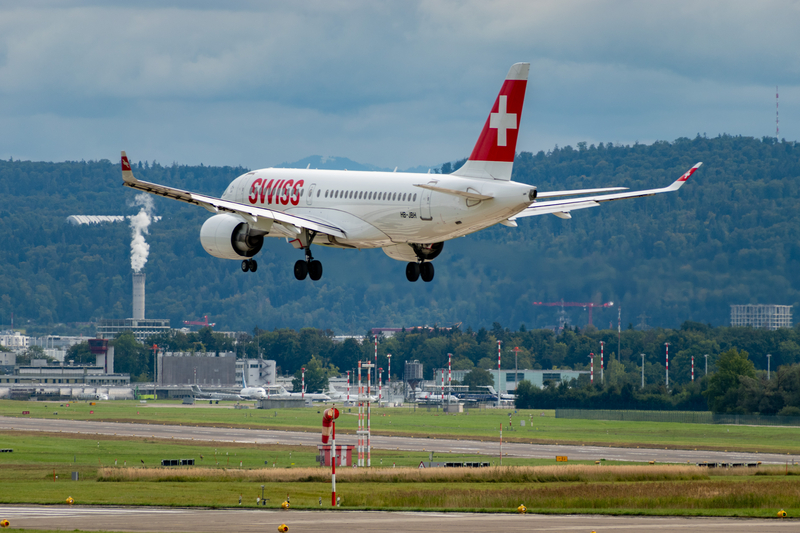
SWISS has parked its entire fleet of nine Airbus A220-100s for at least 18 months as it continues to battle persistent reliability problems with the type’s Pratt & Whitney geared turbofan (GTF) engines.

Why SWISS Is Doing This
Speaking during the airline’s third-quarter results, Chief Financial Officer Dennis Weber said the decision is preventive rather than safety-related, but the constant troubleshooting on the smaller A220 variant was no longer operationally sustainable. By taking the A220-100s out of service, SWISS can use their engines to keep its larger and more commercially important A220-300 fleet flying.
“This isn’t a safety issue, but it’s a constant source of effort. The A220-100s will remain grounded. This will take around a year and a half,” Weber said.
Read our stories in your inbox
Two aviation newsletters. Zero fluff.
Engines Are The Bottleneck
Like many A220 and A320neo-family operators, SWISS has been hit by GTF issues traced back to manufacturing and durability problems. The A220-100 and A220-300 use nearly identical Pratt & Whitney PW1500G variants, so cannibalizing the -100s gives SWISS immediate access to engines and parts to stabilize the 21 A220-300s it operates (plus five on lease).
This also reduces complexity: one A220 subfleet to schedule, one to crew, one to maintain.
Current SWISS A220 fleet:
-
A220-100: 9 aircraft, avg. age ~8.7 years → grounded
-
A220-300: 21 in fleet + 5 on lease, avg. age ~6.9 years → will keep flying
Why The -300 Matters More
The A220-300 carries more passengers and is the backbone of SWISS’s short- and medium-haul network from Zurich (ZRH) and Geneva (GVA). Keeping those aircraft available matters more than keeping a small subfleet of older, smaller jets online — especially when engine shop slots are scarce across Europe.
SWISS has already had to plug gaps by wet-leasing A220-300s from airBaltic. That move drew criticism in Switzerland because the Latvian crews are on lower pay scales; boosting in-house A220-300 availability should reduce the need for those leases.
A Long, Frustrating A220 History
SWISS was the global launch customer for the then–Bombardier C Series in 2016 and for years showcased the jet’s quiet cabin, good range, and steep-approach capability. But the airline has also lived through:
-
Multiple A220 groundings for engine inspections
-
Several in-flight diversions due to unusual smells/smoke
-
Up to eight A220s parked at once awaiting engines
-
A 2024 cabin smoke event that tragically led to a crew member’s death
-
Clear warnings from management in 2025 that A220 engine pain could last “until the end of the decade”
Given that backdrop, preemptively shelving the nine -100s is less a surprise than an overdue rationalization.
What Passengers Will Notice
-
Fewer A220-100s on European routes — schedules will be covered with A220-300s, A320-family aircraft, or leased capacity.
-
Better reliability — fewer last-minute swaps and cancellations if SWISS can keep its A220-300 engine pool healthier.
-
Some wet-leases may still appear — but the airline should need fewer of them once the -300s are better supported.
Big Picture
This is an unusually blunt move for a flag carrier, but it shows how severe the GTF supply crunch still is. Rather than run two subfleets badly, SWISS is choosing to run one properly.
Keep reading FlyMag
Get the Daily Brief in the morning or the Route Watch weekly recap on Fridays. Or both.