Qantas has set mid-2028 as the launch window for nonstop flights between Sydney (SYD) and New York (JFK), giving its second Project Sunrise route a firm place in the airline’s Airbus A350-1000ULR rollout.

Tickets are scheduled to go on sale in August 2027, according to the airline’s updated Project Sunrise plan. The service will follow the introduction of daily nonstop Sydney-London flights in October 2027, which Qantas plans to put on sale in February 2027.
The dates establish a clearer sequence for the program: the first A350-1000ULR is scheduled for delivery in April 2027, London launches six months later, and New York follows from mid-2028. Qantas said the sales and service dates remain subject to regulatory approvals and aircraft certification.
Read our stories in your inbox
Two aviation newsletters. Zero fluff.
New York Follows the London Launch
Qantas has long identified London and New York as the opening markets for Project Sunrise, but the latest timeline confirms that the North American route will start after the London operation is established.
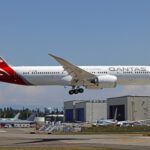
The gap gives Qantas time to introduce the aircraft, complete crew and operational preparations, and build a larger pool of available A350s before opening the second route. It also reduces the pressure to launch two highly specialized, ultra-long-haul operations simultaneously with a new aircraft subtype.
The nonstop service will replace the stop in Auckland (AKL) for passengers traveling through from Sydney. Qantas currently sells New York as a through service under QF3 and QF4, with the Boeing 787-9 operating Sydney-Auckland-New York. The airline’s current international network continues to list Sydney-JFK via Auckland.
Qantas introduced that routing in June 2023, returning to New York after a three-year absence. At launch, the airline calculated the journey at 16,371 kilometers, including a three-hour, five-minute Sydney-Auckland sector and a 16-hour, 15-minute Auckland-JFK flight. The nonstop A350 operation will remove the intermediate landing and associated ground time.
The Auckland service nevertheless gave Qantas an early operating and commercial presence in the New York market before the Project Sunrise aircraft became available. It also allowed the airline to use its existing 236-seat 787-9, rather than wait for an aircraft capable of reliably carrying a commercial payload nonstop from Australia’s east coast.
A350-1000ULR Built Around the Mission
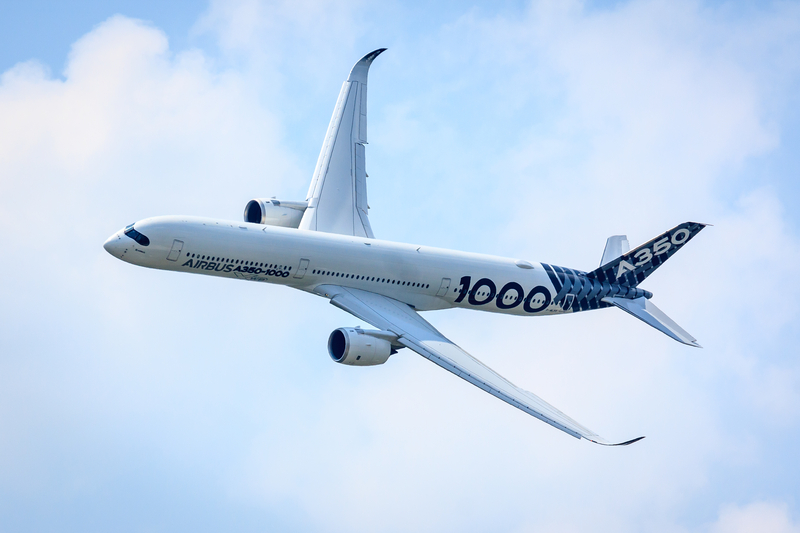
The New York route depends on a specialized version of the Airbus A350-1000 rather than the standard long-haul aircraft. Qantas has ordered 12 A350-1000ULRs for Project Sunrise, with the type incorporating an additional rear center fuel tank, changes to the fuel system and a new galley refrigeration architecture.
The 20,900-liter rear center tank extends the aircraft’s range to almost 10,000 nautical miles. The twin-engine jet is powered by Rolls-Royce Trent XWB-97 engines and has been developed to support Project Sunrise sectors approaching 22 hours.
Airbus began the subtype’s certification campaign when MSN707 made its first flight from Toulouse in June 2026. During subsequent testing, the aircraft completed a 24-hour, 24-minute development flight covering 12,460 nautical miles. Airbus said the mission was intended to demonstrate a 23-hour block-time capability around Qantas’ planned operating requirement, including allowances for taxiing, holding and diversion.
The manufacturer used that campaign to validate the rear center tank, cabin temperature control and a new divided flight-crew rest compartment. Those are central considerations on missions where fuel management, crew rotation and cabin conditions must remain stable for substantially longer than on conventional long-haul services. Airbus has published a detailed account of the A350-1000ULR’s long-range testing.
A Low-Density, Premium-Heavy Cabin
Qantas will configure each Project Sunrise A350 with 238 seats, an unusually low total for an aircraft the size of the A350-1000. The cabin will contain six First suites, 52 Business suites, 40 Premium Economy seats and 140 Economy seats.
More than 40% of the capacity will therefore sit in First, Business or Premium Economy. The allocation reflects the revenue requirements of operating a route with high fuel and crew costs but no intermediate stop, while also targeting passengers willing to pay for a time-saving itinerary.
The Economy total includes 42 Economy Plus seats with 34 inches of pitch. Most of the remaining Economy cabin will offer 33 inches. Qantas has also allocated floor space to a Wellbeing Zone between Premium Economy and Economy, reducing the number of revenue seats but providing an area for movement, hydration and refreshments during the airline’s longest flights.
First will use six enclosed suites, each with a separate armchair and an 80-inch bed. The 52-seat Business cabin will introduce Qantas suites with closing doors and fully flat 80-inch beds. The airline’s published cabin specifications also call for free onboard Wi-Fi, Bluetooth audio and lighting sequences designed around the destination time zone.
Project Sunrise Anchors Qantas’ Fleet Shift
The A350-1000ULR is more than a solution for two headline routes. Qantas expects the 12 Project Sunrise aircraft to form part of a wider international fleet renewal that also includes additional Boeing 787-9s, 787-10s and standard-range A350-1000s.
In its 2026 annual report, Qantas projected that Project Sunrise could contribute about A$400 million in annual earnings before interest and tax once the program reaches scale. The airline also plans to raise the premium-cabin share of its international capacity as next-generation aircraft replace older widebodies.
The sequencing of London in October 2027 and New York in mid-2028 aligns the network expansion with the arrival of additional A350-1000ULRs. It also gives Qantas a staged path toward the larger economic target, rather than depending on the immediate availability of the full 12-aircraft fleet.
Bottom Line
For passengers, the main gain is straightforward: Qantas will remove Auckland from a journey that already links Sydney and New York under one flight number. The benefit is not only the time saved in the air and on the ground, but also the elimination of an additional takeoff, landing and transit process on an itinerary extending well beyond 19 hours.
For Qantas, the more significant development is the deliberate spacing between its first two Project Sunrise routes. London will test the new aircraft, cabin, crew-rest model and ultra-long-haul operating procedures before JFK is added. That phased introduction should become increasingly important as Qantas begins retiring Airbus A380s from 2028 and shifts more of its international network toward smaller, premium-heavy twinjets.
The next details to watch are the precise inaugural date, flight numbers and frequency for Sydney-New York. Those decisions will show how quickly Qantas expects its A350-1000ULR fleet to build and whether the nonstop service will initially complement or immediately reshape the existing QF3/QF4 operation through Auckland.
Keep reading FlyMag
Get the Daily Brief in the morning or the Route Watch weekly recap on Fridays. Or both.