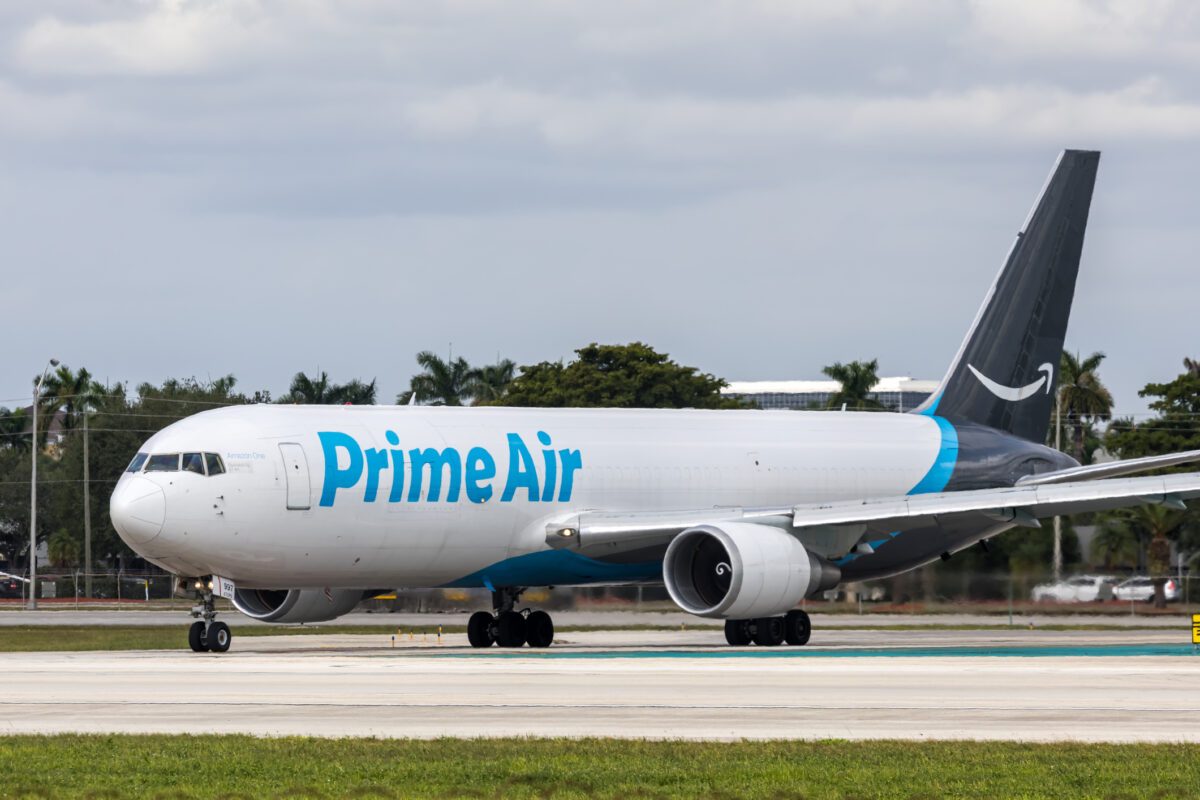
A pilot repeatedly warned that a 21 Air Boeing 767-33A was flying too fast during its final approach to Miami International Airport (MIA), according to preliminary recorder information released by the National Transportation Safety Board.
The Amazon Air cargo flight subsequently touched down at 158 knots, initiated a go-around after landing and then returned its engines to idle before overrunning Runway 30 on September 6. Five people were killed in the accident, according to Amazon.
Flight 7598 was operating under Part 121 from San Juan (SJU) to Miami. The NTSB has not determined a probable cause, and its recorder findings remain preliminary.
Read our stories in your inbox
Two aviation newsletters. Zero fluff.
Speed Warnings Continued Through Final Approach
The NTSB’s September 9 investigative update provides summaries of selected cockpit voice recorder and flight data recorder events. A full CVR transcript has not yet been produced.
The sequence shows the crew configuring the aircraft relatively late in the approach. A pilot called for flaps 1 six minutes before the recording ended. The crew contacted Miami tower and received clearance to land on Runway 30 with four minutes and 18 seconds remaining.
Flaps 5 were called at 2:53, followed by landing gear extension 16 seconds later and a call for flaps 15 at 2:14.
At 1:42, one pilot called for flaps 20. The other pilot cautioned that the aircraft was too fast and continued commenting on its excessive speed through the remainder of the recording. The NTSB said those comments did not receive a consistent verbal response.
A sound consistent with the autopilot disconnecting was recorded 19 seconds later. The aircraft’s automated 1,000-foot callout followed at 1:12, placing the repeated speed concerns inside the final segment of the approach.

The warning environment then intensified. The cockpit system issued two “sink rate” alerts, the first eight seconds after the 1,000-foot callout and the second shortly after the 500-foot callout. The aircraft subsequently generated a minimums alert and multiple “too low terrain” warnings.
A pilot did not call for the landing flap setting of 30 degrees until 41 seconds before the recording ended. The sound identified as touchdown followed about 10 seconds later.
Uneven Touchdown Preceded Go-Around Attempt
The flight data recorder adds detail to the aircraft’s behavior after reaching the runway. The NTSB cautioned that the CVR and FDR timelines have not yet been precisely synchronized.
The nose gear and right main landing gear touched down at a groundspeed of 158 knots, according to the FDR. Braking began seven seconds later at 146 knots.
The left main landing gear did not register touchdown until 11 seconds after the nose and right main gear, when groundspeed had fallen to 134 knots. That sequence indicates the aircraft was not initially established on all three landing-gear assemblies after runway contact.
Fifteen seconds before the FDR stopped, the crew released the brakes at 120 knots and advanced the throttles to a setting consistent with go-around thrust. The CVR separately captured a pilot calling for a go-around after the sound of touchdown.
The attempt was short-lived. Four seconds after go-around thrust was selected, the throttles returned to idle and the brakes were reapplied at 117 knots. Those inputs remained in place through the end of the recorded data.
The FDR showed a marked change in lateral, longitudinal and vertical acceleration at 96 knots, consistent with the aircraft encountering substantially different terrain or obstacles after leaving the prepared runway environment. The recorder stopped with the aircraft still moving at 65 knots.
Investigators found no recorded indication that the speed brakes or thrust reversers deployed. Both systems normally contribute substantially to a transport-category aircraft’s deceleration after touchdown, although wheel braking provides the primary stopping force.
Runway Length Left Little Margin for Reversal
Runway 12/30 is 9,355 feet long, according to Miami airport’s published information. That is a substantial landing distance for a 767, but the recorder sequence places several factors into the NTSB’s inquiry: excessive speed identified in the cockpit, a late landing configuration, warning alerts below 1,000 feet, the delayed touchdown of the left main gear and the decision to attempt a go-around after runway contact.
The transition from braking to go-around thrust and back to braking is particularly consequential. Releasing the brakes at 120 knots allowed the aircraft to continue consuming runway while the engines accelerated. Returning the throttles to idle four seconds later left the aircraft at 117 knots, with less pavement remaining and without recorded deployment of the speed brakes or reversers.
The 767-300 is a central aircraft in express freight networks because it combines widebody volume with lower trip costs than larger freighters. Boeing lists a structural payload of about 57 metric tons and a range of roughly 3,300 nautical miles for current 767-300 freighter configurations, describing the type as suited to e-commerce and express cargo. The short SJU-MIA sector uses only a fraction of that range while connecting Caribbean freight flows with one of the country’s largest cargo gateways.
Amazon introduced its dedicated air network with the 767-300, unveiling its first branded aircraft in 2016. The company does not operate the flights itself; certificated cargo airlines supply the aircraft and crews. Amazon said 21 Air operated Flight 7598 and that it is coordinating with the carrier while supporting the investigation.
Investigation Moves to Crew and Aircraft Records
The NTSB recovered both recorders and successfully downloaded them at its laboratory in Washington. The CVR contained more than two hours of good-quality audio across four channels. The FDR held about 54 hours of information covering more than 400 parameters.
A specialist group will review the complete cockpit recording and prepare a transcript. Investigators will also correlate the two recorder timelines, examine aircraft performance and systems, and compare the approach with 21 Air’s stabilized-approach and go-around procedures.
The investigation remains active as case DCA26MA352. Miami-Dade officials said firefighters reached the scene in less than 30 seconds, extinguished the fire and treated the injured. Two of MIA’s four runways remained closed during the initial investigation, affecting airport operations.
Bottom Line
The recorder sequence shifts the investigation’s center of gravity toward decisions made during the last two minutes of flight. Investigators will need to establish why the approach continued after repeated speed comments and automated sink-rate and terrain warnings, as well as how the two pilots divided monitoring and aircraft-control duties. The absence of a consistent response to the speed cautions will receive particular scrutiny in the crew coordination review.
The attempted go-around after touchdown raises a separate operational question. Transport crews train for both rejected landings and maximum-effort stopping, but rapidly moving from one strategy to the other can surrender the runway needed for either. Precise synchronization of the recorders, engine-response data and runway-position calculations should show how much pavement remained when the brakes were released and whether a viable airborne escape path still existed.
For Amazon and its contract carriers, the findings will reach beyond one aircraft. The 767 remains a workhorse of the company’s domestic air network, and 21 Air operates a sizable mixed fleet of Boeing 757s and 767s. Any conclusions involving stabilized-approach discipline, go-around policy, crew communication or post-touchdown configuration could therefore influence training and oversight across a much wider contracted cargo operation.