Luxair’s 2025 results were not spectacular, but they were important.

In a year shaped by geopolitical volatility, higher costs, and the usual pressure facing regional European airlines, Luxair still carried more than 2.6 million passengers, kept operating profit positive at €9.2 million, and began the most important structural shift in its recent history: fleet renewal with the arrival of its first Embraer E195-E2.
That makes 2025 less a breakthrough year than a transition year. Luxair did not suddenly transform its financial profile. What it did do was show that it can stay operationally stable while starting to modernize the airline underneath the surface.
Read our stories in your inbox
Two aviation newsletters. Zero fluff.
Stable Traffic, Fewer Flights
One of the most revealing numbers in the 2025 report is that Luxair carried broadly the same number of passengers as in 2024 despite operating fewer flights.
The airline flew 29,998 flights in 2025, down from 31,035 the year before, yet still transported more than 2.6 million passengers. That matters because it suggests the carrier is already getting some benefit from using larger and more efficient aircraft while reducing reliance on smaller regional turboprop flying.

In other words, Luxair is beginning to do more with less.
Revenue Slipped, But Not For The Simplest Reason
Revenue fell slightly to €786.2 million, but the decline was not purely a sign of weaker passenger demand.
A meaningful part of the drop reflected structural changes in the cargo business rather than a collapse in the airline’s core passenger operation. That distinction matters. A small fall in topline revenue can look more alarming than it really is if the underlying composition of the business has shifted at the same time.
What matters more here is that Luxair still stayed profitable at the operating level while navigating that change.
The E195-E2 Is The Real Story
The most important development of the year was not in the income statement. It was on the fleet side.
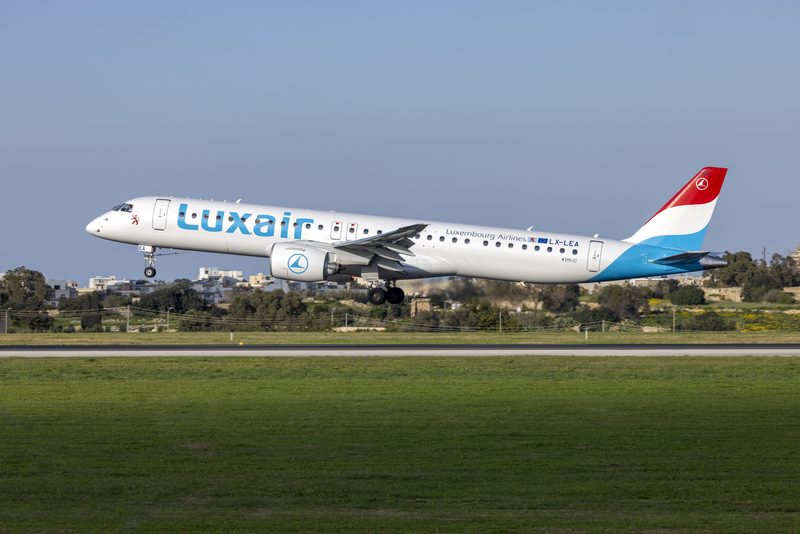
Luxair began its long-term fleet modernization with the arrival of its first Embraer E195-E2, a major step for an airline that has long relied on a mix of Dash 8 Q400 turboprops and Boeing 737-family aircraft. The E2 is a very different machine from the Q400 in both economics and passenger experience, and its arrival marks the beginning of a much broader fleet transition.
That matters because fleet changes define airline strategy more than most annual-result headlines do. The aircraft Luxair chooses now will determine where it can fly, how efficiently it can operate, and how competitive it can be over the next decade.

Why The E2 Changes The Shape Of The Airline
The E195-E2 gives Luxair something valuable: range and capacity in a form that is better suited to modern regional European flying.
It offers lower fuel burn than older-generation regional jets, quieter operations, more passenger comfort, and a better fit for routes that may be too long or too high-volume for turboprops but too thin for larger narrowbodies. For a carrier like Luxair, that flexibility matters enormously.
This is not just about replacing airplanes. It is about replacing limitations.
Leisure Demand Is Still Doing The Heavy Lifting
The traffic mix also tells an important story.
Luxair says leisure demand remained the strongest part of the network, with particularly solid performance on non-European holiday markets such as Egypt and Morocco. That is consistent with what many European carriers have been seeing: sun-demand and package-style leisure traffic remain more dependable than some business-heavy or marginal regional sectors.
For Luxair, this matters because it shapes where capacity can be deployed most productively while the fleet transition is underway.
2026 Looks Harder Than 2025
If 2025 was stable, 2026 already looks more difficult.
Luxair says the first months of 2026 are running below budget, and the airline now expects only a slightly positive operating result for the full year. That is a notable warning, especially because it comes just as the carrier is investing in new aircraft, training, and broader operational adaptation.
The airline has pointed to familiar pressures: fuel volatility, aircraft and operational constraints, and disruption linked to the wider Middle East situation. It has even cited the temporary suspension of its Dubai route and a greater reliance on partner airlines to help protect schedule reliability.
That means 2026 is likely to be a test of resilience, not expansion for expansion’s sake.
This Is A Transitional Airline, Not A Static One
That may be the most important way to understand Luxair right now.
The airline is not in a holding pattern. It is in transition. It is still profitable, still carrying stable passenger volumes, and still investing in its future, but it is also dealing with the friction that comes with changing fleet types, reshaping the network, and operating in a harsher cost environment.
That combination can make the numbers look less dramatic than the strategy really is.
Bottom Line
Luxair’s 2025 results show an airline that remained stable under pressure while quietly beginning a more important transformation. Passenger volumes held up, operating profit stayed positive, and the arrival of the Embraer E195-E2 marked the real start of a fleet-renewal era that could reshape the carrier’s economics and network flexibility over time.
The challenge now is that 2026 looks tougher, not easier. But if Luxair can stay operationally steady through that transition, 2025 may end up looking less like a flat year and more like the year the airline started becoming something more efficient and more durable.
Keep reading FlyMag
Get the Daily Brief in the morning or the Route Watch weekly recap on Fridays. Or both.