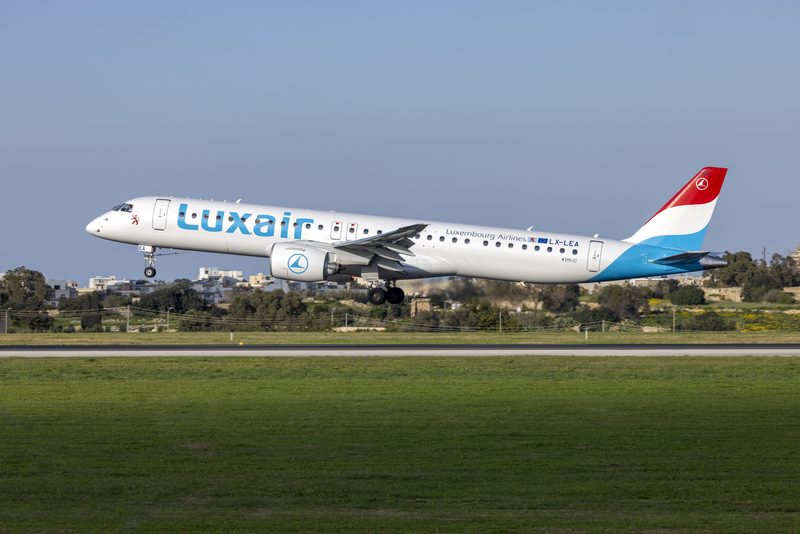
Luxair has launched scheduled nonstop service between Helsinki Airport (HEL) and Luxembourg Airport (LUX), adding a new twice-weekly connection between Finland and the Grand Duchy while giving Helsinki its first regular scheduled operation with the Embraer E195-E2.

The inaugural Luxair flight departed Helsinki (HEL) on July 2, 2026, with the route scheduled every Monday and Thursday. For passengers, the service adds another direct option between the Finnish capital and Luxembourg. For aviation observers, the more interesting detail is the aircraft: Luxair is using the Embraer E195-E2, the newest-generation member of Embraer’s E-Jet family and a key part of the airline’s fleet renewal program.
The route is not just a ceremonial network addition. It gives Luxair a direct presence at Helsinki (HEL), expands Luxembourg’s reach into the Nordic market, and creates a useful bridge between two high-value European business and government centers.
Read our stories in your inbox
Two aviation newsletters. Zero fluff.
A New Luxair Route Into Finland
Luxair’s Helsinki (HEL)-Luxembourg (LUX) service operates twice weekly, on Mondays and Thursdays. The schedule is modest, but appropriate for a route that is likely to lean on a mix of business traffic, leisure passengers, diplomatic travel, European institutional demand, and onward connections through Luxembourg.
Luxembourg Airport (LUX), also known as Findel, is not a mega-hub in the way Amsterdam (AMS), Frankfurt (FRA), or Paris Charles de Gaulle (CDG) are. But Luxair has built a strong European network from LUX, with particularly useful links to Southern Europe and leisure markets. That gives Finnish passengers another routing option beyond the largest European hubs.
Finavia specifically noted that the new route opens onward opportunities via Luxembourg Airport (LUX), especially to popular destinations in Southern Europe. That matters because Luxair’s strength is not just point-to-point travel to Luxembourg City. It is also the ability to connect passengers from smaller and mid-sized European markets into vacation and business destinations that may not have nonstop service from Helsinki (HEL).
The E195-E2 Is the Real Aviation Story
The aircraft makes this route stand out. The Helsinki-Luxembourg service is being flown with Luxair’s Embraer E195-E2, making it the first regular scheduled E195-E2 operation at Helsinki Airport (HEL).
The E195-E2 is the largest aircraft in Embraer’s E2 family. It is a twin-engine, single-aisle jet designed for short- and medium-haul routes where airlines want mainline-jet economics without the seat count of an Airbus A320neo or Boeing 737 MAX. Embraer’s latest specification sheet lists the E195-E2 with a range of up to 3,000 nautical miles, depending on configuration and operating assumptions, which is far more than required for the roughly 1,040-mile Helsinki (HEL)-Luxembourg (LUX) sector.
Luxair’s aircraft are configured with 136 seats in a single-class layout. The cabin uses Embraer’s 2-2 seating arrangement, meaning every passenger has either a window or an aisle seat. There are no middle seats, which is a real passenger-experience advantage on a two-and-a-half- to three-hour intra-European flight.
For Luxair, the E195-E2 provides the right combination of capacity, operating cost, passenger comfort, and range. It is larger than a turboprop, smaller than a full-size narrowbody, and efficient enough to support thinner European routes that may not justify a Boeing 737-800 or 737 MAX.
Why This Aircraft Fits Luxair’s Network
Luxair’s network has always required flexibility. The airline serves a compact home market, but that market is unusually high-value because of Luxembourg’s role in finance, EU institutions, cargo, cross-border business, and tourism. That creates demand for frequent European flying, but not always at the scale required for larger narrowbody aircraft.
That is where the E195-E2 fits. It gives Luxair a modern jet with more seats than the De Havilland Canada Dash 8-400, faster cruise performance, a quieter cabin, and better passenger appeal on routes where turboprop economics once made sense but customer expectations have moved higher.

Embraer has described the E195-E2 as the most efficient aircraft in the single-aisle regional segment, and Luxair has emphasized its lower noise, lower fuel burn, larger overhead bins, and quiet cabin. Those are not just marketing points. For a carrier operating into airports across Europe, lower noise and improved fuel performance can help reduce operating friction, while the cabin layout gives Luxair a product that feels more premium than a traditional regional jet.
On Helsinki (HEL)-Luxembourg (LUX), the E195-E2 is almost perfectly sized. The route is long enough that passengers will notice cabin comfort, but not long enough to require a larger aircraft. It is also thin enough that twice-weekly 136-seat service gives Luxair a way to build the market without flooding it with capacity.
Helsinki Gains Another European Link
For Helsinki Airport (HEL), Luxair’s arrival adds depth to a European network that is still heavily shaped by Finnair’s hub strategy. Helsinki is best known internationally for Finnair’s Europe-Asia connectivity, but intra-European routes remain essential to the airport’s year-round relevance.
Luxair’s service gives HEL another western European connection and strengthens access to the Benelux region. It also complements existing Helsinki-Luxembourg flying rather than creating an entirely new city pair. Finnair is also active in the Helsinki (HEL)-Luxembourg (LUX) market, meaning travelers now have more airline choice between the two capitals.
That competitive context is important. Luxair is not entering an empty market. It is entering a route where schedule quality, local point-of-sale strength, loyalty appeal, and onward connectivity will all matter. For business travelers, a Monday/Thursday pattern can support short work trips. For leisure travelers, the schedule can work for long weekends or broader European itineraries.
Luxembourg Gets Better Nordic Access
For Luxembourg (LUX), the route provides a direct link into Finland and the wider Nordic market. Luxembourg’s economy is deeply international, with strong finance, logistics, government, and institutional demand. Direct air links are especially useful for a country whose catchment area extends into parts of Belgium, France, and Germany.
Helsinki (HEL) is also a valuable destination in its own right. It is Finland’s political, financial, and cultural center, with strong technology, design, education, and conference demand. The city also acts as a gateway to the rest of Finland, including Lapland and domestic points across the Finavia airport network.
That makes the route more balanced than a simple leisure service. It can carry Luxembourg-origin passengers to Finland, Finnish travelers to Luxembourg, and connecting passengers moving through LUX to Southern Europe. The two-weekly frequency is not aggressive, but it gives the route a foundation.
A Symbolic Arrival for the E195-E2 at HEL
The first regular scheduled E195-E2 operation at Helsinki (HEL) is also notable from an airport standpoint. The aircraft type has been gaining ground in Europe, particularly with airlines that need efficient, right-sized capacity below the A320/737 category.
For Helsinki, seeing the E195-E2 in scheduled service reflects a broader shift in European regional and thin-route flying. Airlines are increasingly looking for aircraft that can serve secondary and mid-sized markets with lower trip costs, lower emissions per mission, and a better passenger experience than older regional jets or turboprops.
The E195-E2 is not a regional jet in the old sense of a 50-seat connector aircraft. With 136 seats in Luxair’s configuration, it sits much closer to the lower end of the mainline narrowbody market. That makes it especially useful for routes like Helsinki-Luxembourg, where the market may be too small for daily larger narrowbody service but strong enough for a modern jet product.
Bottom Line
Luxair’s new Helsinki (HEL)-Luxembourg (LUX) route is a smart, right-sized addition to both airports’ European networks. The twice-weekly Monday/Thursday schedule gives passengers a direct link between Finland and Luxembourg while also opening onward travel options through Luxembourg Airport.
The bigger aviation story is the aircraft. By operating the route with the Embraer E195-E2, Luxair is bringing Helsinki Airport its first regular scheduled service with the type and showcasing why the aircraft matters for European network planning. With 136 seats, a 2-2 cabin, no middle seats, and modern operating economics, the E195-E2 gives Luxair exactly the kind of capacity it needs for thinner but high-value routes.
For Helsinki, it is another European connection. For Luxembourg, it is stronger Nordic access. For Luxair, it is a clear example of how its new-generation Embraer fleet can open markets that need precision, not excess capacity.
Keep reading FlyMag
Get the Daily Brief in the morning or the Route Watch weekly recap on Fridays. Or both.