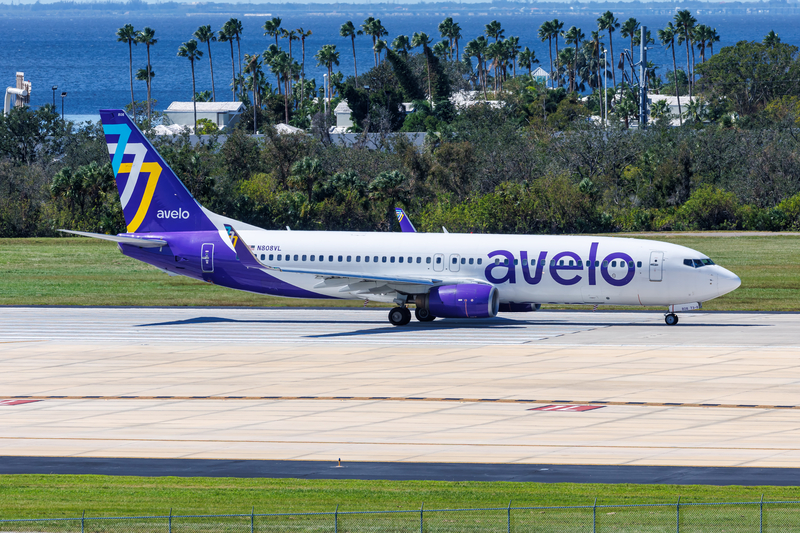
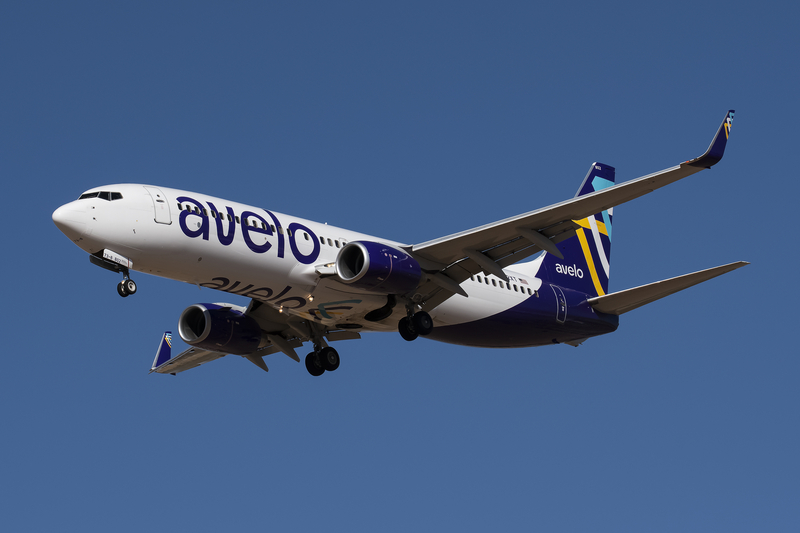
Avelo Airlines has now exited scheduled international flying altogether, ending a short-lived push into Mexico, Jamaica, and the Dominican Republic as it reshapes itself into a smaller, more domestically focused carrier.

That is the real story. This was not simply a case of a few weak sun routes being cut. It was a broader strategic reset. Avelo’s international flights were tied to airports and operating patterns that no longer fit the airline’s 2026 structure, and once management decided to streamline the network around a smaller number of core bases, the overseas routes became much harder to justify.
In practical terms, the airline chose focus over breadth.
Read our stories in your inbox
Two aviation newsletters. Zero fluff.
The International Network Was Always Narrow
Avelo’s scheduled international operation was limited from the start. It was built around a small group of East Coast airports rather than a broad cross-network strategy.
From Bradley International Airport (BDL), the airline served Cancún International Airport (CUN), Sangster International Airport in Montego Bay (MBJ), and Punta Cana International Airport (PUJ). From Raleigh-Durham International Airport (RDU), it flew to MBJ and PUJ. From Wilmington International Airport (ILM), it added PUJ.
That was never a large international platform. It was a selective leisure experiment aimed at winter sun demand from secondary U.S. airports. The problem with that kind of network is that it can work only if the routes perform well enough to survive inside a very lean airline model.
Avelo’s last scheduled international flight appears to have been the BDL-MBJ service on January 25, 2026, which effectively closed the chapter on the carrier’s overseas flying.
Network Restructuring Made the Outcome Almost Inevitable
The biggest reason Avelo abandoned international service is that the airline changed its entire operating map in early 2026.
In January, Avelo announced it would streamline around four existing bases — Tweed New Haven Airport (HVN), Wilmington Airport in Delaware (ILG), Concord-Padgett Regional Airport (USA), and Lakeland Linder International Airport (LAL) — while opening Dallas/McKinney National Airport (TKI) later in the year. At the same time, it said it would close bases at Phoenix-Mesa Gateway Airport (AZA), RDU, and ILM.
That immediately weakened the logic of the international network. Two of the three airports that still had overseas routes, RDU and ILM, were no longer part of the future base plan. BDL, meanwhile, was being exited altogether. Once those airports fell outside the airline’s core structure, the international services looked more like loose ends than growth markets.
This is often how route exits happen at smaller airlines. A route may not fail in isolation. It may simply stop fitting the shape of the airline around it.
Some of the Routes Were Not Performing Well Enough
The other reason is more straightforward: performance.
Avelo’s international network never looked especially robust. Bradley’s exit was publicly tied to revenue shortfalls, and local reporting in North Carolina said ILM-PUJ had gotten off to a slow start and had always been expected to be seasonal. In other words, these were not breakout routes that management was abandoning reluctantly. They were routes that were already struggling to prove themselves.
That matters because Avelo is not an airline built to absorb underperformance for long. Its entire model depends on making thin routes work with tight costs, simple scheduling, and fast decision-making. If a market is underwhelming and the surrounding base structure is changing, the airline is unlikely to give it much extra time.
The Fleet Shift Also Points Toward a Domestic Future
Fleet strategy reinforces the same conclusion.
As part of its 2026 restructuring, Avelo said it would remove six Boeing 737-700 aircraft, leaving the airline primarily reliant on the larger and more efficient Boeing 737-800. That alone signals a desire to simplify. But the more important clue came earlier, when the airline ordered up to 100 Embraer E195-E2 aircraft.
Avelo was unusually explicit about what those jets are for: expanding affordable and convenient travel across the United States. That language matters. The carrier is not presenting the Embraer order as a tool for rebuilding international flying. It is presenting it as the next step in a domestic network strategy built around right-sized aircraft and thinner U.S. routes.
That makes sense. The E195-E2 is far better suited to underserved domestic markets than to a tiny leisure network in the Caribbean.
The ICE Controversy Was Part of the Backdrop, Not the Core Reason
There is no question that Avelo’s brand took a hit from its involvement in ICE deportation charter flying. The backlash was real, and the airline faced protests, boycott calls, and political criticism before ending that work in January 2026.
But it would be too simplistic to say that public controversy alone is why Avelo scrapped its international service. The stronger explanation is structural. The airline itself said the deportation program was dropped because it did not provide enough consistent and predictable revenue to overcome its operational complexity and costs. At the same time, it was simplifying its network, cutting bases, shrinking part of the fleet, and repositioning for a new phase of growth.
So the controversy mattered, but the more durable reason for the international exit was that Avelo was becoming a different airline.
Bottom Line
Avelo did not scrap all international flying because it suddenly gave up on the Caribbean. It scrapped it because the routes no longer fit the airline it wants to be.
The international operation was small, tied to airports that were being downgraded or abandoned, and was not performing strongly enough to survive a broader restructuring. Once Avelo narrowed its focus to a handful of core domestic bases, cut six Boeing 737-700s, and pointed its long-term fleet strategy toward Embraer E195-E2 growth across the United States, the international network became expendable.
That is the real takeaway. Avelo’s overseas routes did not just end. They were squeezed out by a carrier that decided its future was domestic, simpler, and more tightly controlled.
Keep reading FlyMag
Get the Daily Brief in the morning or the Route Watch weekly recap on Fridays. Or both.