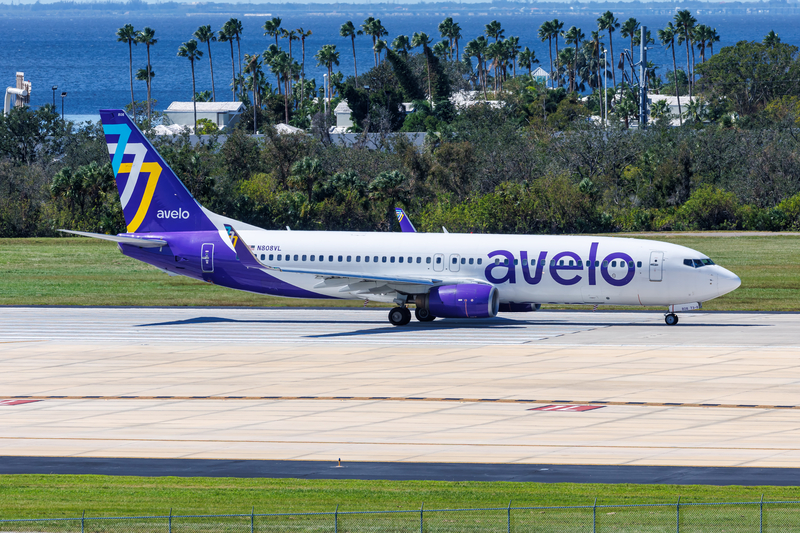
Avelo Airlines (XP) has pushed back the arrival of its first Embraer E195-E2 from mid-2027 to 2028, confirming that the delivery timeline for its planned E2 fleet is still being finalized. The delay doesn’t cancel Avelo’s regional-jet ambitions—but it does extend the runway for its current strategy: operating as an all-Boeing 737 carrier while it continues to refine where, and how fast, the E2 will be introduced.

When the first E195-E2 finally arrives, Avelo is set to become the first U.S. airline to operate Embraer’s E2 family, a notable milestone in a market where Airbus and Boeing dominate mainline narrowbody fleets and where the earlier-generation E175 has been the preferred “scope-compliant” regional tool for network carriers.
The order: up to 50 E195-E2s, 140 seats, and a different mission profile
Avelo’s September 2025 deal with Embraer covers up to 50 E195-E2 aircraft, and CEO Andrew Levy has said the carrier expects a 140-seat, single-class configuration.
Read our stories in your inbox
Two aviation newsletters. Zero fluff.
That seat count is a deliberate “between sizes” bet:
-
It’s materially smaller than a typical 737-800 (often 170–189 seats depending on cabin density).
-
It’s meaningfully larger than the E175 class that many U.S. travelers associate with “regional jets,” and it offers a more modern cabin experience than older 50–76 seat aircraft.
For network planners, the E195-E2’s value is in right-sizing and opening thinner city pairs where a 737 simply carries too much capacity for the demand curve—especially outside peak seasons. It’s also about building frequency. In a leisure-first airline model, going from 2x weekly to 4x weekly can outperform “bigger aircraft, fewer flights” because it creates more sellable schedule utility and better captures weekend-heavy demand patterns.
Why the timeline slip matters: it keeps Avelo a pure 737 operator longer
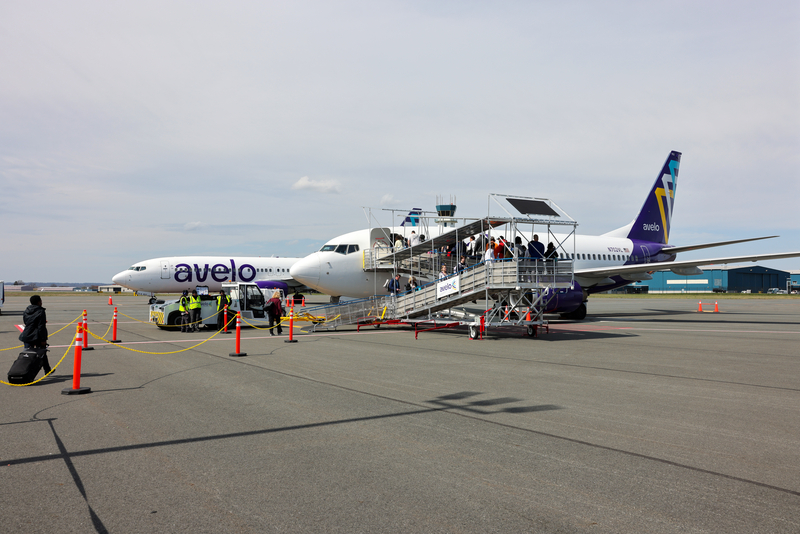
According to fleet data, Avelo currently operates three Boeing 737-700s and fourteen 737-800s—a tight, single-family fleet that simplifies training, maintenance, and crewing.
Delaying the E195-E2 to 2028 extends the period where Avelo remains:
-
operationally simple (one fleet type), and
-
structurally constrained (one aircraft size).
That constraint can be a benefit when the airline is prioritizing reliability and cost control. But it also limits flexibility in markets where a 737 is too much airplane—particularly shoulder-season leisure routes and smaller-airport flying where trip cost and risk exposure rise quickly when loads soften.
The E2 is meant to solve that. Pushing it out means Avelo will have to keep using network levers it already knows well—seasonality, frequency trimming, and selective market exits—rather than deploying a smaller gauge to hold market presence.
Why the E195-E2 is a different tool than Avelo’s 737-800 workhorse
Avelo’s 737-800 is a high-density, low unit-cost aircraft when it’s full. But in thinner markets, trip cost and break-even load factor become the problem.
That’s where the E195-E2 fits:
-
Trip costs are typically lower than a 737-800 on comparable stage lengths, even if unit costs can be higher.
-
The aircraft is optimized for routes where 140 seats is the correct supply, allowing better yield discipline and less reliance on fare stimulation to fill the last 30–40 seats.
-
The cabin experience is strong for a single-aisle regional jet: 2–2 seating means no middle seats, which is a meaningful marketing hook in leisure-heavy markets.
For Avelo, the E2 isn’t a “regional” aircraft in the traditional U.S. sense—it’s a mainline right-size aircraft that can grow the addressable network while limiting downside risk.
What could be driving the delay
Avelo hasn’t pinned the schedule slip to a single cause publicly, but the industry environment provides several plausible pressures:
-
OEM production slot timing: New aircraft delivery queues remain tight across manufacturers, and delivery sequencing often shifts as airlines re-trade slots and reorder priorities.
-
Financing and capital planning: Introducing a new fleet type involves upfront costs that aren’t just the aircraft—spares pools, tooling, simulators, training pipelines, and IT integration.
-
Fleet strategy pacing: Avelo may be aligning E2 introduction with specific bases, route waves, or airport partnerships—especially if it plans to use the E2 in markets where it can secure favorable costs and operational support.
Bottom Line
Avelo’s decision to delay its first Embraer E195-E2 delivery to 2028 keeps the airline in “737-only mode” longer than originally planned. That preserves operational simplicity in the near term, but it delays the strategic payoff of the E2: opening thinner routes, improving right-sizing, and expanding frequency without forcing 737-level capacity into markets that don’t consistently support it.
When the first E195-E2 arrives, it will still be a milestone—Avelo is positioned to become the first U.S. operator of the E2 family, likely with a 140-seat, single-class cabin. The question now isn’t whether Avelo wants the E2—it’s how the airline will shape its network and fleet economics until 2028 arrives.
Keep reading FlyMag
Get the Daily Brief in the morning or the Route Watch weekly recap on Fridays. Or both.